


Time:2026-07-27
In the rapidly evolving landscape of architectural lighting, smart residential automation, and commercial facility management, legacy lighting systems are undergoing a fundamental transformation. Static illumination and basic standalone infrared or Bluetooth light strips no longer satisfy the requirements of luxury estate developers, smart home system integrators, and Mechanical, Electrical, and Plumbing (MEP) contractors. Modern intelligent environments demand robust, multi-zone, scalable lighting solutions that integrate seamlessly into unified smart home automation ecosystems.
At the forefront of this technological shift is neon led flex with zigbee smart home integration. Combining the continuous, dot-free aesthetic of gas-phase silicone LED extrusions with the low-latency, self-healing mesh networking of the IEEE 802.15.4 Zigbee 3.0 open protocol, this lighting architecture provides an enterprise-grade foundation for dynamic architectural illumination.
However, specifying and deploying smart Zigbee neon systems across large residential properties, commercial hospitality venues, or corporate facilities presents complex engineering challenges. Issues such as Radio Frequency (RF) attenuation through heavy structural materials, co-channel interference with 2.4 GHz Wi-Fi networks, high-frequency Pulse-Width Modulation (PWM) dimming performance, and long-run voltage drop require rigorous technical planning.
Partnering with a specialized factory-direct manufacturer like TTK LED Neon ensures access to engineered Zigbee-enabled drivers, heavy-duty copper sub-circuits, and IP67/IP68 silicone extrusions designed for zero-latency, long-term commercial reliability.
Understanding the superiority of Zigbee-integrated neon illumination over consumer-grade lighting requires analyzing the underlying physical layer and networking topologies defined by the IEEE 802.15.4 standard.
Zigbee 3.0 operates in the unlicensed 2.4 GHz Industrial, Scientific, and Medical (ISM) radio band (specifically 2,400 MHz to 2,483.5 MHz), divided into 16 distinct channels (Channels 11 through 26) with a channel spacing of 5 MHz. Data transmission utilizes Offset Quadrature Phase Shift Keying (O-QPSK) combined with Direct Sequence Spread Spectrum (DSSS) modulation, delivering a raw data rate of 250 kbps.
In dense commercial or luxury residential environments flooded with high-throughput 802.11 b/g/n/ax Wi-Fi traffic, RF spectrum congestion is a primary cause of packet loss and latency in smart lighting. Wi-Fi channels (typically Channels 1, 6, and 11 at 20 MHz bandwidth) overlap heavily with standard Zigbee channels.
To eliminate co-channel interference, TTK LED Neon’s smart Zigbee controllers are engineered with advanced channel-agility algorithms and sideband filtering. System integrators can configure the lighting network on non-overlapping Zigbee Channels 15, 20, or 25, which sit cleanly in the guard bands between primary Wi-Fi signals, guaranteeing uninterrupted command transmission.
Unlike point-to-point Bluetooth connections or star-topology Wi-Fi networks where every device must maintain a direct connection to a central wireless access point, Zigbee 3.0 operates on a decentralized mesh architecture consisting of three node types:
Zigbee Coordinator (ZC): The central trust center and root of the network tree. It stores network keys, manages security credentials, and bridges the Zigbee mesh to local automation servers (e.g., Home Assistant, Hubitat, or Tuya gateways).
Zigbee Router (ZR): Fully powered nodes that maintain active routing tables, receive and retransmit data packets across the network, and extend RF coverage. Crucially, all TTK LED Neon Zigbee driver units function as active Zigbee Routers.
Zigbee End Device (ZED): Low-power battery-operated devices (such as wireless motion sensors or wall switches) that do not route traffic but sleep until woken by an event.
Because every installed TTK LED Neon driver acts as a Zigbee Router node, adding more neon led flex with zigbee smart home integration across a facility actually strengthens the wireless network rather than congesting it. If a specific RF path is blocked by a temporary obstacle or structural wall, the self-healing mesh protocol automatically reroutes data packets through adjacent router nodes in milliseconds via dynamic Ad-hoc On-Demand Distance Vector (AODV) routing algorithms.
Predicting wireless coverage across architectural spaces requires calculating indoor signal propagation. RF attenuation over distance and through physical obstructions is modeled using the Log-Normal Shadowing Model:
PL(d) = PL(d0) + 10 * n * log10(d / d0) + X_sigma
Where:
PL(d) is the total path loss at distance d (in decibels, dB).
PL(d0) is the reference path loss at d0 (typically 1 meter, approximately 40 dB for 2.4 GHz).
n is the path loss exponent determined by the indoor environment (typically 2.0 for free space, 3.0 to 4.5 for dense commercial structures with concrete and steel).
d is the operational distance between nodes (in meters).
X_sigma is a zero-mean Gaussian random variable representing shadow fading caused by physical obstacles (in dB).
By maintaining a maximum physical node spacing where PL(d) does not exceed the Receiver Sensitivity Threshold (typically -95 dBm to -100 dBm on TTK LED Neon controllers), integrators achieve flawless mesh reliability across multi-story structures.
Delivering smooth visual performance from neon led flex with zigbee smart home integration requires specialized hardware engineering within both the wireless controller module and the constant-voltage power stage.
[AC Mains 100-240V] ──> [Active PFC Power Unit] ──> [24V DC Bus]
                                                           │
[Optocoupler Isolation] <── [32-Bit MCU + PWM Engine] <── [Zigbee 3.0 SoC]
         │
         ▼
[High-Current MOSFET Array] ──> [Silicone LED Neon Flex Array]
TTK LED Neon’s smart driver hardware integrates industry-leading System-on-Chip (SoC) architectures, such as the Silicon Labs EFR32MG21 or Texas Instruments CC2652P series. Featuring an 80 MHz ARM Cortex-M33 core, integrated power amplifiers (up to +20 dBm TX output power), and high receiver sensitivity (-102 dBm at 250 kbps), these hardware modules process complex lighting scenes, color transitions, and group broadcasts with zero processing delay.
To adjust the brightness of solid-state LEDs without altering their chromaticity or color temperature, controllers utilize Pulse-Width Modulation (PWM) to toggle the current on and off at rapid intervals.
Low-quality smart controllers operate at low PWM frequencies (typically 200 Hz to 480 Hz). At these frequencies, the rapid pulsing creates stroboscopic effects visible to the human eye during motion, leading to eye strain, headaches, and visible rolling dark bars on digital video camera sensors, security feeds, and smartphones.
TTK LED Neon smart Zigbee drivers incorporate high-frequency 16-bit resolution PWM dimming engines operating at frequencies between 2,000 Hz and 4,000 Hz. This ultra-high switching frequency ensures:
Flicker-Free Compliance: Meets IEEE 1789-2015 recommended practices for dimming LEDs, eliminating biological health risks associated with stroboscopic flicker.
Broadcast Quality: Guarantees zero camera rolling lines or banding during high-definition video recording, making these systems suitable for broadcast studios, commercial retail displays, and luxury residential media rooms.
Smooth Low-End Dimming Curves: Provides logarithmic and linear dimming curves with 65,536 discrete brightness steps, enabling smooth transitions down to 0.1% minimum light output without step jumping or color shifting.
A major flaw in consumer smart lighting systems is their reliance on active internet connections and third-party cloud servers. If the internet connection fails, cloud-dependent lights become unresponsive to app commands or automated sensors.
Industrial-grade neon led flex with zigbee smart home integration operates on a local-first control architecture. The Zigbee protocol executes network management, scene execution, and direct binding at the local network layer. When paired with a local coordinator (such as Home Assistant running ZHA or Zigbee2MQTT, or a local hardware gateway), the lighting system continues to execute automated schedules, wall switch commands, and motion-sensor triggers even if the facility loses external internet access entirely.
For projects prioritizing local control and IP67 durability, learn more in our detailed analysis of
Deploying flexible neon across expansive architectural layouts requires balancing radio frequency wave behavior with direct-current electrical distribution principles.
Structural Attenuation Barriers:

[Zigbee Node A] ──> (Concrete Wall: -14 dB) ──> [Weak Signal]   ──> [Requires Intermediate Node]
Radio waves at 2.4 GHz suffer energy loss when penetrating physical building materials. When designing the physical layout for a neon led flex with zigbee smart home integration deployment, MEP engineers must account for specific material attenuation coefficients:
| Architectural Building Material | Typical Thickness (mm) | 2.4 GHz Attenuation (dB) | Impact on Wireless Node Spacing |
| Standard Interior Drywall (Gyp Board) | 12.5 mm to 25 mm | 2 dB to 4 dB | Negligible; signals pass through easily |
| Clear Float Glass Window | 6 mm | 2 dB to 3 dB | Minimal attenuation |
| Low-E Coated Double Glazing | 24 mm | 8 dB to 14 dB | Moderate reduction; re-plan perimeter node positions |
| Poured Reinforced Concrete Wall | 150 mm to 200 mm | 12 dB to 20 dB | Severe shielding; requires nodes on both sides of wall |
| Brick / Masonry Partition | 100 mm | 6 dB to 10 dB | Moderate attenuation; reduce spacing by 30% |
| Solid Hardwood Panel / Door | 40 mm | 3 dB to 6 dB | Low to moderate attenuation |
| Expanded Metal Mesh / Foil Insulation | Varies | 25 dB to 40+ dB | Total RF barrier (Faraday Shielding effect) |
To maintain reliable network communication across heavy concrete structures, intermediate TTK LED Neon Zigbee router drivers should be placed within 8 to 12 meters of one another, utilizing corridors and doorways to route RF signals around impenetrable structural elements.
In large residential or commercial installations where linear runs of neon flex extend dozens of meters, direct current (DC) voltage drop along internal copper traces poses a primary engineering challenge.
Voltage drop along a uniform direct-current conductor is calculated using Ohm's Law and conductor resistance parameters:
Delta V = (2 * L * I * rho) / A
Where:
Delta V is the total voltage drop along the run (in Volts, V).
L is the one-way circuit distance from the power supply to the LED array (in meters, m).
I is the total operating current drawn by the neon flex (in Amperes, A).
rho is the electrical resistivity of copper (1.72 x 10^-8 Ohm-meters at 20°C).
A is the cross-sectional conductor area of the Flexible Printed Circuit (FPC) traces (in square millimeters, mm²).
To eliminate voltage drop and ensure perfectly uniform luminosity from the first meter to the last meter of a continuous neon run, TTK LED Neon implements a three-part electrical design:
24V / 48V DC Native Operating Voltage: By doubling the operational voltage from legacy 12V to 24V or 48V DC, current draw is reduced by 50% to 75% for the same power output. Because line power loss scales with the square of current , operating at 24V/48V reduces voltage drop by up to 75%.
3-Ounce Rolled Annealed Copper FPCs: Standard commercial light strips use thin 1-ounce or 2-ounce copper substrates. TTK LED Neon manufactures all smart neon flex using 3-ounce double-sided rolled annealed copper FPCs, dramatically increasing conductor cross-sectional area and reducing line resistance.
Parallel Power Injection Topologies: For continuous runs exceeding 10 meters, dual-ended power feeds or parallel bus wiring harnesses are deployed to inject regulated DC voltage directly at intermediate points, keeping overall voltage variance below 3% across the entire installation.
For comprehensive architectural planning advice regarding large residential installations, read
The chief advantage of deploying neon led flex with zigbee smart home integration lies in its native interoperability across diverse home automation ecosystems and professional building management systems (BMS).
Zigbee 3.0 achieves multi-vendor device compatibility by enforcing standardized data structures defined in the Zigbee Cluster Library (ZCL). TTK LED Neon Zigbee controllers implement standard ZCL lighting clusters, enabling instant plug-and-play identification across compliant hubs:
Basic Cluster (Cluster ID 0x0000): Provides device manufacturing metadata, firmware versioning, hardware revisions, and power source status.
On/Off Cluster (Cluster ID 0x0006): Handles primary switching logic, touch-link commission commands, and configurable power-on state memory (e.g., restore last state, default to on, or default to off after power loss).
Level Control Cluster (Cluster ID 0x0008): Manages smooth brightness dimming, transition time parameters, and rate-of-change metrics for soft start/stop lighting effects.
Color Control Cluster (Cluster ID 0x0300): Manages full color space mapping, supporting RGB color coordinates , Hue and Saturation parameters, and Correlated Color Temperature (CCT) adjustment from 2200K warm white to 6500K cool white.
By supporting standard ZCL profiles, TTK LED Neon systems integrate natively with leading automation platforms without requiring proprietary cloud plugins or custom API scripting:
Home Assistant (ZHA & Zigbee2MQTT): Exposes all operational attributes, firmware update endpoints (OTA over Zigbee), individual channel power diagnostics, and real-time Link Quality Indicators (LQI) directly to open-source dashboards.
Matter-over-Bridge Compatibility: As smart home standards unify under Matter, Zigbee lighting networks link seamlessly into Matter ecosystems (Apple Home, Google Home, Amazon Alexa) via Matter-enabled Zigbee bridges (such as Dirigera, Aqara M3, or Tuya Matter Gateways).
Enterprise Systems (Control4, Crestron, Savant, Lutron): Integrate via two-way IP gateways or RS485 serial bridges, allowing luxury estate integrators to map Zigbee neon flex zones alongside centralized Lutron Homeworks or Crestron Home lighting panels.
When automating large architectural spaces containing dozens of separate neon flex segments (e.g., cove lighting surrounding an expansive perimeter ceiling), sending individual unicast commands to each strip sequentially creates visible lighting delay ("zipper effect").
TTK LED Neon controllers support Zigbee Multicast Group Addressing (ZCL Group Cluster 0x0004). The Zigbee coordinator transmits a single, encrypted group broadcast command across the mesh network. Every designated neon driver node processes the command simultaneously, achieving synchronized color shifts, scenes, and dimming execution across hundreds of meters of lighting within less than 10 milliseconds.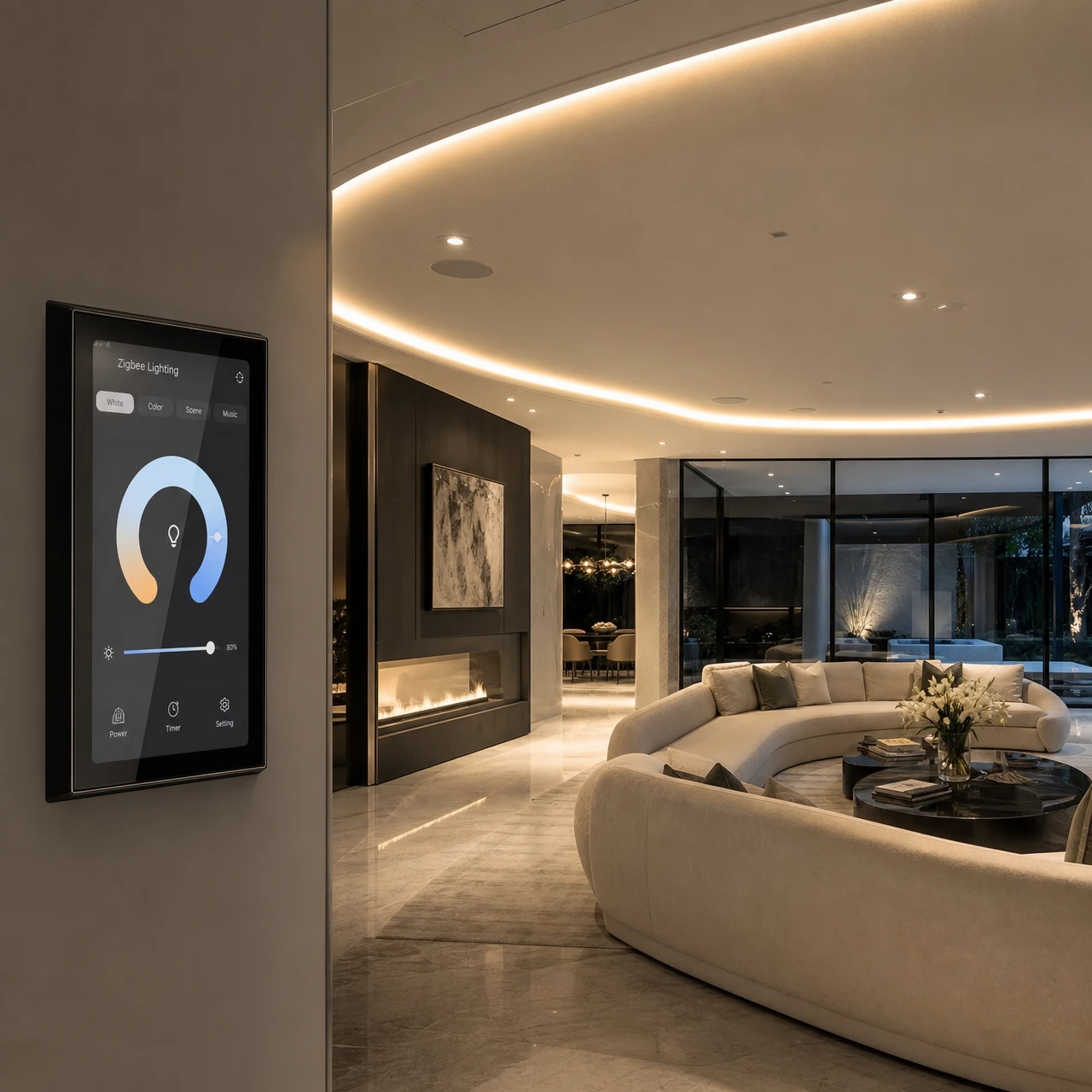
For global enterprise buyers, commercial procurement managers, and OEM/ODM clients, product longevity, safety certifications, and manufacturing rigor are essential considerations when selecting a LED neon supplier.
TTK LED Neon Quality Control Pipeline:
[Automated SMT Assembly & Optical Inspection]
                       │
                       ▼
[Gas-Phase Optical Silicone Co-Extrusion Line]
                       │
                       ▼
[Continuous 72-Hour Dynamic Burn-In & Aging Test]
                       │
                       ▼
[Automated Spectroradiometer Binning Audit]
                       │
                       ▼
[IP67/IP68 Pressure Chamber Ingress Verification]
Cheap commercial light strips utilize polyvinyl chloride (PVC) housing materials that degrade rapidly under environmental stress. Under UV exposure and thermal heat cycling, PVC releases plasticizers, leading to yellowing, hardening, surface cracking, and loss of optical clarity within months.
THINK TEAM KING (TTK LED Neon) manufactures all commercial-grade smart neon flex extrusions exclusively using 100% gas-phase optical silicone.
Thermal Endurance: Maintains structural flexibility and optical clarity across an extreme temperature range from -50°C to +200°C, preventing thermal cracking or hardening.
UV and Chemical Resistance: Highly resistant to direct solar ultraviolet radiation (UV-A/UV-B), saltwater corrosion, atmospheric ozone, and commercial cleaning chemicals, preventing yellowing over 10+ years of operation.
Flame Retardancy: Formulated to meet UL94 V-0 flame retardant standards, self-extinguishing within 10 seconds of flame removal without producing toxic flaming droplets.
To ensure bulletproof reliability in indoor wet areas (bathrooms, spa facilities), outdoor architectural facades, and sub-grade installations, TTK LED Neon applies fully automated co-extrusion sealing:
IP67 Ingress Protection: Fully protected against dust ingress and resistant to temporary water immersion up to 1 meter depth for 30 minutes.
IP68 Marine-Grade Ingress Protection: Encapsulated using automated liquid silicone injection molded end-caps, capable of continuous submersion in water feature installations.
IK08 Mechanical Impact Protection: Resists physical impacts up to 5 Joules, safeguarding internal LEDs and FPC circuits from vandalism or accidental damage in public commercial spaces.
As an asset-heavy manufacturer with deep engineering capacity, TTK LED Neon offers complete customization for large-scale enterprise developments:
Custom Extrusion Profiles: Over 100+ cross-sectional profile shapes available, including top-bend, side-bend, 3D-bend, round 360-degree diffusion, and ultra-narrow micro profiles.
Pre-Configured Zigbee Firmware: Factory pre-flashing of custom Zigbee cluster profiles, specific power-on state behaviors, group IDs, and network security keys to streamline on-site commissioning for electrical contractors.
Custom Wiring Harnesses: Factory-molded IP68 quick-connect jumper cables, custom lead lengths, and pre-assembled aluminum mounting channel kits tailored to exact architectural shop drawings.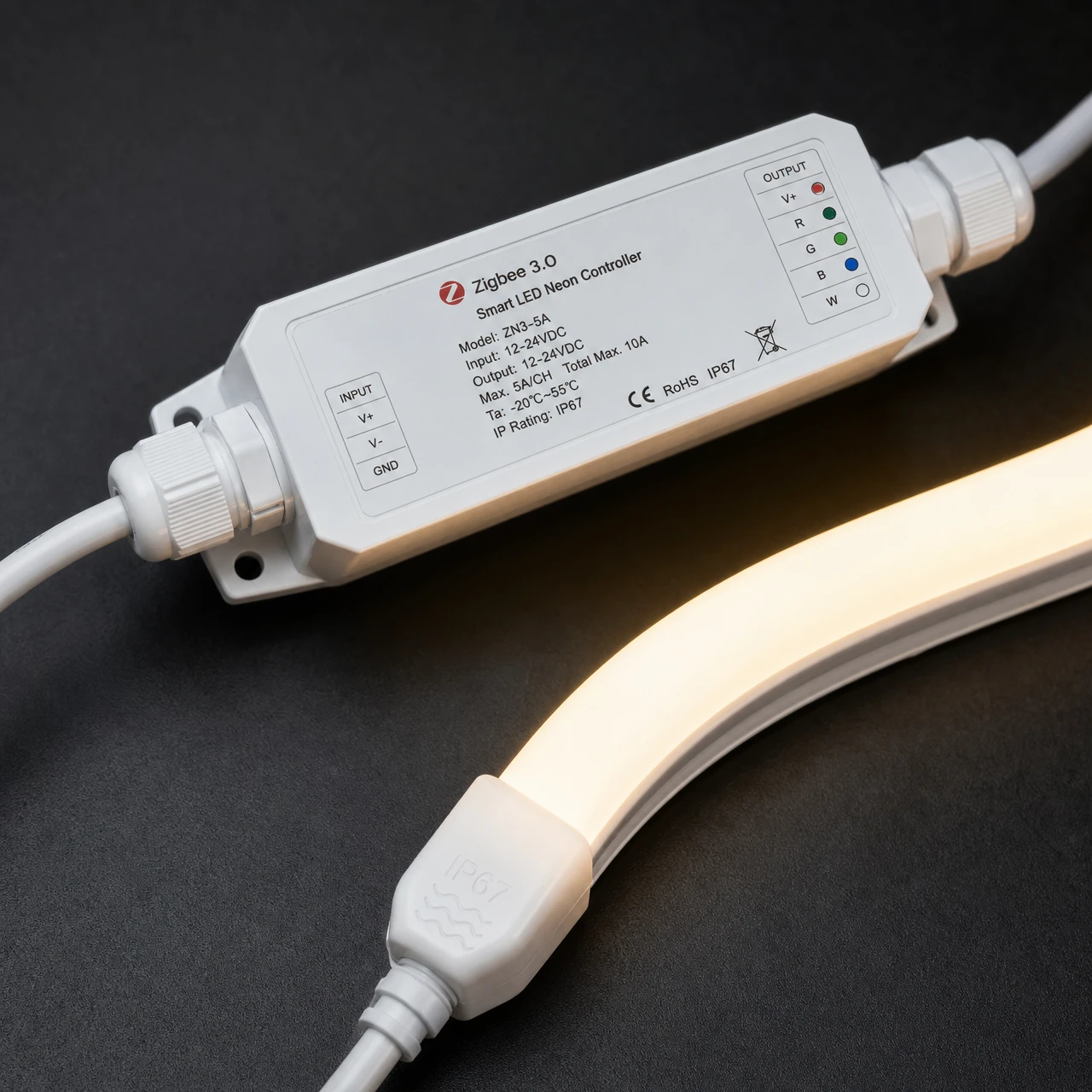
Zigbee 3.0 operates on 16 narrow 5 MHz channels within the 2.4 GHz spectrum. TTK LED Neon controllers feature dynamic channel selection and sideband filtering, allowing integrators to set the Zigbee network on non-overlapping channels (such as Channels 15, 20, or 25) that sit cleanly in the frequency guard bands between standard Wi-Fi channels (1, 6, and 11), ensuring zero inter-protocol interference.
Because our Zigbee 3.0 drivers process network commands locally at the IEEE 802.15.4 link layer, the entire lighting system maintains full operational capability. Local wall switches, motion sensors, automated schedules, and multi-strip group bindings managed by a local coordinator (such as Home Assistant, Hubitat, or a local hardware gateway) continue to execute normally without internet access.
Using our native 24V DC or 48V DC power architectures with 3-ounce double-sided copper FPCs, continuous runs of up to 10 meters (24V) or 20 meters (48V) can be powered from a single end without visible voltage drop or brightness reduction. For longer continuous linear installations, parallel power injection harnesses are supplied to extend runs infinitely while maintaining unified Zigbee control.
Integrating neon led flex with zigbee smart home integration into your commercial developments, luxury residential projects, or retail environments delivers a powerful combination of optical elegance, robust wireless mesh performance, and long-term energy efficiency. Sourcing directly from an established factory like TTK LED Neon guarantees high engineering standards, complete international safety compliance, factory-direct wholesale pricing, and dedicated technical support.
Are you preparing to specify intelligent Zigbee neon lighting, request custom product samples, or secure factory-direct pricing for an upcoming commercial development? Our experienced engineering team is ready to assist you with load calculations, RF network mapping, custom profile selection, and complete OEM/ODM manufacturing.

It provides all-round service for customers
and users 24 hours a day.
Enter your email for exclusive offers
and information on new upcoming products.


