


Time:2026-05-28
The luxury residential market is changing. Today, estate owners, smart home contractors, and electrical engineers want more than basic accent lighting. Large homes present unique setup challenges. These spaces include villas, multi-story smart houses, and expansive private estates.
Standard wireless lighting platforms face major problems when scaling across vast physical spaces. They often experience dropped signals. They also suffer from painful lag times and massive power drain.
Modern residential construction has delivered an integrated solution to this problem. That solution is energy-efficient zigbee neon for large homes. This technology combines the self-healing power of the Zigbee protocol with premium linear neon lines. The system gives you complete control over sprawling interior spaces. At the same time, it drives down standby utility costs.
For international B2B buyers and high-end designers, sourcing properly engineered smart lighting is vital. It guarantees seamless coverage without expensive wireless repeaters. It also satisfies green energy building rules and boosts property values. This deep guide explores the network science, technical benchmarks, and setup rules needed for large-scale home deployments.
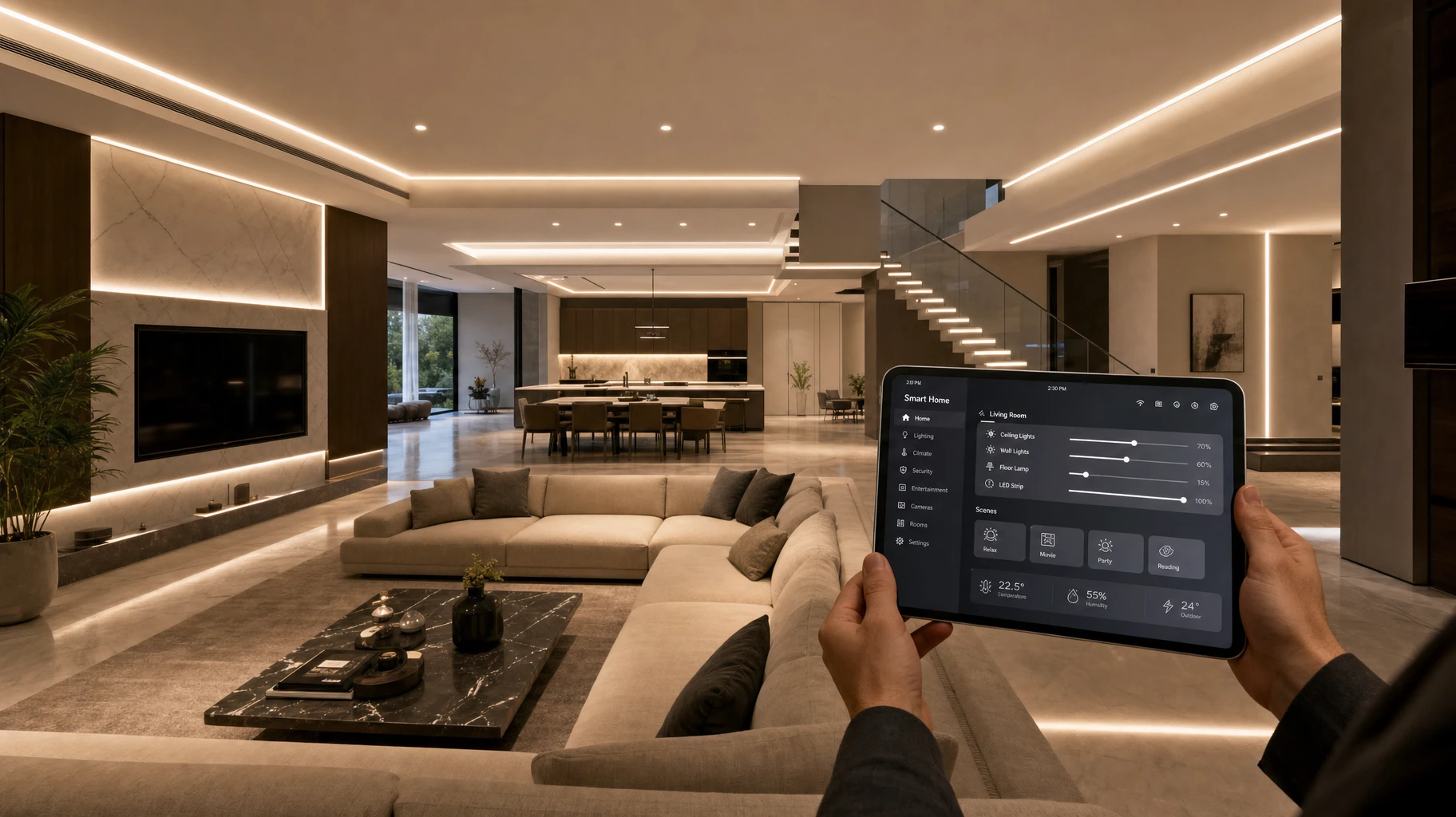
Sprawling residential designs create natural barriers for standard point-to-point networks. Direct Wi-Fi and traditional Bluetooth systems struggle in these layouts. Concrete walls, steel structural beams, and smart appliances scatter the signals. These obstacles leave distant bedrooms with dead connectivity patches.
The Zigbee protocol handles large layouts by using an interconnected mesh network. Zigbee networks do not force every fixture to talk directly to one central router. Instead, they use three distinct device profiles to pass data effortlessly:
Zigbee Coordinator: This is the central master gateway. It establishes the root of the network and manages security keys.
Zigbee Routers: These are main-powered smart devices. They remain active constantly. They listen for data packets and repeat signals across the network to reach distant rooms.
Zigbee End Devices: These are battery-operated sensors or simple switches. They wake up briefly to talk to a local router. Then, they return to low-power sleep mode immediately.
Every main-powered Zigbee light tube works as a dedicated Zigbee Router. Therefore, every new light line you install strengthens the signal grid. If a single room's light path loses contact due to a physical barrier, the system adapts instantly. The signal reroutes automatically through adjacent light lines. This self-healing process ensures instant control response across properties exceeding 10,000 square feet.
Selecting engineering-grade led technology for premium homes requires looking at deep specs. Wholesale buyers must look beyond retail descriptions to find verifiable data.
The technical matrix below outlines the core metrics of professional smart neon installations. It compares them directly to standard consumer alternatives:
| Engineering Specification | Standard Consumer Strip Lights | Professional Zigbee Neon Systems | Direct Asset Value for Large Properties |
| Networking Protocol | Standard 2.4GHz Direct Wi-Fi | Zigbee 3.0 Standard Mesh | Forms a self-healing grid that prevents gateway congestion and signal dropouts. |
| Standby Power Load | 1.2W to 2.5W per controller | Less than 0.3W per node | Maximizes energy efficiency by dropping idle household phantom power drain to near-zero. |
| Signal Transmission Range | 10m to 15m (Point-to-point) | 30m+ per node router link | Bypasses thick brick walls and structural steel by hopping data safely across nodes. |
| Circuit Board Layout | 1-ounce Single Copper Foil | 3-ounce Rolled Dual Copper | Prevents voltage drop and dim tails across continuous linear runs. |
| Refresh Frequency Rate | Below 1,500Hz (Camera flicker) | Over 4,000Hz (Flicker-Free) | Looks perfectly smooth under high-definition security setups and smart home media centers. |
| Color Fidelity Index | Below 80 Ra (Dulls space) | Over 92 Ra (High-Density Chips) | Restores and highlights the rich textures of premium marble, hardwood, and custom finishes. |
| Ingress Protection (IP) | IP20 or IP44 | IP67 / IP68 Dual-Extrusion | Guarantees safe installation in humid bathrooms, kitchens, and outdoor pools. |
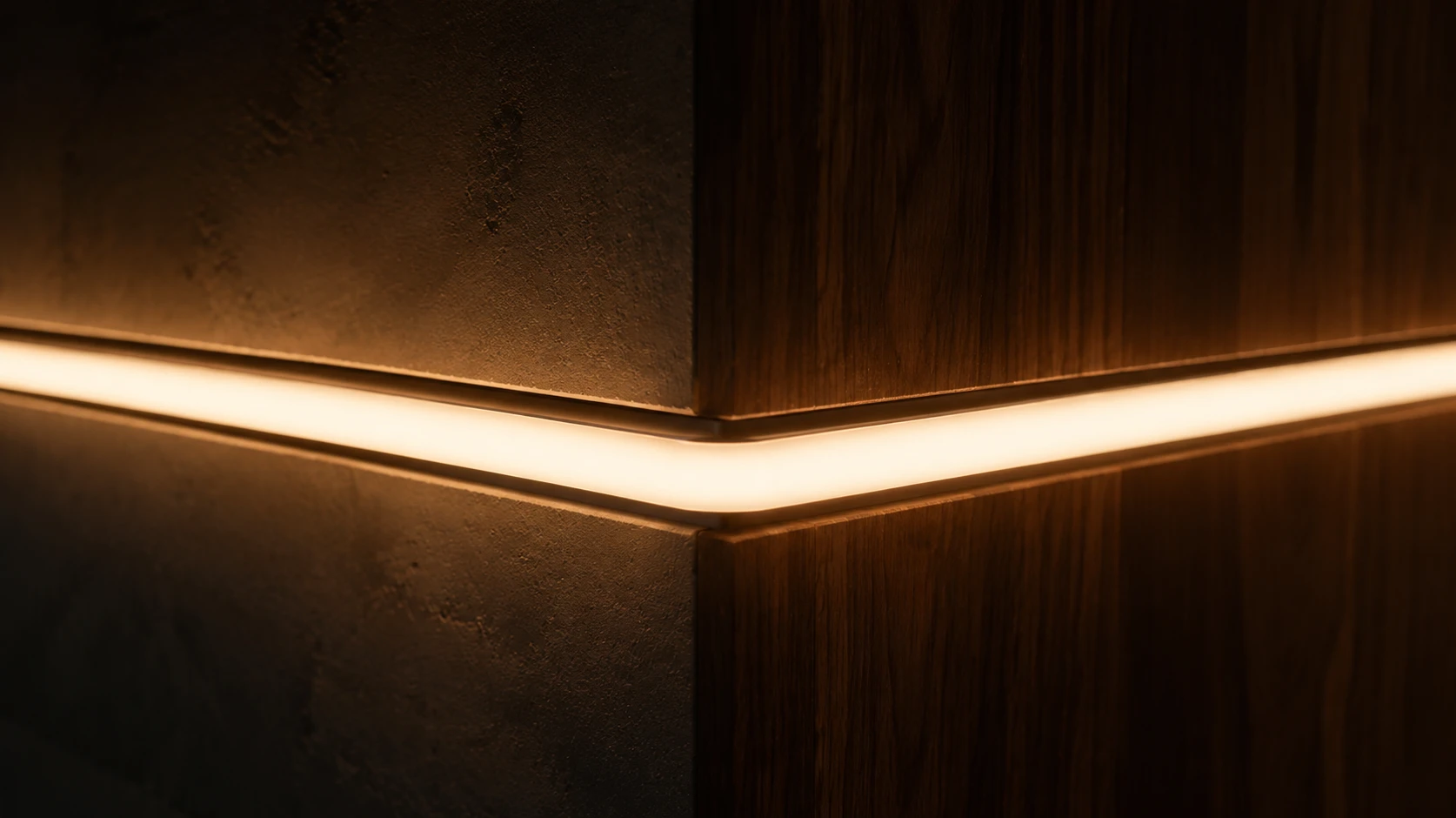
Large estates contain hundreds of individual lighting loads. If managed incorrectly, these loads create massive electric bills. Standard consumer smart ropes run on line-voltage or inefficient transformers. These old systems waste power through high heat output.
Modern led neon lights feature advanced Zigbee microchips with built-in power-monitoring tech. These smart control boards track real-time current draw. They feed the metrics back to your primary home dashboard. This visibility allows home automation software to run custom rules to target waste:
Daylight Harvesting Integration: Ambient light sensors feed lux data into the Zigbee coordinator. The system dims the interior neon lights smoothly as natural sunlight fills the room. This cuts excess power draw automatically.
True Idle Load Drop: Wi-Fi smart devices must run hot internal radios constantly. They do this to listen for router signals at all hours. In contrast, Zigbee nodes operate on a tight sleep-and-wake schedule. This protocol drops the background power draw down to microscopic fractions, keeping building costs low.
Occupancy-Linked Fading: Some systems leave decorative lighting running at 100% capacity in empty hallways. To fix this waste, presence sensors dim the neon tracks to a low 10% safety glow when they detect no motion. The light ramps back up smoothly to full brightness the microsecond a family member approaches.
The physical lifespan of your linear lights is critical. The flexible outer jacket protects the internal electronics from weather and structural stress.
Historically, budget factories used Polyvinyl Chloride (PVC) plastic sleeves to keep costs low. However, PVC degrades rapidly under home heating and direct solar rays. Over a few years, a PVC jacket turns amber, cloudy, and stiff. This yellowing distorts the output of your red, green, and blue chips. Even worse, brittle PVC cracks easily during winter building shifts. These cracks expose copper tracks to ambient moisture and cause short circuits.
Professional architectural lighting projects eliminate these risks by specifying gas-phase silicone dual-extrusions. Silicone offers multiple physical advantages for luxury home spaces:
Absolute Optical Permanence: Pure silicone molecules resist UV damage. The outer sleeve retains its absolute clarity for over ten years without color shifting.
Excellent Thermal Stability: Silicone maintains its elastic, flexible texture from -40°C up to +85°C. It routes heat away from internal LED chips efficiently to prevent premature burnout.
True Structural Diffusion: The dense material science of silicone diffuses raw diode outputs naturally. This feature eliminates ugly pixel dots. It creates a flawless, solid line of light with zero reflection spots on glossy interior surfaces.
The Operational Challenge: In late 2025, an automation engineering group took on a renovation project for a 12,000-square-foot luxury smart estate. The layout required 800 meters of color-changing neon accent lines. The design placed these lines into crown moldings, under-counter steps, and home theater walls.
The original plan used standard Wi-Fi-controlled smart strips. However, during early testing, 60 individual Wi-Fi controllers tried to link with the home router at the same time. The local network crashed immediately due to bandwidth overload. Furthermore, thick concrete floors and steel-reinforced walls cut off the wireless signals completely. The basement cellar and rooftop patio lost contact, causing massive command lag.
The Integrated Mesh Upgrade: The installation team removed the consumer strips. They upgraded the entire layout to an energy-efficient zigbee neon for large homes platform. The supplier provided long spools cut to exact structural sizes. They paired these lines with premium constant-current Zigbee 3.0 drivers. These drivers formed a tight, low-power mesh topology across all three floors of the villa.
The Final Result: The installation crew completed the field layout 35% faster. They saved time because the Zigbee nodes linked with each other automatically upon power-up. This automation eliminated tedious manual app pairing completely.
The system handled all commands instantly with zero lag times, even in the deepest concrete basement zones. By removing the massive data load from the home's main router, overall Wi-Fi performance returned to normal. Most importantly, integrating the network with motion sensors and daylight dimmers reduced power usage by 52%. This saved massive amounts of energy and proved the long-term cost benefits of professional custom components.
To achieve a clean installation and maximum lifetime performance from smart mesh linear systems, electrical crews must follow three industrial protocols:
Map Out Your Node Routing First: When laying out a large network, installers must check node distances. Ensure that the space between any two main-powered Zigbee light drivers does not exceed 10 to 15 meters in highly obstructed zones. Placing nodes with clean sightlines guarantees a strong, unbreakable link back to the main Coordinator.
Calculate Voltage Drop Proactively: Low-voltage DC networks (12V/24V) experience voltage drop over long continuous runs. This resistance causes the tail end of the line to look dimmer or shift colors. Technicians must use the appropriate wire thickness (AWG). They must also inject raw power feeds at proper intervals to ensure flat, even brightness across the layout.
Seal On-Site Edges Cleanly: When trimming a flexible neon tube on-site, technicians must cut strictly on the marked factory lines. The raw cut edge must be sealed immediately. Use a matching endcap and structural industrial silicone adhesive. Skipping this sealing process allows humidity and ambient moisture to creep onto the circuit board. This moisture corrodes the copper traces and causes system connectivity drops.
Standard Wi-Fi controllers force every light strip to maintain an individual connection with the main internet router. In a large home with dozens of lighting zones, this data load congestes the router. This traffic causes connection dropouts and slow control response times. Zigbee networks use a mesh setup where lights talk through each other. This layout lightens the load on your internet router. It allows commands to travel long distances with zero signal lag.
Yes. Traditional smart devices keep power-hungry wireless components active 24/7. They must do this to listen for network commands constantly, resulting in high standby power drain. Zigbee control modules use optimized low-energy mesh radios. These units draw less than 0.3 Watts when idle. Integrating these smart controls with presence sensors and daylight harvesting dimmers maximizes energy efficiency across your entire estate.
Absolutely. Professional-grade neon spools feature clear cut-marks at regular, tight intervals along the circuit path. Technicians can cut the flexible casing to exact room dimensions on-site. Trimming the physical tube does not disrupt the internal Zigbee chip address. It will not break network routing communication with downstream nodes.
THINK TEAM KING specializes in manufacturing premium commercial-grade neon ceiling systems and heavy-duty residential lighting solutions tailored for global B2B projects. We build our wholesale neon lighting lines using certified Zigbee 3.0 chipsets. These systems are fully compatible with mainstream smart home controllers and professional automation setups.
Every batch of our led neon lights uses premium 3-ounce dual copper circuit boards and gas-phase silicone jackets. This hardware choices guarantee high durability and prevent voltage drops. Whether you need a volume shipment for private estate developments or customized systems for premium commercial lighting builds, THINK TEAM KING delivers certified systems. Our products are engineered to pass strict safety codes and operate flawlessly in large structural environments.

It provides all-round service for customers
and users 24 hours a day.
Enter your email for exclusive offers
and information on new upcoming products.


