


Time:2026-07-17
The global commercial architecture and industrial facility management sectors are undergoing a permanent structural shift. As multinational corporations, logistics hubs, large manufacturing plants, and worldwide retail networks commit to strict net-zero carbon initiatives, every element of facility infrastructure is being evaluated for operational optimization. Traditional architectural accent illumination and high-visibility corporate branding displays have historically acted as massive energy drains.
For international procurement managers, factory directors, and engineering contractors, selecting sub-standard commercial lighting configurations poses severe financial risks. High operating currents, frequent power supply failures, and rapid lumen depreciation quickly increase total cost of ownership. Overcoming these challenges requires transitioning to advanced energy-efficient neon tube lights for signage. Sourcing optimized solid-state architectural lighting platforms helps industrial complexes drastically lower energy baselines, satisfy local environmental regulations, and maintain perfect brand visibility for years.
To justify large-scale component upgrades to corporate financial controllers, procurement teams must analyze the fundamental electrical differences between traditional high-voltage glass discharge systems and modern solid-state polymer extrusions.
Traditional glass neon tubes operate via gaseous discharge, requiring specialized step-up transformers to convert standard grid voltages into massive open-circuit loads ranging between 5,000V and 15,000V. This high-voltage ionization process converts a significant portion of incoming electrical energy into radiant heat rather than visible light, resulting in a poor luminous efficacy profile—often hovering between 10 and 20 lumens per watt (lm/W).
In contrast, industrial-grade energy-efficient neon tube lights for signage utilize advanced surface-mount diode (SMD) arrays running on regulated low-voltage direct current (typically 24V DC or 48V DC). By eliminating high-voltage gas ionization, these solid-state assemblies achieve exceptional luminous efficiency metrics, frequently exceeding 120 to 140 lm/W. This technical improvement represents an immediate 80% drop in active power consumption for identical luminous output.
Consider a mid-sized automotive logistics center or an international fulfillment warehouse featuring a 150-meter linear perimeter logo layout running 12 hours per day, 365 days per year.
Legacy High-Voltage Glass Layout: A standard 15mm neon tube draw averages roughly 45 watts per linear meter when factoring in transformer core losses. Over a 150-meter installation, the total active load is 6,750 watts. Annual energy consumption reaches 29,565 kilowatt-hours (kWh).
Solid-State Energy-Efficient Alternative: A premium, low-power linear silicone tube requires only 8 watts per linear meter to match the same visual candela output. The total load drops to 1,200 watts, and annual energy consumption plummets to 5,256 kWh.
Assuming an average commercial industrial utility rate of $0.15 per kWh, transitioning to modern solid-state technology delivers direct utility savings of over $3,640 annually per signage assembly. Replicated across a global network of 50 distribution facilities, the operational savings exceed $182,000 per year, driving a rapid return on investment (ROI).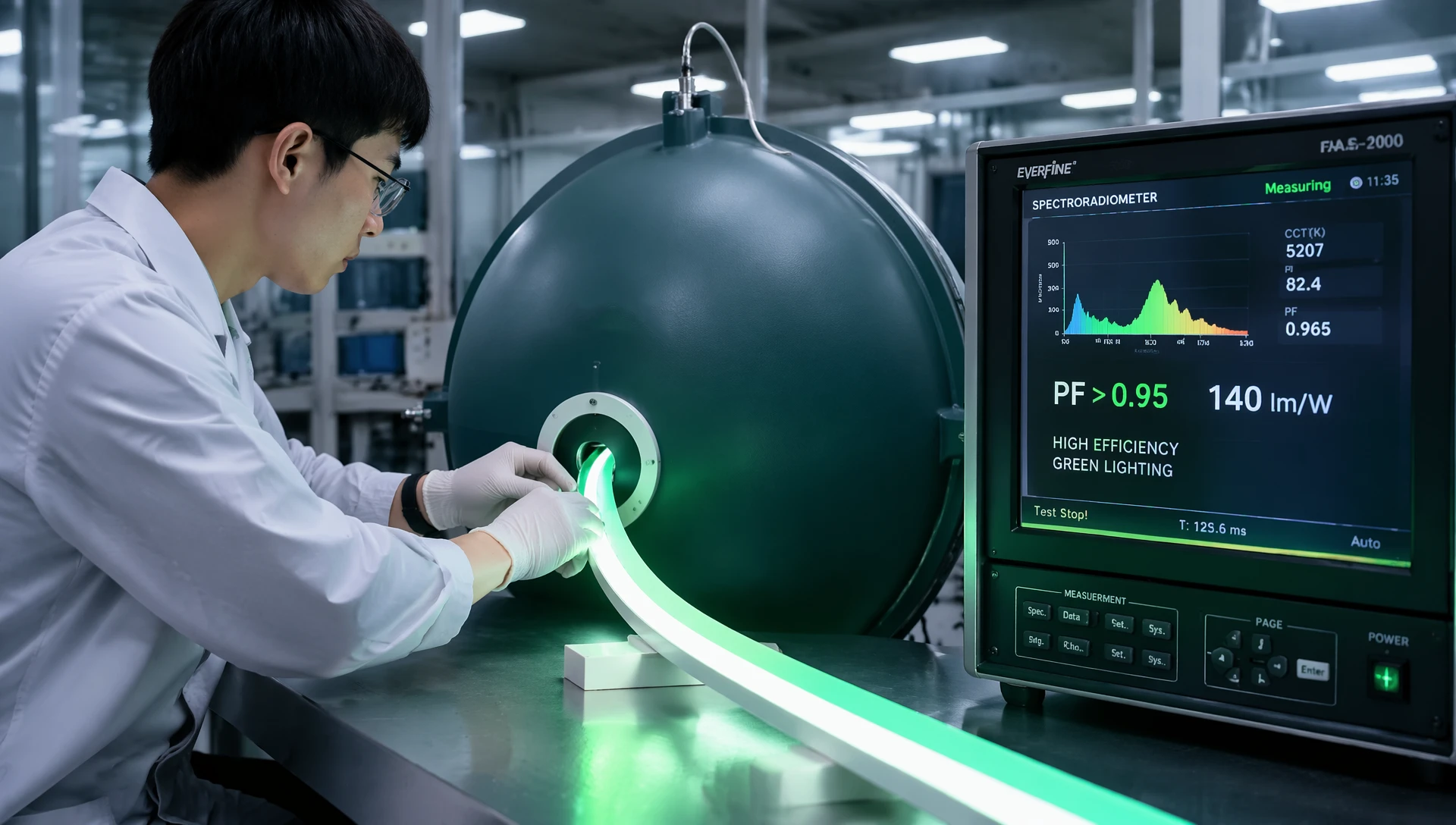
Maximizing energy efficiency involves more than just minimizing the wattage rating of internal circuit boards. True commercial performance requires optimizing the entire optical pathway, ensuring every lumen generated by the underlying diodes is focused and diffused without internal absorption losses.
Low-cost commercial flexible fixtures frequently use cheap polyvinyl chloride (PVC) formulations for their diffusion housings. PVC features an inconsistent molecular structure that causes high internal light scattering and absorption, reducing light transmission efficiency by up to 30%. Furthermore, PVC undergoes photolytic degradation under natural solar UV rays, causing the jacket to turn yellow and brown, which further traps heat and dampens light output.
Professional energy-efficient neon tube lights for signage are built using high-purity, gas-phase co-extruded silicone polymers. Optically pure silicone maintains a light transmission efficiency rating exceeding 93%. Its highly stable silicon-oxygen molecular backbone resists solar UV exposure, completely preventing yellowing over decades of continuous operation. This material stability ensures the sign maintains crisp, high-contrast illumination without needing higher driving currents to overcome a fading outer shell.
For a comprehensive guide on selecting the ideal flexible linear component architectures to balance optimal brightness with long-term low power consumption, read our engineering team's specialized report on
Industrial job sites expose outdoor accent lighting to harsh conditions. Signs installed on coastal ports, chemical factories, or exposed building roofs face high winds, heavy rain, salt spray, and extreme temperature swings. Component failure immediately halts energy-saving benefits and triggers expensive maintenance calls.
The lifecycle and efficiency of an LED chip are tied directly to its operating junction temperature. Diodes driven hard inside poorly ventilated housings accumulate heat rapidly. As the junction temperature rises past 85°C, the internal quantum efficiency drops, forcing the diode to draw more current while emitting fewer lumens—a destructive cycle known as thermal runaway.
To counter this, leading commercial manufacturers like TTK LED Neon construct internal flexible printed circuits (FPCs) using extra-thick, 3-ounce double-sided rolled annealed copper. Copper serves as a high-performance thermal highway, pulling heat away from the diode bases and venting it into the aluminum mounting tracks. This efficient thermal pathway keeps junction temperatures well below 65°C, ensuring stable light output and helping the system reach an operational lifespan exceeding 60,000 hours (L80B10 compliance).
Outdoor industrial installations require true IP67 or IP68 waterproof ratings. Lower-grade signs rely on manual end-cap gluing, which eventually fails due to thermal expansion and contraction cycles.
Industrial-grade production plants utilize automated high-pressure liquid injection molding lines to fuse terminal connections directly to the main body. This technique creates a continuous, single-piece water barrier that easily passes rigid chemical stability tests:
ASTM B117 Salt Spray Validation: Survives over 1,000 hours of continuous saltwater fog testing without trace corrosion, making it perfect for marine logistics hubs and coastal warehouses.
ISO 14001 Environmental Compliance: Chemically inert silicone resists industrial acid rain, heavy ozone, and direct chemical cleaning sprays without structural cracking.
When engineering multi-kilometer linear lighting installations for large distribution facilities or factory perimeters, electrical infrastructure design becomes critical. Sourcing teams must analyze how these lighting arrays interact with the facility's main power distribution network.
Running low-voltage direct current across long distances naturally introduces electrical resistance, causing a voltage drop toward the end of the circuit run. This drop reduces brightness and causes color variations at the far end of the sign.
The total direct current voltage drop along a conductor loop is calculated as follows:
Voltage Drop = (2 * Circuit Length * Total Current Draw * Copper Resistivity) / Cross-Sectional Area
To solve this challenge on expansive factory perimeters, specialized manufacturers use high-voltage 24V DC or 48V DC power topologies rather than standard 12V layouts. Higher operating voltages lower the overall current draw, which significantly reduces voltage drop and allows for continuous runs up to 20 meters from a single power feed.
Additionally, embedding miniature constant-current integrated circuits (ICs) directly onto the internal FPC protects the diodes from small voltage changes. These smart ICs maintain a steady current flow through every chip, ensuring uniform brightness from the first meter to the last.
Large industrial facilities are often penalized by power companies if their equipment causes poor electrical power factors or high Total Harmonic Distortion (THD). Cheap lighting power supplies can create electrical noise that disrupts sensitive production machinery on the factory floor.
Industrial supply networks from premium brands integrate commercial power drivers featuring built-in Active Power Factor Correction (PFC) circuitry. These components align the system's voltage and current phases perfectly, delivering a clean power factor rating above 0.95 and keeping THD below 10%. This high electrical efficiency helps factories pass strict grid performance audits and avoids utility penalties.
For corporate procurement agents overseeing complex global supply lines, finding a reliable, high-volume production partner is vital to keeping project timelines on track. Sourcing directly from asset-heavy manufacturing facilities ensures consistent quality and reliable delivery.
Before selecting an industrial component vendor for large-scale development projects, corporate sourcing teams should review the factory's automated assembly lines and verification testing equipment:
Automated High-Speed SMT Lines: Automated pick-and-place equipment ensures durable, precise solder joints across every batch, eliminating human errors and preventing dead pixels.
Integrated Multi-Axis Spectroradiometer Auditing: Confirms that every batch matches strict color temperature limits, preventing color mismatches across separate factory shipments.
Seamless Smart Controls Integration: Commercial signs must easily connect with building automation systems. High-quality neon tube systems are fully compatible with standard DMX512 controllers, wireless Art-Net interfaces, and automated Dali control networks.
Our advanced solid-state systems deliver over 130 lumens per watt, easily outperforming traditional glass neon and low-grade PVC flexible options. This high efficiency cuts power consumption by up to 80% for the same brightness level, directly lowering your facility's Scope 2 electrical carbon footprint.
For major commercial and industrial installations, our systems carry full international safety and performance credentials, including UL94 V-0 flame retardancy, CE compliance, RoHS material tracking, and IK08 mechanical impact ratings.
Yes, absolutely. THINK TEAM KING specializes in manufacturing complete OEM/ODM linear flexible solutions for global logistics hubs, factory complexes, and retail networks. We provide custom pre-cut lengths, factory-sealed IP68 wire harnesses, and complete matching hardware kits built directly to your layout blueprints.
An exhaustive evaluation of global commercial facility trends confirms a vital operational fact: advanced system design determines product reliability and factory profitability. Sourcing premium energy-efficient neon tube lights for signage from an asset-heavy manufacturer eliminates installation headaches, satisfies strict building safety regulations, and prevents costly post-installation service calls. Lower-grade consumer alternatives simply cannot deliver the long-term reliability required for major commercial spaces.
Are you looking to streamline your component sourcing, request custom product samples, or get a competitive factory-direct quote for a major project? Our technical engineering team is here to assist you with layout planning, electrical calculations, and custom options tailored to your project blueprints.

It provides all-round service for customers
and users 24 hours a day.
Enter your email for exclusive offers
and information on new upcoming products.


