


Time:2026-07-29
In modern industrial manufacturing facilities, chemical processing plants, automated logistics hubs, and heavy machining environments, solid-state lighting infrastructure faces extreme operational demands. Traditional task luminaires, high-bay metal halide fixtures, and legacy fluorescent tubes frequently suffer from premature optical degradation, mechanical enclosure cracking, chemical corrosion, and water ingress.
The demanding nature of high-vibration CNC machining cells, high-humidity food packaging plants, and washdown chemical facilities requires a shift toward continuous, ruggedized, and flexible linear lighting solutions.
At the forefront of this industrial transformation are ip67 silicone neon strip lights for industrial use. Fusing gas-phase optical silicone encapsulation with high-density surface-mount LED arrays and heavy-duty flexible copper sub-circuits, this lighting technology provides an impervious, chemical-resistant, and high-luminance lighting solution.
However, specifying linear lighting for heavy industrial facilities requires a thorough evaluation of materials science, mechanical vibration isolation, capillary fluid dynamics, and electrical grid engineering.
Partnering with an asset-heavy manufacturer like TTK LED Neon provides industrial facility managers, Mechanical, Electrical, and Plumbing (MEP) contractors, and OEM equipment builders with access to factory-engineered linear lighting systems built to withstand the harshest operating conditions.
Selecting linear task and architectural lighting for industrial plants requires an understanding of polymer chemistry. The primary cause of failure in standard commercial light strips deployed in industrial environments is the rapid chemical degradation of the outer protective jacket.
Standard flexible light strips utilize Polyvinyl Chloride (PVC) or Polyurethane (PU) protective extrusions. PVC and PU possess an organic carbon-carbon (-C-C-) molecular backbone with a bond dissociation energy of approximately 348 kJ/mol. When exposed to airborne industrial solvents, machine cutting fluids, synthetic hydraulic oils, or atmospheric ozone, these carbon bonds break down rapidly.
In contrast, ip67 silicone neon strip lights for industrial use manufactured by TTK LED Neon utilize 100% gas-phase optical silicone. Silicone features an inorganic silicon-oxygen (-Si-O-Si-) polymer backbone with a bond dissociation energy of 445 kJ/mol. This higher molecular bond strength delivers superior resistance across harsh industrial environments:
Cutting Oils and Machine Coolants: Remains completely inert when continuously splashed with water-soluble machining coolants, synthetic lubricants, and cutting fluids found inside CNC milling stations and lathe enclosures.
Acidic and Alkaline Solvents: Resists chemical corrosion from industrial washdown solutions, including sodium hydroxide (NaOH) sanitizers, nitric acid mists, and industrial degreasers used in food processing and pharmaceutical facilities.
Extreme Thermal Cycling: Maintains physical elasticity and optical transmittance without outgassing or hardening across an operational thermal window spanning from -50°C in cold-storage logistics freezers up to +200°C in proximity to industrial drying ovens and heat-treatment equipment.
In facilities featuring high-intensity UV curing systems or outdoor industrial processing yards, light housing materials suffer from solar photo-oxidation. UV-A and UV-B radiation breaks down plasticizers inside commercial PVC, causing severe yellowing, micro-fissuring, and optical clouding within 6 to12 months.
Gas-phase optical silicone exhibits zero UV absorption within the visible spectrum, maintaining a high light transmission efficiency rating (over 92%) and zero color shifting across a 10-year operational lifespan.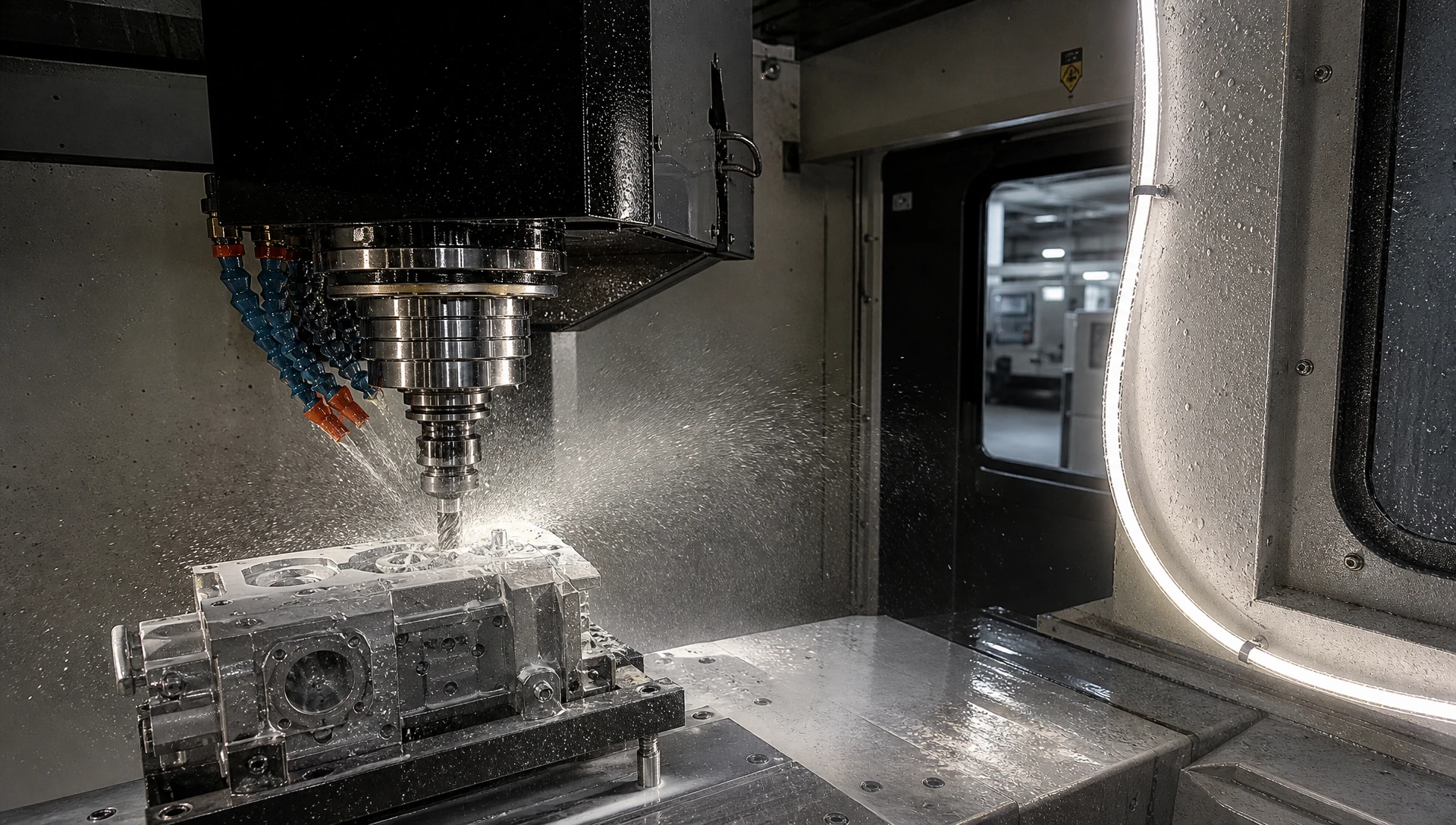
Heavy industrial machinery—such as metal stamping presses, automated assembly conveyors, punch presses, and industrial crushers—generates continuous, high-amplitude mechanical vibration. This physical oscillation poses a severe threat to solid-state lighting components.
In low-cost flexible light strips, the internal Flexible Printed Circuit (FPC) is manufactured using thin 1-ounce or 2-ounce electro-deposited (ED) copper foil. When subjected to continuous mechanical vibration, ED copper's rigid grain structure develops micro-fractures along trace paths and solder pads. This results in intermittent circuit breaks, localized flickering, and ultimate section failure.
To prevent vibration-induced mechanical fatigue, TTK LED Neon engineers all industrial-grade silicone neon strips using 3-ounce double-sided rolled annealed (RA) copper FPCs. Rolled annealed copper undergoes mechanical rolling compression, creating elongated horizontal grain structures that absorb continuous physical flexing and high-frequency vibration without trace fatigue.
In manufacturing plants, lighting fixtures are subject to physical impacts from dropped tools, forklift scrapes, flying metal turnings, and maintenance machinery.
Standard glass-encased task lamps present severe safety hazards upon impact, releasing hazardous glass shards into production lines. Silicone neon extrusions act as a continuous shock-absorbing bumper:
IK08 Mechanical Protection: Standard profiles withstand kinetic impact energies up to 5 Joules (equivalent to dropping a 1.7 kg steel mass from a height of 300 mm).
IK10 Reinforced Heavy-Duty Profiles: Custom-engineered thick-wall silicone extrusions absorb impact energies up to 20 Joules, ensuring uninterrupted operation in high-traffic logistics corridors and heavy equipment bays.
Achieving reliable ingress protection in industrial environments requires more than basic topical coatings or mechanical press-fit end caps. High-pressure washdowns, thermal shock, and airborne oil mists exploit micro-gaps in inferior lighting enclosures.
In industrial washdown zones, fixtures experience rapid temperature swings. When an operational light strip (running at 45°C) is suddenly sprayed with cold washdown water (10°C), the air trapped inside a hollow light housing contracts rapidly.
This thermal contraction creates an internal vacuum (negative differential pressure), pulling washdown water and chemical vapors past weak mechanical seals and cable entry points via capillary action.
To explore specialized micro-profiles designed for compact machinery integration, review our technical overview of
TTK LED Neon eliminates capillary fluid migration by utilizing a continuous vacuum co-extrusion process. The gas-phase silicone is extruded directly around the internal SMT LED light engine under precise vacuum conditions, completely encapsulating the circuit board in a solid silicone matrix with zero internal air pockets.
To complete the ingress barrier, wire connections and end terminal closures are sealed using automated liquid silicone injection molding. Rather than relying on manual room-temperature vulcanizing (RTV) silicone glues, the end caps undergo thermal fusion bonding directly with the main extrusion body, creating a continuous IP67 seal compliant with IEC 60529 standards:
Dust-Tight Ingress (IP6X): Complete protection against fine industrial particulates, conductive graphite dust, and abrasive grain dust.
Liquid Ingress Protection (IPX7): Proven resistance against temporary water immersion up to 1 meter depth for 30 minutes, withstands high-humidity condensation cycles inside industrial processing plants.
For a deeper analysis of industrial durability benchmarks, read our comprehensive industry report on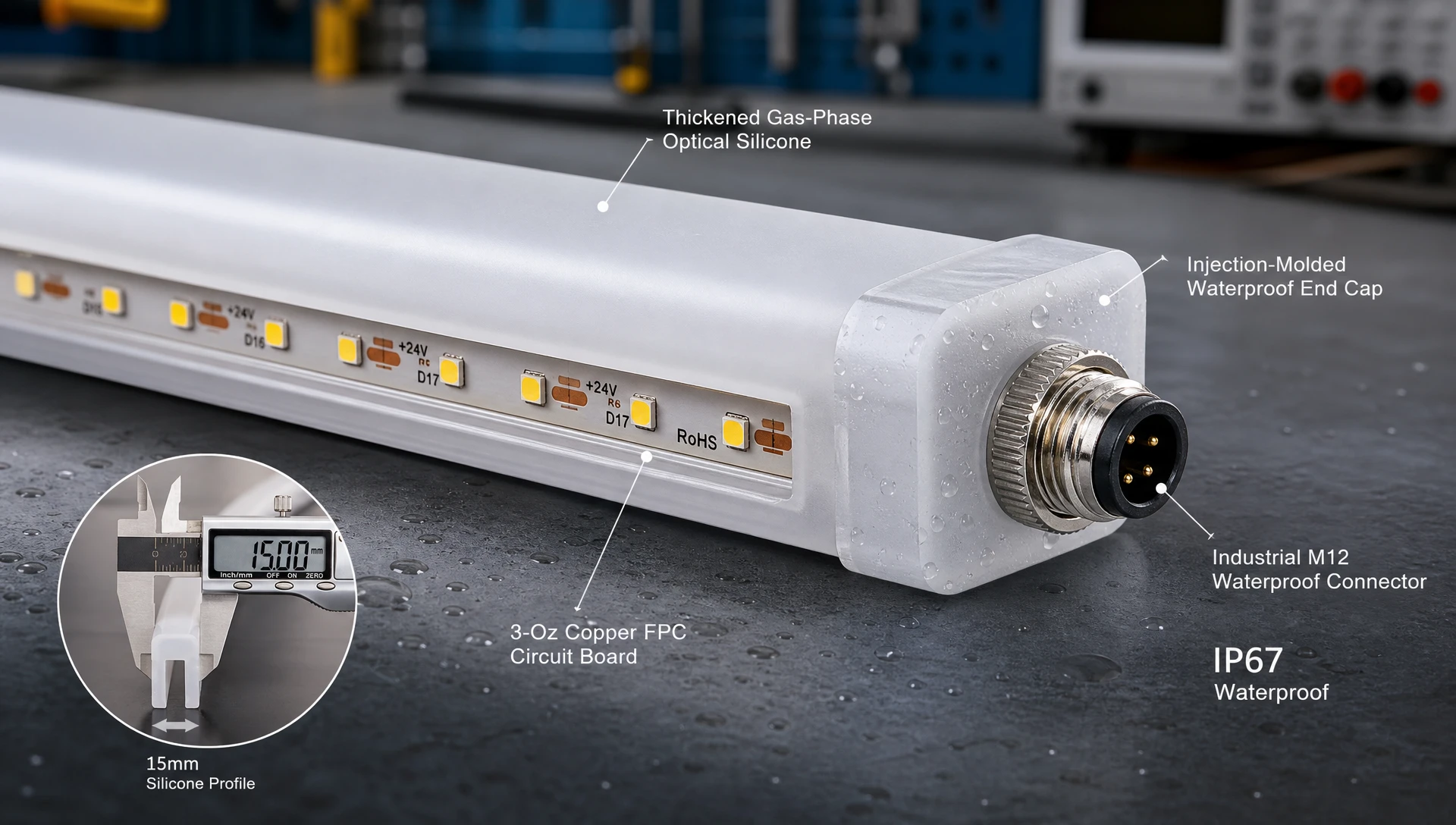
Industrial facilities present challenging electrical environments characterized by heavy inductive loads, power factor fluctuations, high electromagnetic interference (EMI) from arc welding equipment and large electric motors, and long physical wiring distances.
In large manufacturing halls, warehousing facilities, and long conveyor lines, distribution runs of low-voltage DC power often cover distances exceeding 50 to 100 meters. Controlling direct-current voltage drop along the circuit path is critical to preventing end-to-end brightness loss and thermal hot spots.
The voltage drop along a uniform direct-current copper conductor bus is calculated using Ohm's Law and material resistivity parameters:
Delta V = (2 * L * I * rho) / A
Where:
Delta V is the total voltage drop along the run (in Volts, V).
L is the single-distance circuit length from the power supply to the lighting array (in meters, m).
I is the total operating current drawn by the neon lighting circuit (in Amperes, A).
rho is the electrical resistivity of copper (1.72 x 10^-8 Ohm-meters at 20°C).
A is the cross-sectional conductor area of the copper FPC traces (in square millimeters, mm²).
| Electrical Parameter | 12V DC Conventional Light Strip | 24V DC Industrial Neon Flex | 48V DC High-Efficiency Neon Flex |
| Operating Current for 100W Load | 8.33 Amperes | 4.17 Amperes | 2.08 Amperes |
| Relative Line Power Loss (I^2 * R) | Baseline (100%) | Reduced by 75% | Reduced by 93.75% |
| Maximum Single-Feed Continuous Run | 5 Meters | 10 to 15 Meters | 25 to 30 Meters |
| Trace Temperature Rise at Max Load | High (+25°C over ambient) | Moderate (+8°C over ambient) | Minimal (+3°C over ambient) |
| Recommended Industrial Application | Small Instrument Displays | Standard Plant Task Lighting | Long Logistics Conveyors & Facades |
By standardizing on 24V DC or 48V DC native power architectures, TTK LED Neon systems cut operating current requirements in half or by three-quarters, reducing resistive power loss along internal FPC traces and keeping overall voltage variation below 3% across extended linear runs.
In industrial environments containing high-speed rotating machinery—such as lathes, drill presses, saws, and automated turbine blades—low-frequency lighting flicker creates a severe safety threat known as the stroboscopic effect. If the switching frequency of the light source matches the rotational speed of a machine tool, the moving component appears stationary to human operators, leading to workplace injuries.
TTK LED Neon industrial driver systems incorporate high-frequency Pulse-Width Modulation (PWM) dimming engines operating at frequencies above 3,000 Hz. This high switching frequency eliminates visual and sub-visual flicker, ensuring full compliance with IEEE 1789-2015 safety standards and providing optical safety around high-speed industrial machinery.
For procurement managers, factory operations directors, and OEM machinery builders, specifying ip67 silicone neon strip lights for industrial use involves evaluating initial procurement cost against long-term maintenance savings and operational uptime.
While high-grade silicone LED neon carries a higher initial hardware cost than cheap PVC light strips or traditional fluorescents, the Total Cost of Ownership (TCO) calculation heavily favors industrial silicone neon across a 5-year operating period:
Energy Consumption Reduction: High-efficacy LEDs (exceeding 120 lm/W) deliver energy savings of 60% to 70% compared to traditional fluorescent or metal halide task fixtures.
Maintenance Labor Elimination: Industrial plants often incur high maintenance costs when servicing ceiling-mounted or machinery-integrated lights (requiring scissor lifts, production line shutdowns, and certified electrician labor). With an operational lifespan exceeding 50,000 hours (L70B10 at 55°C ambient), TTK LED Neon strips eliminate routine lamp replacements.
Reduced Scrap and Quality Defects: High Color Rendering Index (CRI > 90 / TLCI > 92) illumination allows quality control inspectors to identify surface finish defects, paint imperfections, and assembly errors quickly, reducing material scrap rates.
As an asset-heavy manufacturer, THINK TEAM KING (TTK LED Neon) provides complete OEM/ODM engineering customization for industrial machinery integration and facility construction projects:
TTK Customization Pipeline:
[Custom Profile Geometry] ──> [Specific Color Spectrum Binning] ──> [Pre-Wired IP68 Harnessing]
Custom Extrusion Profiles: From ultra-compact 6x12mm side-bend profiles for tight CNC machine tool channels up to heavy-duty 20x20mm square extrusions for perimeter safety lighting in logistics hubs.
Custom Wavelengths and Color Spectrums: Specialized single-wavelength monochromatic LEDs (e.g., 590nm Amber for photoresist semiconductor cleanrooms, 450nm Blue for inspection stations, or 6500K High-Lumen Daylight White for assembly benches).
Pre-Wired Industrial Harnessing: Custom lead lengths fitted with factory-molded IP68 quick-disconnect M12 or M16 threaded industrial connectors, simplifying field installation for electrical contractors.
Rigorous Factory Testing: Every production batch undergoes a continuous 72-hour dynamic thermal aging test at maximum rated power, followed by automated spectroradiometer color verification and high-pressure immersion testing.
TTK LED Neon manufactures industrial light extrusions using 100% gas-phase optical silicone. Unlike PVC or polyurethane plastics that crack and yellow when exposed to synthetic cutting coolants and hydraulic fluids, silicone features an inorganic silicon-oxygen (-Si-O-Si-) backbone. This molecular structure remains chemically inert, preventing swelling, hardening, or optical degradation in harsh machining environments.
Yes, absolutely. We offer complete OEM/ODM manufacturing services, including compact 6x12mm side-bend and top-bend profiles engineered specifically for tight recessed channels inside CNC machine tools, automated packaging lines, and industrial control cabinets. These micro-profiles maintain full IP67 ingress protection and IK08 mechanical impact resistance.
Our industrial-grade power driver systems operate at Pulse-Width Modulation (PWM) frequencies exceeding 3,000 Hz. This ultra-high switching rate ensures that light pulses are imperceptible to human vision and eliminate optical stroboscopic interference with high-speed rotating shafts, drill bits, and conveyor systems, ensuring full compliance with IEEE 1789-2015 safety standards.
Deploying high-performance ip67 silicone neon strip lights for industrial use across your manufacturing plants, processing facilities, or equipment builds eliminates lighting failures, cuts maintenance costs, and ensures worker safety. Sourcing directly from an established B2B manufacturer like TTK LED Neon provides factory-direct wholesale pricing, robust custom engineering support, strict international safety certifications, and bulletproof long-term product reliability.
Are you preparing to specify heavy-duty industrial task lighting, request custom product samples, or secure a direct factory quote for an upcoming commercial development? Our experienced technical engineering team is ready to assist you with lighting layout design, voltage drop calculations, chemical compatibility verification, and custom OEM/ODM fabrication.

It provides all-round service for customers
and users 24 hours a day.
Enter your email for exclusive offers
and information on new upcoming products.


