


Time:2026-07-08
The global commercial lighting and signage market moves very fast. Today, international LED factories, bulk assembly plants, and sign manufacturing brands face a major engineering bottleneck. When building high-end linear lighting systems or complex custom illuminated displays, engineering teams must cut and assemble lighting paths to exact custom dimensions. However, typical field cutting often ruins the architectural layout. Low-end materials tear easily, and weak connection joints lead to moisture ingress, voltage drops, and complete component burnout.
To protect your factory production margins, your line needs industrial-grade cuttable led silicone neon strips with connectors. Sourcing pre-tested, high-efficiency flexible channels removes field installation risks entirely. Working directly with a certified, asset-heavy production facility ensures that your automated assembly lines receive perfectly matched, reliable hardware every single time.
For factory sourcing managers and engineering directors, choosing flexible linear lighting goes far beyond matching basic brightness numbers. Badly designed cutting paths and cheap plastic jackets cause costly delays on factory floors. They also trigger expensive warranty claims from your commercial clients.
Many assembly lines buy raw neon strips and separate connection end-caps from low-end trading brokers. While individual parts pass basic bench tests, cutting and combining them into large commercial configurations introduces severe system errors:
Structural Jacket Tearing: Cheap Polyvinyl Chloride (PVC) or low-grade silicone formulations tear easily when cut in the field. This rough edge prevents connection caps from sealing flush against the internal copper pads.
Oxidization and Contact Loss: Standard pin connectors loosen under minor physical tension or thermal expansion. This contact loss creates localized heat buildup, causing visible flickering and sudden dark zones along the run.
Moisture Ingress Failures: In outdoor sign installations, morning dew and heavy rain penetrate bad connection joints easily. This water leakage short-circuits the internal flexible printed circuits (FPC), ruining the entire display.
Top OEM/ODM production lines stop these component problems completely. Elite component factories build flexible systems using 100% high-purity, UV-stabilized gas-phase silicone. They mark exact cutting increments on the side profiles and build matching connection accessories.
Using a verified, pre-tested flexible architecture lets your assembly line scale up production with absolute confidence. This hardware tuning ensures a perfect physical and electrical seal every time you resize a strip. It delivers uniform, flicker-free illumination across thousands of custom architectural layouts.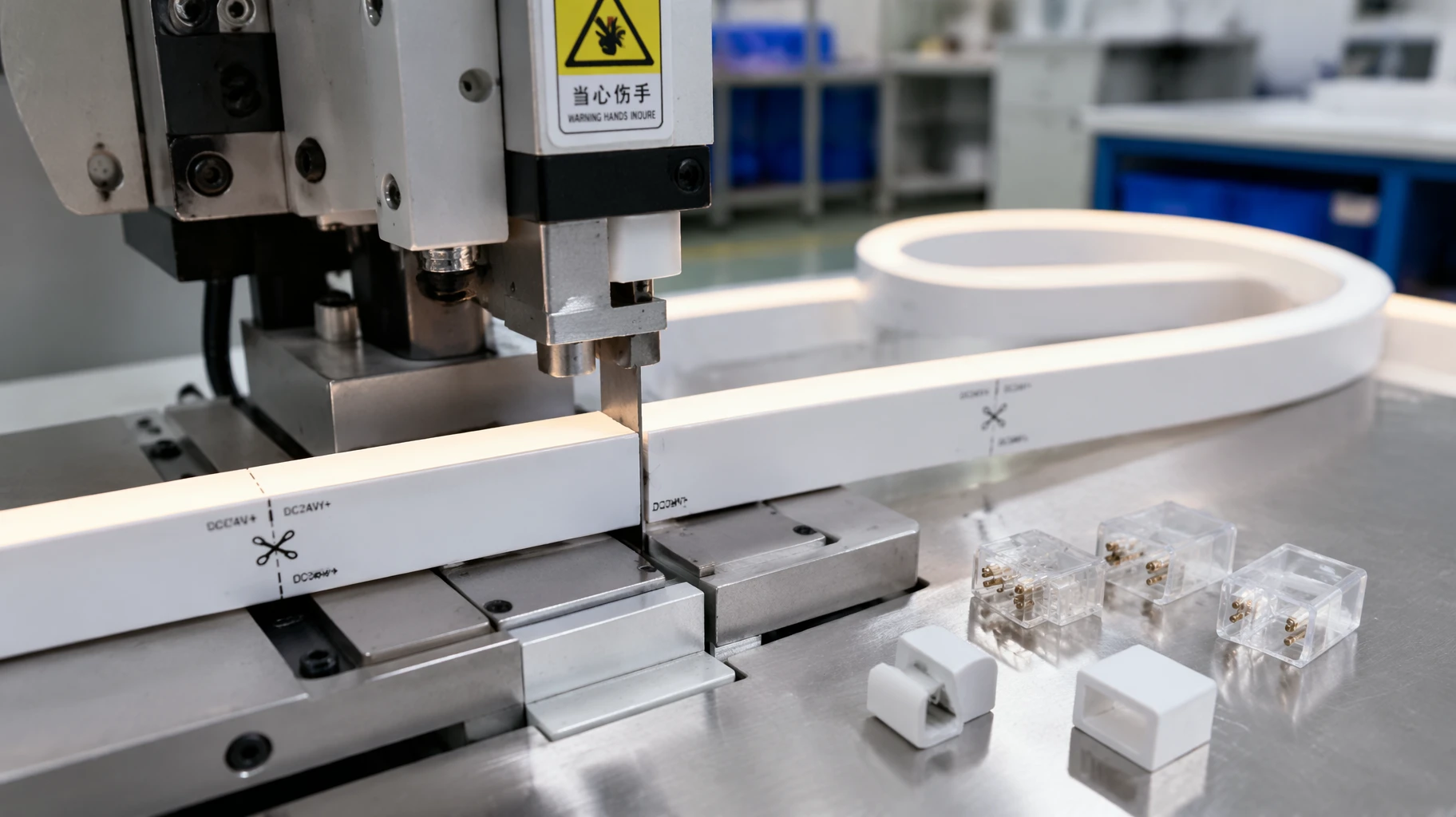
Sourcing directors, engineering project auditors, and industrial procurement managers need clear data to make smart buying decisions. Look at the data table below. It shows why cheap retail lights fail compared to our tough commercial systems:
| Technical Specs | Consumer Retail Flexible Strips | Premium Factory Silicone Systems | Supply Chain & Corporate Benefits |
| Jacket Material | Standard PVC Compound with Halogens | 100% Gas-Phase Silicone (Halogen-Free) | Resists heavy UV rays, freezing snow, and yellowing; stays soft and flexible. |
| Cutting Unit | Long 50mm to 100mm Cut Marks | Ultra-Short 10mm to 25mm Increments | Minimizes layout dead space; enables precision sizing for tight angles and letters. |
| Connector Integration | Loose Plastic Pins with Manual Gluing | Precision Injection-Molded Snap Connectors | Forms a mechanical lock; cuts factory assembly time down by 50% per fixture. |
| Waterproof Level | IP65 (Hand-Glued End-Caps) | True IP67 / IP68 Molded Integration | Guarantees absolute structural safety in wet outdoor and underwater installations. |
| PCB Copper Track | 1-oz Standard Copper FPC | 3-oz Rolled Annealed Dual-Copper FPC | Prevents voltage drops over long runs; keeps brightness perfectly uniform. |
| System Lifespan | 15,000 to 20,000 Hours | Over 50,000 Hours Certified (L70) | Reduces long-term replacement costs and field maintenance claims to zero. |
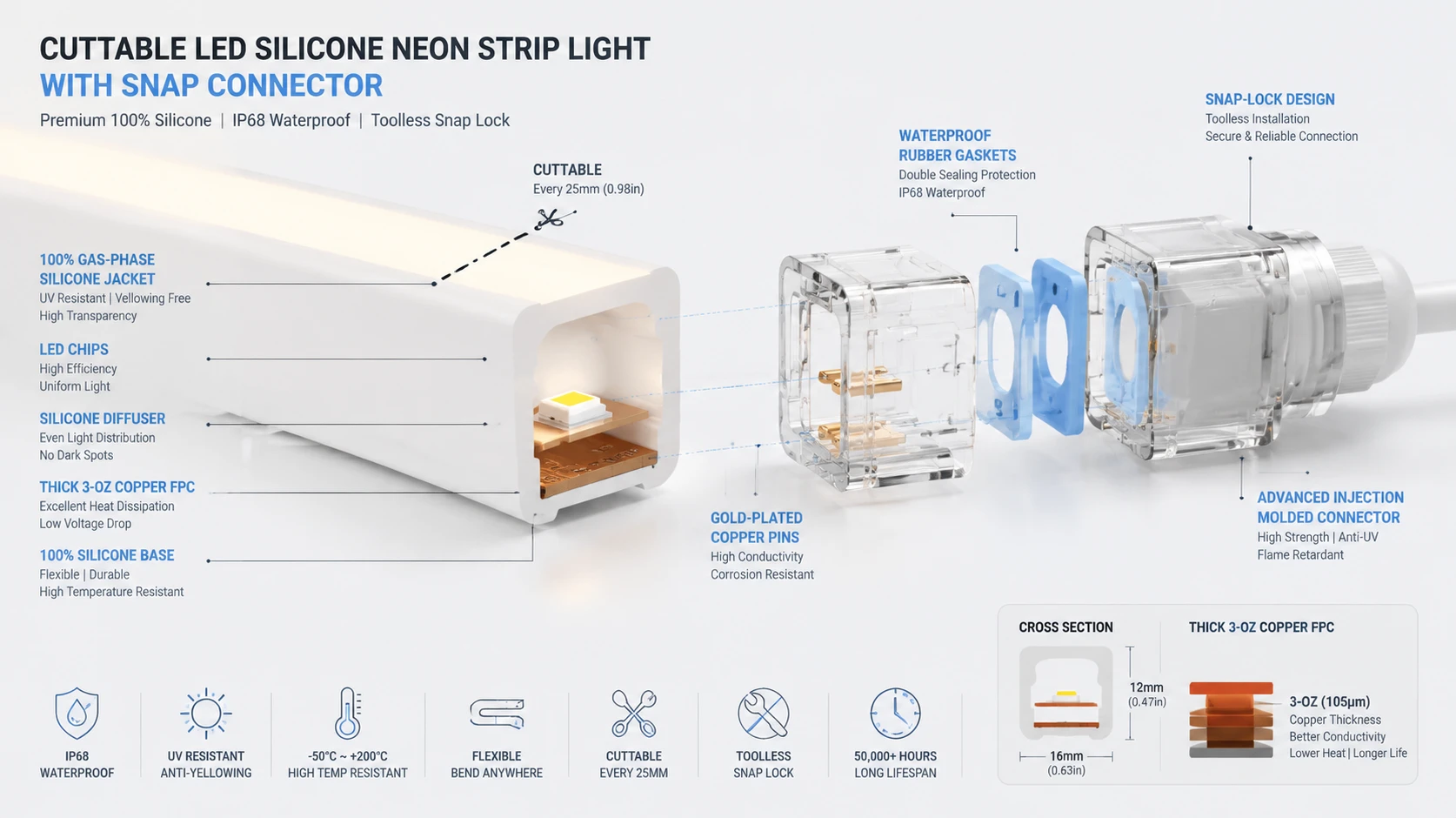
Achieving a flawless exterior or interior installation requires inspecting a manufacturer's underlying engineering methods. You must evaluate both the circuit architectures and the connector mechanics to ensure long-term structural satisfaction.
When building custom signs or fine interior linear details, layout flexibility is essential. Standard market neon products feature long distances between their cutting marks. If your engineering team needs a line of light exactly 415 millimeters long, but the product only cuts at 100-millimeter intervals, you are forced to alter your design blueprints. This limitation creates dark gaps at the edges of your fixture housings or sign letters, ruining the premium look required for luxury commercial projects.
Professional certified factories resolve this design challenge effectively. They layout high-density component arrays on custom circuit boards to achieve cutting marks as short as 10 millimeters. This ultra-precise engineering lets your assembly staff cut the strip to the exact length your blueprints demand. It completely removes dark zones, enabling your brand to execute intricate, custom-shaped layouts seamlessly.
When custom linear lights stretch continuously along building borders or long corridors, internal electrical resistance creates a common problem called voltage drop. The light near the power source glows bright, while the far end looks dim and faded. This uneven performance looks unpolished and compromises commercial project inspections.
To prevent this issue, top-tier production facilities build their flexible systems using heavy-duty 3-ounce rolled annealed dual-copper Flexible Printed Circuits (FPC). This thick copper pathway carries low-voltage current uniformly over continuous 10-meter to 15-meter runs from a single power feed. It reduces internal operating temperatures by up to 15°C, improving electrical efficiency and ensuring matching brightness from the first inch to the very last link.
Modern B2B independent stations must provide actionable application insight alongside technical product lists. Reviewing recent innovations in flexible architectures reveals how integrated component ecosystems can optimize factory product development and reduce assembly times.
For global manufacturing plants building high-end linear systems, traditional single-color installations are no longer enough to satisfy high-paying clients. Moving toward smart, multi-color addressable systems streamlines product lines and opens up premium market spaces. Factory engineering teams can review technical deep dives on
Using high-purity silicone channels allows production managers to pack dense RGB or addressable pixel chipsets inside an airtight housing. These systems give lighting designers the freedom to program complex chasing effects, slow color fades, and dynamic brand matching without sacrificing the rugged durability of the outer shell.
A common problem in high-volume sign manufacturing is the long labor hours needed to hand-solder thin wires around sharp letter corners. This manual step slows down factory throughput and introduces weak joints that break during transport. Factory procurement teams can study how utilizing a dedicated
By replacing old glass neon or fragile PVC tracks with flexible, tight-bending silicone channels, operators can form tight curves and sharp script fonts easily. The injection-molded connectors snap onto the cut ends securely without soldering torches. This mechanical speed helps production plants double their daily output, reduce wiring labor by 60%, and deliver rugged, shake-proof signs that survive international shipping.
For architectural lighting distributors and manufacturing hubs executing large hospitality rollouts, speed and compliance are equally vital. Sourcing teams can review the design advantages highlighted in
Pairing high-density LED arrays with pre-engineered plug-and-play connectors allows factories to build modular lighting kits. Instead of sending long, difficult-to-manage spools to a project site, your plant can supply pre-cut, pre-labeled sections that snap together instantly on the field. This smart layout strategy minimizes installation labor errors, keeps project timelines on track, and ensures matching color temperatures across different shipment batches.
When auditing potential manufacturing partners in major global lighting hubs, procurement agents must look past basic product brochures. Commercial buyers should check three critical factory metrics to guarantee a stable supply chain:
In-House Co-Extrusion Automation: Verify that your supplier runs automated, high-temperature silicone co-extrusion lines inside their own facility. Sourcing from premium
Comprehensive Environmental Testing: Top-tier manufacturers enforce strict automated testing for every production batch. Ensure the vendor uses real laboratory equipment to verify IP67 waterproof compliance, UV aging chambers, and salt spray testing before components enter final shipping containers.
Single-Bin LED Chip Sorting: Premium linear brands enforce strict single-bin MacAdam Ellipse sorting systems. This industrial process ensures all reels match perfectly in color temperature (like an exact 3000K or 4000K) across hundreds of meters, removing any visible color shifts in large projects.
When you source your flexible systems from a certified commercial manufacturer like THINK TEAM KING, the process is fast and toolless. Our engineered connection kits include precision-molded snap-on caps lined with internal waterproofing gaskets. Your installation crews simply cut the silicone along the marked lines and snap the connector down firmly until it locks. For heavy exterior deployments, adding our specialized industrial silicone gel into the end-caps before closing creates a permanent, airtight barrier against water.
Yes, absolutely. Unlike cheap retail-grade PVC lights that turn brittle, yellow, and crack under intense sun or freezing weather, our premium linear channels are built with 100% high-purity, gas-phase silicone. The chemically inert material structure maintains its perfect flexibility and optical clarity in extreme environments. It operates flawlessly in temperatures ranging from -40°C up to 60°C, fully resisting outdoor dust and moisture.
Yes, we provide extensive custom manufacturing support. THINK TEAM KING specializes in engineering and manufacturing premium OEM/ODM linear flexible systems for global assembly plants, sign makers, and corporate distribution networks. Running our own automated extrusion lines, we ensure fast wholesale lead times, custom cutting increment spacing, and pre-assembled connector kits tailored precisely to your engineering blueprints.
Evaluating modern commercial lighting trends confirms a vital operational fact: material engineering dictates product reliability and factory profitability. Choosing high-density, pre-tested flexible silicone channels from a verified reference manufacturer removes field failures, satisfies international building safety codes, and cuts costly maintenance claims to zero. Cheap PVC alternatives create high financial risks due to yellowing and cracked connection joints.
Are you looking to secure a reliable supply chain for an upcoming smart lighting rollout? Do you need to upgrade your current commercial inventory with premium, high-efficiency flexible systems? Our engineering desk is ready to help. We can analyze your layout schematics, calculate voltage distributions, and provide tailored, factory-direct wholesale pricing.

It provides all-round service for customers
and users 24 hours a day.
Enter your email for exclusive offers
and information on new upcoming products.


