


Time:2026-06-11
The international landscape for architectural lighting, exterior facade design, and commercial sign making is moving at a fast pace. Today, professional engineering contractors, bulk lighting distributors, and global branding agencies reject old glass installations. They also avoid low-grade plastic LED ropes that turn yellow under the sun. Modern engineering projects require durable flexible lines. These media must handle seamless fields trims and fast on-site wire links.
The top engineering product solving these project headaches is a premium collection of cuttable silicone neon strips with connectors. These factory-grade spools feature a true IP67 or IP68 waterproof rating. They enclose high-density LED arrays inside a solid, gas-phase silicone shield. This specialized housing delivers a completely smooth visual line without any dark spots. Sourcing these smart, adaptable spools allows international buyers to eliminate material scrap, speed up field assembly, and lower structural maintenance costs for long-term commercial installations.
Managing a large-scale structural lighting layout or a complex commercial signage rollout brings a massive hurdle: high field labor costs. Traditional linear lights force field electricians to measure, cut, and solder every connection by hand high up on scaffolding or roofs.
Manual field soldering takes too much time. When installers handle a long outdoor project with multiple separate runs, workers spend hours stripping wires, heating irons, and applying solder in windy or humid weather. This step requires highly trained workers. Even worse, outdoor vibrations and seasonal heat shifts put immense physical stress on these hand-welded joints. This constant stress causes poor connections to crack over time. When a joint fails inside a sealed outdoor channel, the light flashes or loses power completely, causing angry customer complaints and expensive warranty repair trips.
Professional cuttable silicone neon strips with connectors completely eliminate the need for manual soldering on structural job sites. High-efficiency signage workshops can choose a top-grade cuttable led neon strip built for fast field adjustments.
These specialized solderless clips slide directly onto the trimmed copper ends of the neon silicone strip, locking tightly with internal structural teeth. A built-in rubber gasket seals the wire entry instantly against heavy rain and dust. Any general workshop assistant can link complex linear lines in seconds. This change cuts down assembly labor hours and ensures a secure mechanical bond that never cracks under harsh roadway vibrations.
To justify procurement budgets to corporate boards or municipal committees, sourcing managers need clear engineering parameters over basic marketing fluff. The matrix below contrasts the operational values of standard consumer plastic strip lights against industrial-grade silicone neon systems:
| Engineering and Cost Parameter | Standard PVC Strip Light Lines | Factory-Grade Silicone Neon Systems | Direct Impact on Commercial Project Profits |
| Jacket Material Class | Standard Petrochemical PVC | 100% Gas-Phase Solid Silicone | Guarantees zero yellowing or cracking under hot sun for 10+ years. |
| Ingress Protection (IP) | IP20 or IP65 (Glued Seams) | True IP67 / IP68 Seamless Mold | Survives deep seasonal floods, heavy snowpack, and power washes. |
| Cutting Interval Resolution | 50mm to 100mm (Wide spacing) | 10mm to 25mm (Ultra-short) | Maximizes material yield; fits tight vector paths with zero scrap. |
| Circuit Board Material | 1-oz Raw Copper Ribbon | 3-oz Rolled Dual-Copper FPC | Prevents voltage drop; ensures flat, even brightness across long runs. |
| Average Link Time | 3 to 5 minutes (Hand solder) | Under 15 seconds (Snap-clip) | Cuts field installation labor and wiring expenses by over 45%。 |
| Flame Retardancy Rating | High Risk (Emits toxic chlorine) | UL94-V0 Self-Extinguishing | Meets strict civic fire safety codes; will not support open flames. |
| Average Operational Life | 15,000 to 20,000 Hours | Over 50,000 Hours (L70 Standard) | Lowers product replacement frequency, cutting scope 3 supply waste. |
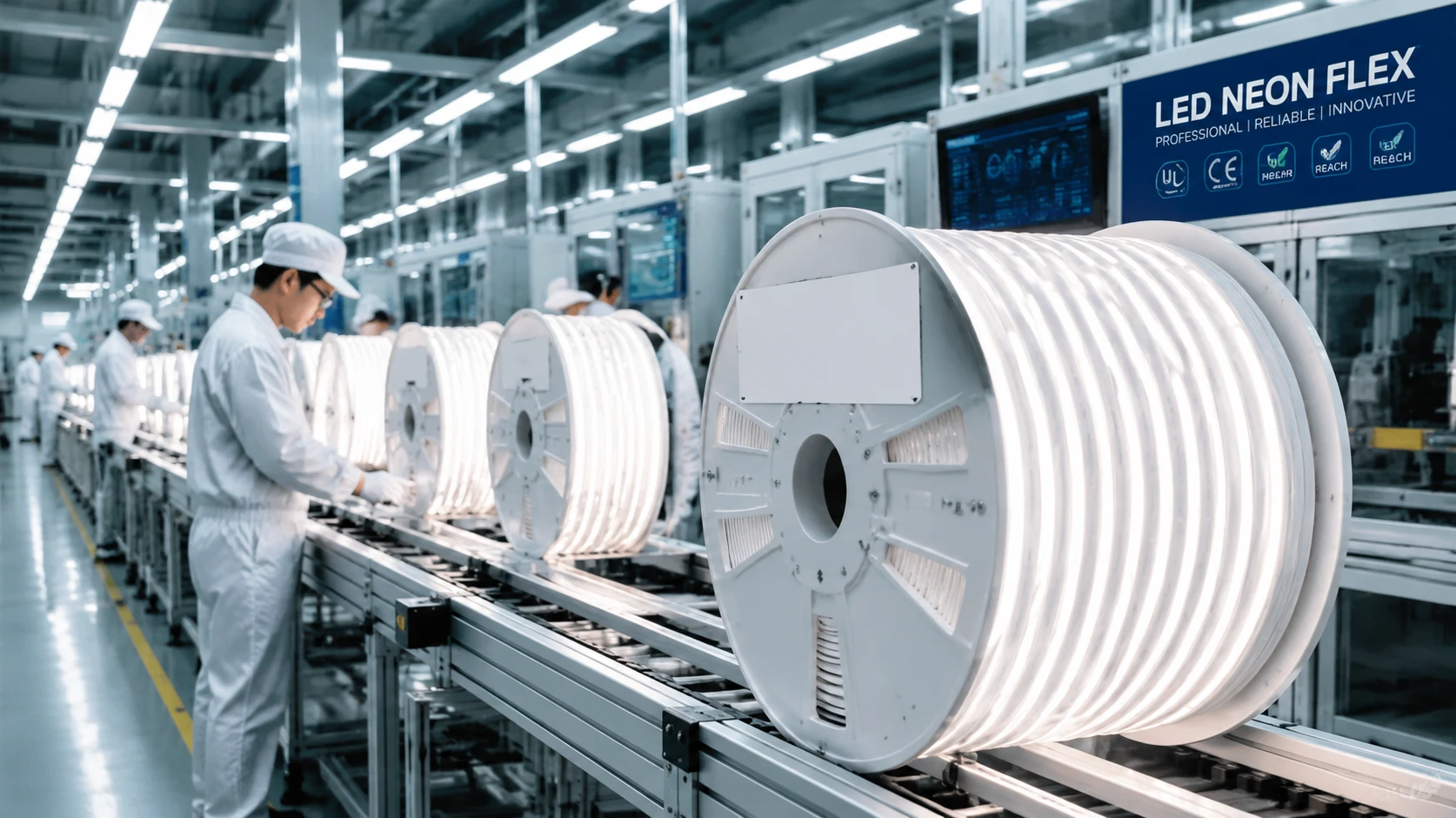
The life expectancy and visual quality of a neon cuttable strip light depend heavily on its outer insulation jacket. This casing must protect the inner light chips from bad weather while maintaining excellent light transmission.
Cheap manufacturing plants use Polyvinyl Chloride (PVC) plastic jackets because the raw material is inexpensive to source. However, PVC carries severe performance flaws. Under direct solar ultraviolet (UV) rays, the polymer chains inside PVC break down rapidly. Within 12 to 24 months, a PVC jacket turns a cloudy yellow color. This cloudiness blocks lumen output and ruins corporate brand colors. Even worse, UV-damaged PVC becomes highly brittle, cracking open under minor human touch or during freezing winter weather. When moisture crawls inside these cracks, the circuit shorts out immediately.
Premium neon silicone strip solutions use pure, gas-phase optical silicone. The chemical backbone of silicone features strong silicon-oxygen links. These links possess a much higher binding energy than the carbon links found in PVC. Because solar UV rays do not have enough energy to break these tough silicone bonds, the jacket stays perfectly clear, soft, and flexible for over a decade without yellowing. Furthermore, silicone resists graffiti cleaning chemicals, salt-air corrosion, and extreme temperatures ranging from -40°C up to 60°C, making it the ideal armor for outdoor architectural facades.
Building large-scale architectural borders or long storefront signs requires highly stable power flow. High-density linear systems need perfect current distribution to deliver continuous, uniform brightness from the first meter to the very end of the run.
Low-cost retail light lines use thin, 1-ounce copper layers inside their flexible circuits. When an installer twists or pulls these thin tracks around sharp structural corners, the copper paths face heavy mechanical stress. This stress leads to high electrical resistance. High resistance cuts the power reaching the far end of the run. As a result, a long linear run experiences severe voltage drop, causing the light to look dim, weak, or discolored at the end of the line.
Professional bulk spools utilize thick, 3-ounce rolled dual-copper Flexible Printed Circuit (FPC) boards. This heavy-duty copper thickness acts as an efficient electrical highway. It carries heavy currents easily over long continuous runs without losing power. This design ensures that your lighting asset stays bright and color-perfect from the initial power feed down to the final section, giving your project a premium, factory-grade finish.
A common headache for sign builders and architectural designers is handling tight typographical paths, such as the sharp curves in cursive lettering or intricate geometric brand borders. Standard retail light lines feature wide cut-points, often forcing users to cut only every 50mm or 100mm. This long spacing leaves workshops with extra lengths that cannot fit inside the designated channel. Workers must waste time trying to hide this extra material, or alter the original font design.
Choosing the best cuttable led neon strip lines solves this design roadblock completely. Advanced circuit engineering allows technicians to cut the media safely every 10mm to 25mm.
This short cutting resolution lets your team follow intricate vector shapes exactly as drawn in blueprints. You can trim the lines to fit tight spaces without leaving any dark gaps or dead material waste. It maximizes your material yield from every bulk roll purchased and ensures your final work matches the customer's corporate layout perfectly.
The Project Setting: In early 2026, an international transit authority started a massive upgrade on its main terminal wayfinding signs and emergency pedestrian paths. The project required miles of bright, continuous linear guidance lines installed along low-level concrete walls and beneath security handrails. The setting demanded an IP67 waterproof build to survive daily automated cleaning, an IK08 impact strength to handle heavy passenger luggage bumps, and clear daytime visibility.
The Initial Trial: The contracting group first tested standard PVC-jacketed linear lights to lower raw material costs. However, during early tests, the wide 50mm cut-points failed. Fabricators could not finish tight directional arrow graphics cleanly. Furthermore, the manual solder connections frequently cracked during structural vibration tests, causing an unacceptable 12% defect rate before field deployment.
The Professional Upgrade: The engineering board pulled out the cheap plastic media. They deployed premium cuttable silicone neon strips with connectors engineered with 3-ounce rolled dual-copper boards and solid co-extruded silicone jackets, supplied by THINK TEAM KING.
The Real-World Outcomes: The upgrade completely solved the transit hub's technical challenges. The ultra-short cutting resolution allowed workers to trace complex symbols and arrows perfectly, removing material waste. Because the solderless locking connectors replaced manual soldering, the workshop finished the assembly phase 45% faster, saving massive labor hours. The durable silicone housing passed all impact checks, dropping the system failure rate to absolute zero.
To protect your system hardware and keep your smart linear installations running perfectly for years, setup teams must follow three core protocols:
Verify Electrical Signals Before Final Sealing: Technicians must run a full circuit power check before mounting the neon strip inside its aluminum track. Confirm that all segments light up evenly. This quick check reveals any loose connector pins or alignment errors before the fixture is mounted high up on a building facade.
Respect the True Side-Bend Axis: Flexible silicone sleeves are built to bend smoothly along one specific directional axis. Do not force a side-bend tube to twist or curve upward against its shape. Forcing the material puts too much stress on the internal copper circuits, which can crack the electrical tracks and cause dead spots.
Seal Every Raw Cut Right Away: When cutting bulk spools down to custom project lengths, every raw end must be closed immediately. Use factory-matching endcaps and industrial silicone adhesive to seal the joints. Skipping this step allows outdoor humidity to creep inside the tube, which corrodes the circuits and shorts out the system.
How does the neon silicone strip price affect long-term project maintenance costs?
While the upfront neon silicone strip price is slightly higher than cheap PVC plastic options, it delivers much higher value over time. It completely prevents yellowing, cracking, and early product failures, saving your brand from expensive maintenance visits and early replacement costs.
Can these flexible silicone neon strips handle tight script lettering curves?
Yes. Because they use advanced 3-ounce rolled dual-copper PCBs and flexible gas-phase silicone, they bend tightly around sharp typographic corners and complex logos without cracking internal circuits or causing dark spots.
How does THINK TEAM KING support volume wholesale buyers with bulk signage materials?
THINK TEAM KING manufactures premium, heavy-duty linear lighting solutions and commercial-grade neon systems for global distributors, sign factories, and contracting groups. We build our high-density wholesale neon lines using certified 3-ounce rolled dual-copper circuit boards and ultra-short cut-points to ensure total design freedom and zero material waste. Every batch of our led neon lights lowers standby power, passes strict safety codes, and integrates perfectly with smart control networks. Whether you need massive container shipments of bulk spools or custom connector setups for premium branding projects, THINK TEAM KING provides robust systems built for your exact technical specs.
Evaluating commercial lighting materials proves that sourcing high-quality bulk reels is vital to protecting your profit margins and delivering clean brand displays. Cheap consumer choices look cost-effective upfront, but their wide cut-points, thin copper paths, and fragile connections cause high material waste and costly field repairs. Upgrading to high-density, short-interval silicone neon lines driven by robust constant-voltage networks and solderless connectors delivers a clean, factory-grade finish while cutting your workshop labor.
Are you running a busy sign fabrication shop? Or are you looking to update your wholesale distribution choices with certified, high-efficiency flexible light systems for corporate branding projects? Our engineering team is ready to provide custom wiring diagrams, specification sheets, and volume wholesale pricing built for your exact factory needs.

It provides all-round service for customers
and users 24 hours a day.
Enter your email for exclusive offers
and information on new upcoming products.


