


Time:2026-03-27
In the sophisticated landscape of the 2026 signage industry, the strategic shift toward low-voltage systems has fundamentally redefined how global brands interact with their physical environments. While 24V architectures and high-voltage (110V/220V) systems still serve specific large-scale architectural roles, 12V low voltage LED flex remains the undisputed gold standard for intricate, high-precision commercial displays. This preference is driven by a unique intersection of electrical safety, manufacturing versatility, and the demand for increasingly complex branding elements.
For professional business sign makers, the 12V platform offers a level of granular control that higher voltage systems simply cannot replicate. From the tightest bending radii required for cursive script to the ultra-short cutting intervals needed for miniature desktop logos, 12v low-voltage neon tube lights provide the technical agility necessary to bring a designer's most ambitious visions to life. Furthermore, as international safety regulations become more stringent, the inherent low-risk profile of 12V systems—which operate well below the threshold for electrical shock—has made them the preferred choice for high-traffic retail and hospitality environments.
This comprehensive guide explores the critical technical advantages, rigorous safety benchmarks, and nuanced engineering considerations that position neon flex 12v as the premier choice for modern commercial applications. We will dive deep into the science of voltage drop management, the benefits of advanced silicone extrusion, and the logistical efficiencies that allow THINK TEAM KING to deliver these high-performance components to projects worldwide, ensuring your brand’s first impression is both brilliant and technically sound.
In the competitive field of architectural lighting, the single greatest engineering advantage of 12V low voltage flexible neon strips is the remarkably short Cutting Unit. In high-end signage, every millimeter of light matters, and the ability to terminate a run exactly where the design dictates is what separates a professional installation from a DIY-quality project.
While 24V architectures have their merits in long-run applications, they typically suffer from cutting intervals ranging from 5cm to 10cm. In contrast, high-performance 12V systems allow for Cutting Marks as short as 1cm or 2.5cm. This four-to-tenfold increase in granularity provides sign makers with an unparalleled level of control over the lighting layout. When working with tight curves or small-scale branding, a 10cm cutting unit often forces the designer to choose between a sign that is "too long" for its frame or one that leaves an unsightly dark gap at the end of a letter.
For complex logos, sharp-angled modern typography, or miniature custom business signs, these short intervals allow for near-infinite design flexibility. Engineers can trim the neon flex with surgical precision to the exact edge of the vector artwork, effectively eliminating "dead zones" or inconsistent shadows at the terminal end of a stroke. This is especially critical for serif fonts or intricate cursive scripts where the "tail" of a letter must be perfectly illuminated to maintain brand legibility.
This meticulous level of precision is the defining characteristic of a masterpiece in architectural branding. By utilizing 12V low voltage flexible neon strips from a specialized manufacturer like THINK TEAM KING, designers can ensure that their client's vision is executed with 100% fidelity, creating a seamless, high-density glow that remains uniform from the first power injection to the very last centimeter of the sign.
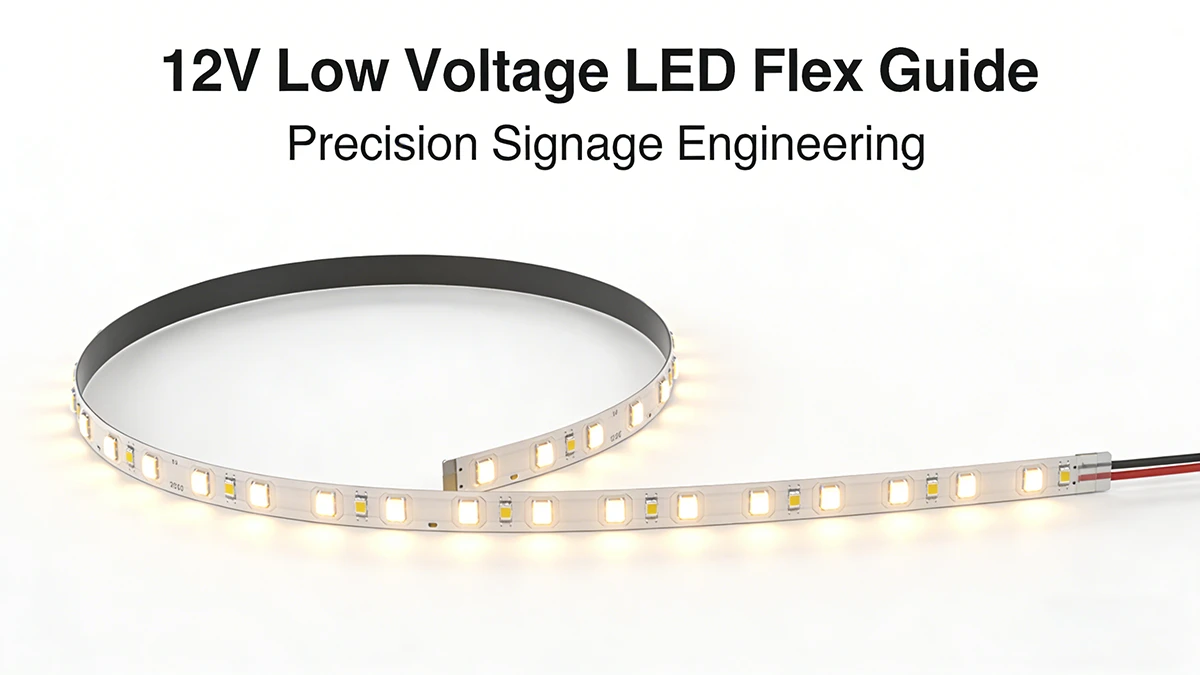
In the high-stakes world of commercial branding, choosing the correct voltage is not merely a technicality—it is a strategic decision that affects the aesthetic outcome, safety profile, and installation complexity of a project. To help procurement officers and specialized engineers make informed, data-driven decisions, we have compared the three primary voltage standards currently dominating the 2026 signage market.
| Feature | 12V Low Voltage LED Flex | 24V Low Voltage LED Flex | 110V/220V High Voltage |
| Min Cutting Unit | 1.0cm - 2.5cm (Best) | 5.0cm - 10.0cm | 50.0cm - 100.0cm |
| Safety Standard | Class 2 (Touch-Safe) | Class 2 (Safe) | High Risk (Shock Hazard) |
| Bending Radius | Very Tight (Intricate) | Moderate | Large (Building Outlines) |
| Thermal Output | Low-Moderate | Very Low | High |
| Voltage Drop | Sensitive (>5 Meters) | Moderate (>10 Meters) | Minimal |
When the objective is high-precision branding—such as intricate script fonts or miniature custom business signs—12V architecture is the undisputed champion. The 1.0cm to 2.5cm cutting unit allows for a level of surgical precision that 24V and high-voltage systems simply cannot replicate. In 24V systems, the longer 5cm–10cm cutting intervals often force designers to compromise on the symmetry of a logo or leave unlit "dead zones" at the ends of letters. High-voltage systems (110V/220V), while excellent for outlining massive skyscrapers, are virtually unusable for detailed indoor signage due to their massive 50cm–100cm cutting increments and inherent shock risks.
Furthermore, the 12V low voltage LED flex excels in the "Bending Radius" category. Its internal circuitry is engineered to handle tighter, more aggressive curves, which is essential for replicating the fluid motion of traditional hand-blown glass neon. From a safety perspective, 12V remains a "Touch-Safe" Class 2 technology. This allows for installation in public-facing "selfie corners" or low-level storefront displays without the need for the heavy, expensive protective conduits required by high-voltage alternatives. While engineers must account for a more sensitive voltage drop over 5 meters, the trade-off is a sign that is safer, more detailed, and far more representative of a premium brand's identity.
In the realm of high-end signage, electrical engineering is just as critical as visual design. While a 12V low voltage LED flex system is prized for its safety and versatility in creating intricate logos, it is physically more sensitive to electrical resistance than higher-voltage 24V alternatives. As current travels through the copper PCB of the strip, the voltage gradually "drops." Over a continuous distance exceeding 5 meters, this resistance leads to a visible decrease in brightness at the far end of the run—a phenomenon known as "dimming at the tail."
To maintain perfectly uniform luminosity across large-scale commercial installations, we recommend the "Double-Feed" technique. By injecting power from both ends of a 5-meter segment—effectively connecting both the beginning and the end of the strip to the transformer—you halve the distance the current must travel. This effectively counteracts the voltage drop inherent in neon flex 12v systems. This attention to electrical integrity ensures that your brand’s signature glow is just as vibrant in the middle of the sign as it is at the power source, providing a professional, flicker-free finish for years to come.
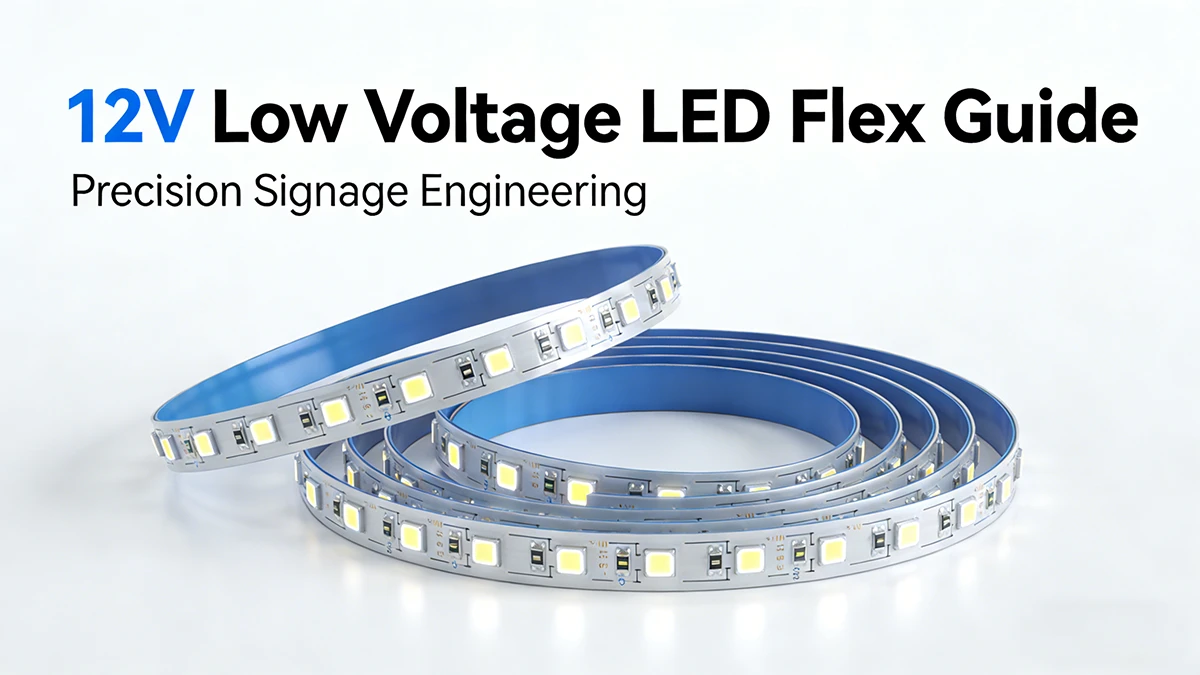
In the high-traffic environments of the hospitality and retail sectors, operational safety is a non-negotiable liability factor. When selecting a lighting system, the "touch-safe" nature of neon flex 12V is its most compelling commercial advantage. These systems fall under the internationally recognized Class 2 Safety Standards, as defined by UL 1310 and the National Electrical Code (NEC).
A Class 2 power circuit is specifically designed to operate at low voltage and limited power output to prevent both electrical shock and fire hazards. By operating at 12V DC—well below the 60V DC threshold for hazardous contact—these signs pose virtually zero risk of lethal electric shock. This is a critical safety feature for custom business signs outdoor or low-level indoor installations. Even in the event of accidental damage or vandalism where a wire might become exposed in a public space, the low-voltage output ensures the environment remains completely safe for curious children and pets. This "fail-safe" engineering significantly reduces the insurance liability for restaurant and bar owners.
From a project management perspective, the Class 2 designation is a massive logistical benefit. Because 12V systems are inherently safe, many local building codes do not require the same rigorous, expensive metal conduits or specialized high-voltage electrical inspections that are mandatory for 220V signage. This lack of "red tape" simplifies the installation process for your contractors and can drastically accelerate your project's "Go-To-Market" timeline.
By sourcing neon flex 12V components from THINK TEAM KING, you ensure that your signage meets these global compliance standards out of the box, providing peace of mind for your legal team and a safer experience for your customers.
In the engineering of high-performance signage, the choice of encapsulation material is just as critical as the internal circuitry. At THINK TEAM KING, we have moved beyond legacy plastics to utilize advanced Silicone Extrusion technology for all our 12V low-voltage neon tube lights. This material shift is not merely aesthetic; it is a fundamental requirement for the longevity of a 12V system.
From a physics perspective, 12V systems operate with higher current (Amperage) than 24V systems to achieve the same wattage. This increased current flow naturally generates more localized heat within the copper PCB. High-grade silicone possesses superior thermal conductivity compared to standard PVC. It acts as a highly efficient heat sink, effectively drawing thermal energy away from the LED chips and dissipating it into the surrounding air. This prevents the "heat-soak" effect—a primary cause of "Lumen Depreciation" where LEDs prematurely dim or shift in color due to thermal stress.
The chemical composition of silicone provides a level of environmental resilience that PVC simply cannot match. Silicone is inherently chemically inert and UV-stable, meaning it will not undergo the photo-degradation process that causes inferior plastics to turn yellow, chalky, or brittle after just 12 months of sun exposure.
Furthermore, our Silicone Extrusion process creates a monolithic, seamless bond around the light source. This ensures that our 12V low-voltage neon tube lights maintain their IP67 waterproof integrity even under extreme temperature fluctuations, ranging from $-40^\circ\text{C}$ to $150^\circ\text{C}$. While a standard PVC sign may fail or crack within two years, a silicone-encapsulated system from THINK TEAM KING is engineered to maintain its optical clarity and structural flexibility for over 50,000 operational hours, providing a significantly lower Total Cost of Ownership (TCO) for your B2B clients.
Flickering is almost always a diagnostic symptom of an overloaded transformer or compromised electrical integrity within your cabling. If the total wattage of your neon flex 12V installation exceeds the rated output of your 12v low voltage transformer, the power supply’s internal thermal protection will "hiccup"—tripping and resetting repeatedly as it struggles to regulate the load. To resolve this, ensure you are utilizing high-purity Oxygen-Free Copper (OFC) wiring. Unlike cheap Copper Clad Aluminum (CCA), which significantly increases electrical resistance and heat, OFC ensures a stable, flicker-free current. At THINK TEAM KING, we provide precision-matched power solutions to eliminate these common performance bottlenecks.
To maintain peak luminosity and prevent "voltage drop" before the current even reaches your 12V low voltage LED flex, professional engineers recommend keeping the lead wire under 3 meters. Because 12V systems are highly sensitive to electrical resistance, extending this distance without adjustments will lead to visible dimming. If your installation requires the 12v low voltage transformer to be placed further away, you must compensate by increasing the wire gauge—for example, upgrading from standard 18AWG to a thicker 14AWG or 12AWG cable. Using high-purity Oxygen-Free Copper (OFC) at these distances is essential to minimize resistance and ensure your brand's glow remains consistent from the power source to the sign.
From an engineering perspective, 12V low voltage LED flex lasts significantly longer than high-voltage alternatives. High-voltage (110V/220V) strips must convert AC to DC internally using miniature bridge rectifiers, which generates massive, concentrated heat within the confined silicone or PVC housing. This "thermal stress" rapidly degrades the LED chips and internal circuitry. In contrast, a 12V system utilizes an external 12v low voltage transformer to handle power conversion, allowing the strip itself to run much cooler. While 220V strips often fail or dim after 15,000 hours, a THINK TEAM KING 12V silicone system is engineered for 50,000+ hours of continuous commercial use, offering a vastly superior Return on Investment (ROI).
【Contact us to get a free quote】
Related Articles
12V Low Voltage Flexible Neon Strips: Safe, Versatile Illumination for Every Space

It provides all-round service for customers
and users 24 hours a day.
Enter your email for exclusive offers
and information on new upcoming products.


