


Time:2026-02-23
In the intricate world of lighting design, "bigger" is no longer synonymous with "better." As architectural trends shift toward minimalism and precision, the demand for Mini Neon Light solutions has skyrocketed. For factory-scale buyers, lighting distributors, and signage manufacturers, the challenge lies in finding ultra-slim lighting that maintains high luminosity without the dreaded "dotting" effect—all while fitting into the tightest of grooves.
At Think Team King (TTK), we specialize in micro-linear engineering. This guide serves as a technical deep dive for B2B procurement professionals looking to master the nuances of sourcing high-performance, small-form-factor neon lighting.
The standard 15mm or 12mm neon flex is often too bulky for high-end cabinet lighting, intricate channel letters, or automotive interior accents. This is where the Mini Neon Light takes center stage. By reducing the PCB width and the silicone jacket profile, manufacturers can now offer lighting that is as thin as a pencil but as bright as a spotlight.
For a B2B buyer, the "Trust Anchor" here is the density of the LEDs per meter. In a tiny mini neon light, you need at least 120 to 180 LEDs per meter to ensure that the diffusion is perfectly smooth. Without this density, the light looks fragmented, which is a major "red flag" for luxury retail or hospitality projects.
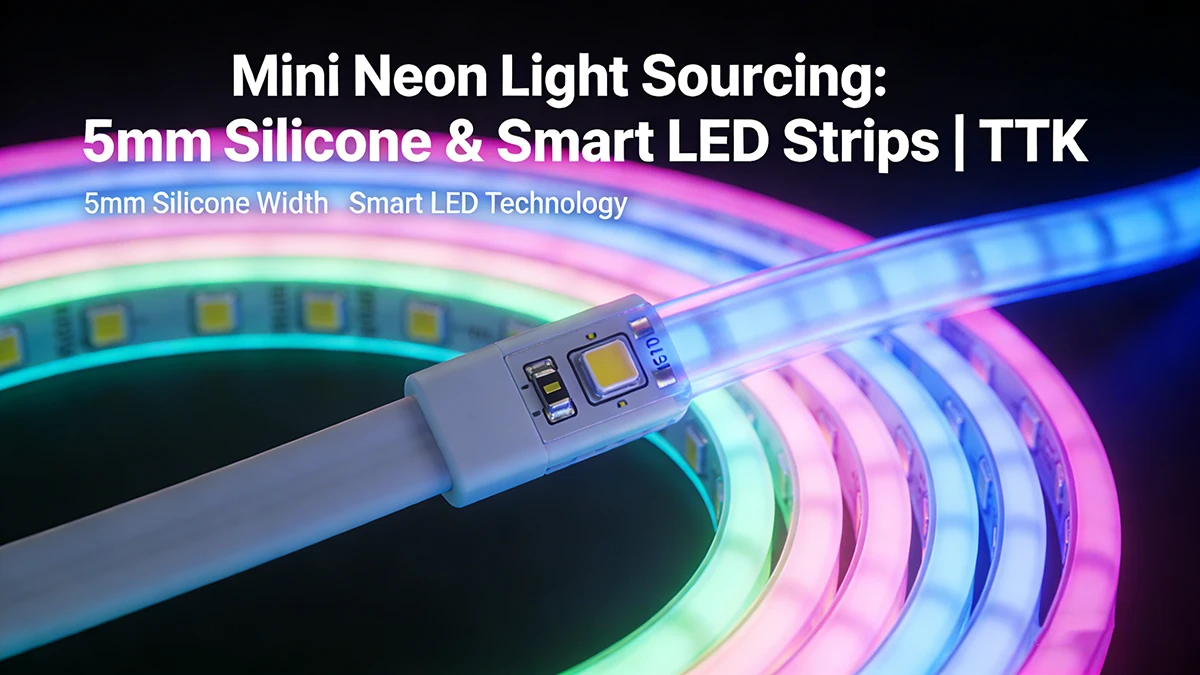
A common question in the procurement phase involves comparing Govee stripe lights vs neon lights. While Govee is a household name for DIY enthusiasts, it often falls short in factory-scale or commercial applications.
| Feature | Govee / Consumer Strips | Industrial LED Neon Lights Strips (TTK) |
| Material | Mostly PVC or thin Plastic | Food-grade High-Density Silicone |
| Diffusion | Visible "dots" or hotspots | 100% Dot-Free uniform glow |
| Voltage Drop | High (dimmer at the end of the run) | Constant current ICs for long runs |
| Durability | Fragile, indoor use primarily | Heavy-duty, UV-resistant, IP67+ |
For a mini smart neon light installation, industrial-grade products offer Zigbee or DMX512 compatibility, whereas consumer brands are limited to basic App control which lacks the stability needed for large-scale building automation.
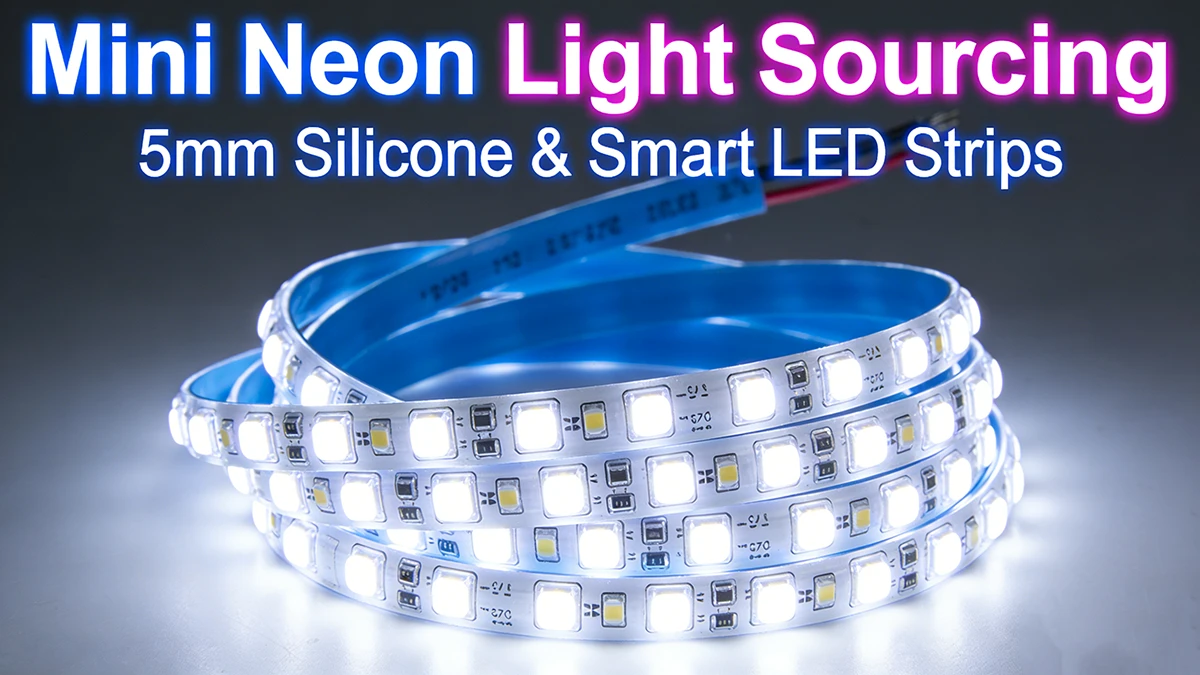
The 5mm silicone neon light strip represents the pinnacle of micro-manufacturing. Why 5mm? This specific width allows for a bending radius that can accommodate sharp angles in calligraphy and complex brand logos.
Thermal Stability: 5mm strips generate heat in a concentrated area; silicone dissipates this heat 3x faster than PVC.
Flexibility: It won't crack or yellow even in extreme temperatures ($-40^\circ C$ to $200^\circ C$).
Chemical Resistance: Essential for neon light mini golf or minigolf wien style installations where floor cleaners and humidity are constant.
The shift toward "intelligent" spaces has birthed the mini smart neon light. These are not just static tubes; they are data-driven assets.
Using a mini neon light multicolored system allows a single installation to serve multiple purposes. A retail store can shift from "Cyber Monday" reds to "Spring Collection" pastels via a mini neon light rope controller.
In the entertainment sector, mini golf neon lights are used to define boundaries and hazards. Because space is tight on a mini-golf course, a tiny mini neon light is required to be recessed into the turf or wood. Similarly, in the promotional world, creating a minion neon light or character-based mascot requires the ultra-flexibility that only a 5mm or 8mm profile can provide.
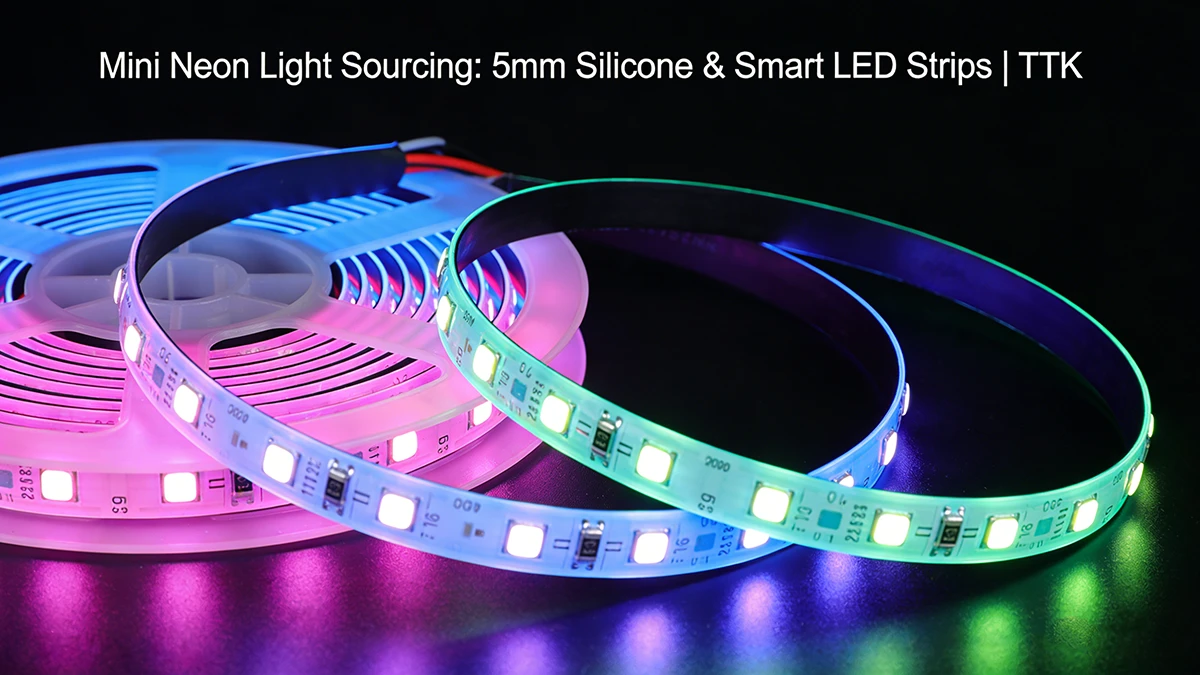
In the B2B procurement world, the "skin" (the outer silicone) is what gets noticed, but the "innards" (the electronic architecture) are what determine your ROI. When sourcing a mini neon light, the difference between a project that lasts five years and one that fails in five months lies in two critical components: the light source and the circuit foundation.
The term mini neon light bulb in the modern LED era refers to the Surface Mounted Device (SMD) chips. For ultra-slim profiles like the 5mm silicone neon light strip, space is limited, meaning each chip must work harder and more efficiently.
Brand Authority: We strictly utilize Epistar (Taiwan) or San’an (Industry Leader) high-lumen chips. These brands are the "Trust Anchors" of the lighting world, offering superior thermal stability and a Color Rendering Index (CRI) of >90.
Lumen Efficiency: High-quality chips ensure that even a tiny mini neon light can output significant brightness without requiring excessive power, which prevents the silicone from overheating and yellowing over time.
Consistency: Top-tier chips undergo rigorous "binning," ensuring that if you buy 1,000 meters of mini neon light multicolored strips, the "Red" on the first meter perfectly matches the "Red" on the last.
The "Micro-Rope" refers to the internal led neon lights strips that carry the current. For mini neon light rope applications, the Flexible Printed Circuit Board (FPCB) is the most common point of failure for low-quality suppliers.
The 2oz Standard: Many "budget" suppliers use 0.5oz or 1oz copper. For a mini neon light, this is a recipe for disaster. We use a minimum of 2oz rolled-annealed copper.
Preventing Voltage Drop: Thicker copper reduces electrical resistance. This ensures that the brightness remains uniform from the power input to the end of the run, preventing the "tail-end dimming" that plagues cheap mini neon light bulb installations.
Heat Dissipation: Copper acts as a heat sink. In the confined space of a mini smart neon light, 2oz copper draws heat away from the SMD chips, effectively doubling the lifespan of the product.
Poor current flow is the silent killer of commercial lighting projects. When an FPCB is too thin or the chips are sub-par, the strip experiences localized "hot spots." This leads to the Decision-Maker's Nightmare: a flickering or burnt-out section in the middle of a permanent architectural installation.
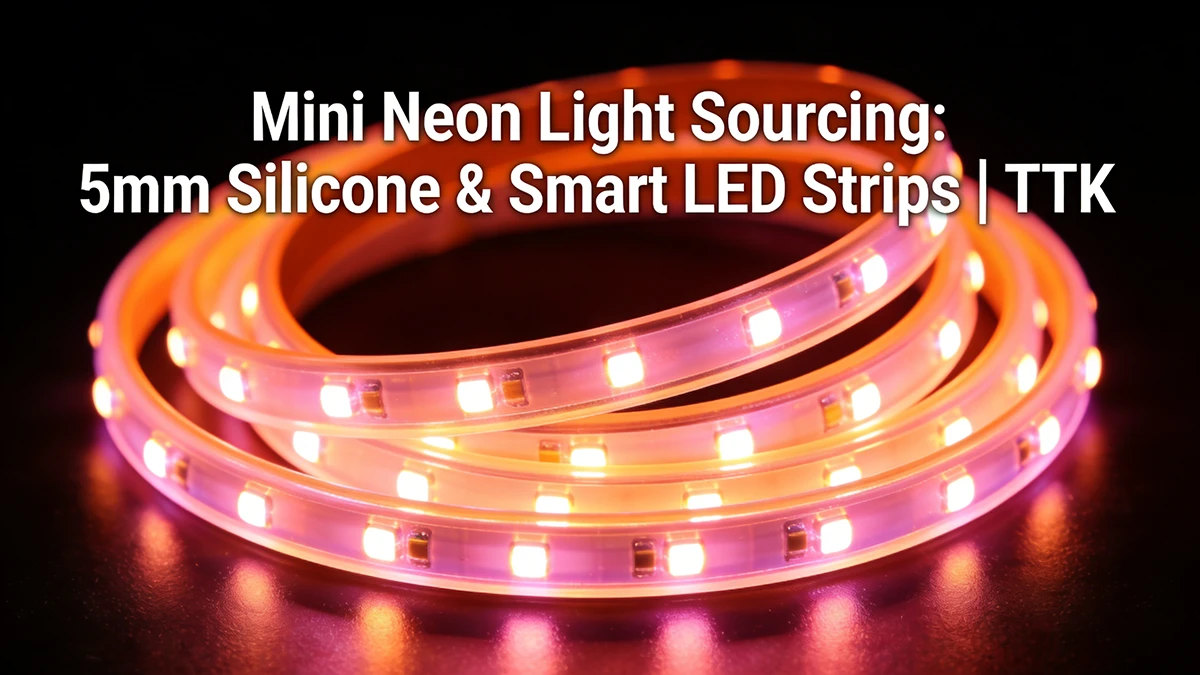
In the world of B2B procurement, there is a common misconception that "miniature" means "fragile." However, for factory-scale applications—ranging from marine interior accents to high-traffic neon light mini golf courses—the structural integrity of a mini neon light is even more critical than its larger counterparts. Because the surface area is smaller, the internal components are under higher thermal and physical stress.
At Think Team King (TTK), we redefine the "Heavy Duty" label. To us, a heavy duty LED neon flex in a 5mm profile isn't just a marketing term; it is a technical promise backed by a rigorous "Trust Foundation" of industrial testing.
For European neon light distributors or coastal project managers, the air is a silent enemy. Even a tiny mini neon light used in an outdoor signage project must withstand saline environments.
The Process: Our 5mm silicone neon light strip undergoes a 72-hour neutral salt spray test (NSS).
The Goal: To ensure that the electrical connections and the silicone jacket do not degrade or oxidize. This makes our mini neon light rope suitable for luxury yacht interiors and beachfront storefronts where standard PVC products would fail within months.
Mini neon light multicolored systems are frequently used in the event rental and exhibition industry. These lights are transported, coiled, and uncoiled repeatedly.
The Process: We subject our led neon lights strips to high-frequency vibration testing to simulate rough transit and mechanical stress.
The Result: By reinforcing the solder joints with high-tensile 2oz copper FPCB, we ensure the mini smart neon light remains 100% functional even after being shipped halfway across the globe or used in a high-vibration environment like a neon light minigolf wien venue.
The "Decision-Maker's Nightmare" is a dead section appearing 48 hours after a project is completed.
The Process: Every batch of mini neon light bulb components and finished rope is subjected to a continuous 48-hour burn-in test at 110% of its rated voltage.
The Goal: This stress test identifies any "weak links" in the LEDs or circuitry before the product leaves the commercial led neon rope light factory. If a strip can survive our burn-in rack, it will survive the most demanding commercial environments.
A heavy duty LED neon flex must maintain its "Dot-Free" aesthetic over time. While cheap PVC-based mini neon light rope will yellow and become brittle under the sun or when exposed to cleaning chemicals, our food-grade silicone maintains a 95% light transmission rate after 5 years of UV exposure.
These are Ingress Protection ratings.
IP65: Splash-proof, suitable for indoor areas with high humidity.
IP67: Fully waterproof against heavy rain and temporary immersion.
IP68: Submersible, ideal for pools or mini golf neon lights in water-hazard areas.
At Think Team King, we provide IP67 as a standard for all our led neon lights strips.
Yes, provided they are made of silicone and sealed with professional-grade end caps. PVC strips tend to expand and contract, which eventually breaks the waterproof seal. Our silicone 5mm silicone neon light strip is chemically bonded to ensure it remains "truly" waterproof for years.
Absolutely. Most mini neon light products have clear cutting marks (usually every 1cm to 5cm depending on the voltage). This allows you to tailor the mini neon light rope to the exact dimensions of your cabinet or signage.
Industrial-grade silicone neon flex is virtually maintenance-free. It is "self-cleaning" to an extent because its anti-static coating prevents dust buildup. A simple wipe-down with water once a year is usually sufficient.
It refers to the structural integrity of the strip. It means the led neon lights strips utilize a thicker PCB, high-grade SMD chips, and premium silicone that can withstand physical impact and extreme UV exposure without degradation.
【Contact us to get a free quote】
Related Articles
Decorative Neon Lights for Stylish Interior and Ambient Lighting
Mini Neon Light Manufacturer | High-Precision LED Neon Tubes | TTK
Mini Neon Lights: Compact Brilliance for Modern Design and Branding

It provides all-round service for customers
and users 24 hours a day.
Enter your email for exclusive offers
and information on new upcoming products.


