


Time:2026-07-31
In the hyper-competitive landscape of modern brick-and-mortar retail, the storefront window display serves as the primary physical conversion touchpoint between a brand and potential customers. With global retail brands and commercial real estate developers competing fiercely for shopper attention in high-footfall shopping malls, luxury fashion avenues, and urban centers, static window graphics and traditional overhead spotlights are no longer sufficient to drive store traffic.
To capture consumer visual interest in brightly lit shopping environments, commercial visual merchandisers, store designers, and sign manufacturers are shifting toward continuous, high-luminance illuminated branding solutions.
At the center of this commercial visual transformation is high-impact neon signage for retail storefronts. Replacing fragile, high-voltage glass neon tubes with engineered optical silicone extrusions, precision CNC-routed cast acrylic backings, and low-voltage surface-mount technology (SMT) LED arrays, modern flexible neon signage delivers brilliant, uniform illumination with zero dark spots.
However, specifying and deploying commercial-grade storefront neon signage across nationwide chain rollouts, flagship luxury boutiques, or shopping center facades involves complex engineering requirements. Issues such as daytime glare contrast, thermal dissipation inside glass display windows, UL safety code compliance, acrylic UV stabilization, and automated brightness control require rigorous technical planning.
Partnering with an asset-heavy manufacturer like THINK TEAM KING (TTK LED Neon) gives commercial brand managers, procurement directors, and custom sign makers access to factory-engineered low-voltage neon systems built to exceed global retail performance standards.
Achieving visual dominance in a retail storefront window display requires balancing sign luminance against ambient outdoor solar illuminance and indoor display lighting.
A common point of failure in low-cost retail signage is optical glare and sunlight washout. Direct solar radiation striking a glass display window can generate ambient light levels ranging from 5,000 Lux on overcast days up to 80,000 Lux under direct afternoon sunlight. Behind double-glazed window glass, ambient display window light routinely measures between 3,000 Lux and 10,000 Lux.
If a storefront sign lacks sufficient luminance (measured in candelas per square meter, or cd/m², commonly called Nits), the brand logo appears dim, muddy, or unlit against ambient daytime glare.
To overcome glass reflection and high ambient light levels, high-impact neon signage for retail storefronts engineered by TTK LED Neon utilizes high-density SMT LED arrays (up to 120 or 140 LEDs per meter) combined with high-transmittance optical silicone diffusers. This setup achieves a surface luminance rating of 2,000 to 3,500 cd/m², ensuring high visual contrast and crisp logo legibility even under direct daytime solar exposure.
In commercial visual merchandising, the visual impact of illuminated signage is defined by the Weber-Fechner Luminance Contrast Ratio (CL):
CL = (L_sign - L_background) / L_background
Where:
L_sign is the surface luminance of the illuminated neon sign (in cd/m²).
L_background is the ambient background luminance reflected off the display window backing or interior store wall (in cd/m²).
To capture the attention of pedestrians walking past at speeds of 1.2 to 1.5 meters per second, visual merchandising standards require a minimum Luminance Contrast Ratio (CL) of 3.0:1 for indoor mall displays and 5.0:1 or higher for street-level exterior storefront windows. TTK LED Neon's engineered optical profiles consistently deliver contrast ratios exceeding 6.5:1 under standard ambient daylight conditions.
For flagship retail rollouts, corporate brand logos must display exact color accuracy across every store location globally. Low-grade commercial light strips often display noticeable color variations between production batches, leading to brand mismatch across adjacent window displays.
TTK LED Neon enforces strict 3-step MacAdam Ellipse spectroradiometric binning aligned with the CIE 1931 Chromaticity Diagram. By pairing custom phosphor-binned LED chips with color-pigmented gas-phase silicone jackets, our retail neon signs guarantee a Delta E threshold under 1.5.
Furthermore, with a Color Rendering Index rating of CRI greater than 90 (Ra) and R9 greater than 50, our signs illuminate store window product displays without casting harsh monochromatic color distortion onto surrounding merchandise.
The structural foundation of commercial storefront neon signage relies on the backing substrate that supports the flexible silicone light engine. The choice of polymer backing directly influences optical clarity, structural rigidity, flame resistance, and long-term yellowing.
Many low-cost sign suppliers use extruded acrylic backings to minimize material costs. However, extruded acrylic suffers from high internal molecular stress, lower impact strength, and rapid yellowing when exposed to solar UV radiation behind display windows.
TTK LED Neon manufactures all retail storefront signage backings exclusively using 100% virgin Cell-Cast PolyMethyl MethAcrylate (PMMA) acrylic.
| Material Parameter | Extruded Acrylic Substrate | TTK Cell-Cast PMMA Acrylic | Impact on Retail Sign Performance |
| Light Transmission Efficiency | ~86% to 88% | 92.5% to 93.0% | Higher optical transparency for crystal-clear floating effects |
| Heat Distortion Temp (HDT) | ~75°C to 80°C | 95°C to 105°C | Prevents board warping in hot glass display windows |
| Tensile Strength (ISO 527) | 60 MPa | 75 to 80 MPa | High resistance to bending and cracking during shipping |
| UV Resistance & Yellowness Index | Yellows within 12–18 months | less than 1.0 Delta YI over 10 Years | Maintains crystal clarity without solar discoloration |
| Laser Cutting Edge Quality | Rough, micro-fissured edges | Flame-polished flame edge | Premium, glass-like aesthetic for luxury retail stores |
To secure flexible silicone neon tubes onto an acrylic backing without messy topical glues or visible mounting clips, TTK LED Neon utilizes high-precision 5-axis CNC routing equipment.
Tolerance Control: Channels are milled with a tight dimensional tolerance of ±0.05 mm, creating an exact friction-fit channel that holds the silicone profile securely in place.
Structural Undercutting: Specialized dovetail and undercut CNC router bits create mechanical interlocks that capture the silicone base, eliminating adhesive off-gassing and visible glue smears.
Cable Channel Concealment: Secondary rear-side CNC routing mills hidden cable raceways into the back of the acrylic. Conductor wires are laid flat within these channels and back-filled with clear optical resin, yielding a completely flush rear surface with no exposed wiring.
For large window displays where neon signs are suspended from ceiling tracks via stainless steel aircraft cables, calculating mechanical panel flexure is vital to prevent acrylic fracture over time.
Maximum center deflection (δ_max) for a horizontally suspended rectangular acrylic sign panel under uniform self-weight load is calculated using thin-plate deflection mechanics:
δ_max = (α * q * b^4) / (E * h^3)
Where:
q is the distributed surface load per unit area (N/m²), including acrylic weight and mounted neon flex.
b is the short-side width of the acrylic sign panel (meters).
E is the Flexural Modulus of Elasticity of cast PMMA (3.1 × 10^9 Pa).
h is the thickness of the acrylic backing plate (meters, typically 5 mm, 8 mm, or 10 mm).
α is a non-dimensional panel aspect ratio coefficient.
By selecting optimal plate thicknesses (h ≥ 8 mm for spans over 1.2 meters) and placing cable mounting points at calculated nodal locations, TTK LED Neon ensures center deflection (δ_max) stays well under 2.0 mm, preventing optical distortion or mechanical stress fractures.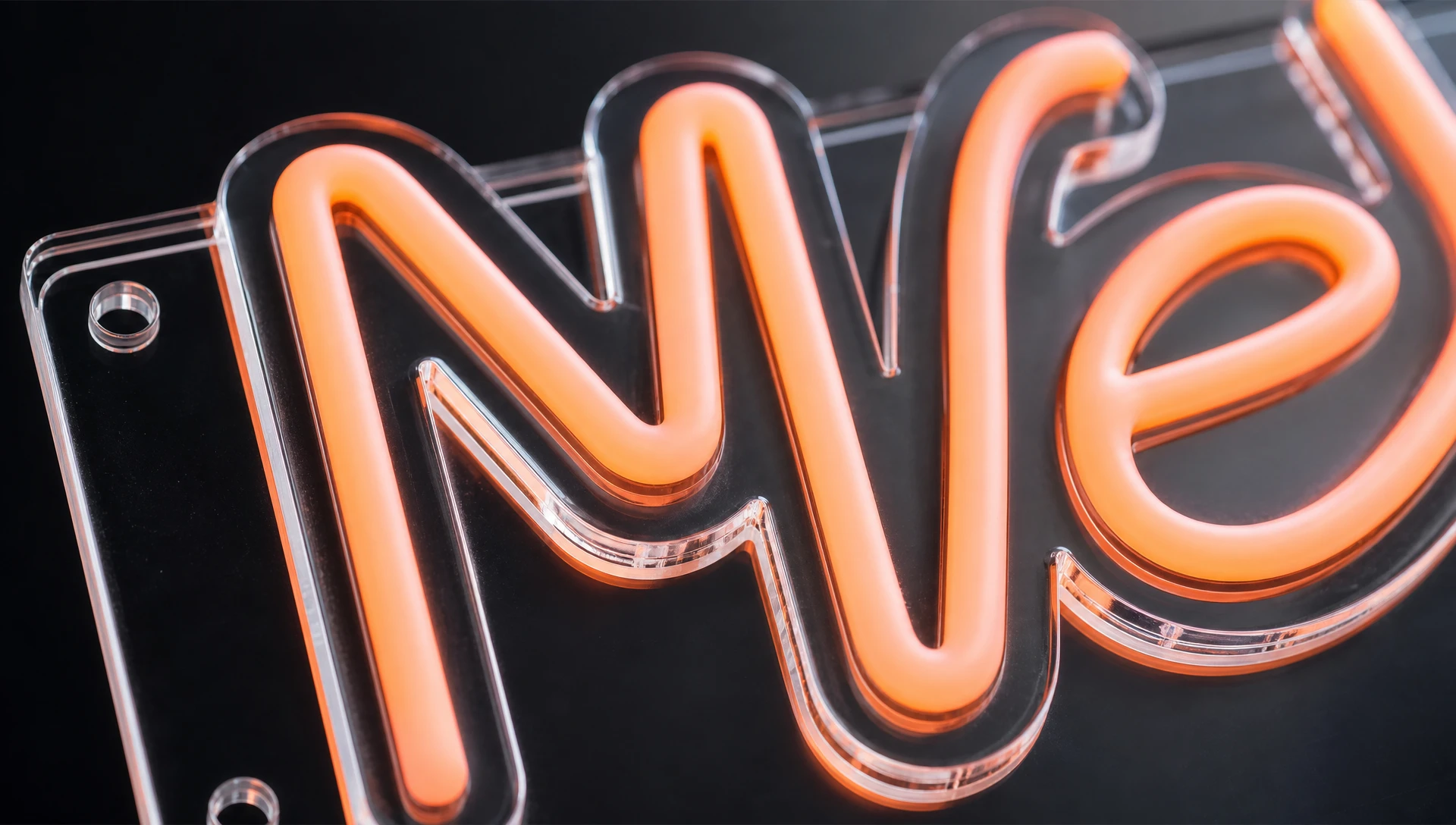
Deploying high-impact neon signage for retail storefronts within commercial shopping malls, airport retail zones, and municipal commercial districts requires strict adherence to international electrical safety and building codes.
Legacy high-voltage glass neon signs require step-up transformers generating between 5,000 Volts and 15,000 Volts AC. These high voltages present severe electrical shock hazards, electrocution risks, and fire hazards. As a result, commercial building managers and shopping mall operators strictly regulate or prohibit high-voltage installations.
TTK LED Neon's commercial signage assemblies comply fully with:
UL 2108 (Low Voltage Lighting Systems): Standard covering low-voltage luminaire assemblies, supply connections, and mounting hardware operating at 30V RMS / 60V DC or less.
UL 8750 (Light Emitting Diode Equipment for Use in Lighting Products): Standard regulating the safety of LED light sources, driver electronics, thermal performance, and electrical insulation.
Sign Accessories Manual (SAM) Listing: All internal LED drivers, interconnect cables, and terminal blocks are UL SAM-recognized, streamlining electrical inspections for commercial contractors.
To meet national electrical codes (such as NFPA 70 / National Electrical Code Article 725), all TTK LED Neon storefront signage operates on Class 2 Power Units:
Maximum Voltage Output: 24V DC regulated constant voltage.
Maximum Power Output: Limited to 100 Watts per output channel.
Overcurrent Protection: Integrated auto-resetting electronic short-circuit, over-voltage, and thermal shutdown protection.
Operating within Class 2 power limits eliminates the need for grounded metal conduit enclosures inside window display cases, allowing clean, low-profile power connections that comply with commercial building codes.
Enclosed retail display windows facing direct sunlight can reach internal ambient temperatures of 55°C to 70°C during summer months. If an LED sign lacks adequate thermal management, high junction temperatures (Tj) accelerate lumen depreciation, cause color shifts, and lead to premature driver failure.
TTK LED Neon solves thermal challenges through a three-part heat dissipation engineering strategy:
Heavy-Copper Printed Circuits: FPCs manufactured with 3-ounce double-sided rolled annealed copper rapidly conduct thermal energy away from LED semiconductor junctions across the entire length of the sign.
Thermally Conductive Silicone Matrix: Gas-phase silicone formulations infused with thermal dissipation micro-fillers yield a thermal conductivity rating of K greater than 0.8 W/m·K, transferring heat outward toward the environment.
Low Operating Junction Temperatures: Keeping operational LED junction temperatures below Tj less than 65°C ensures an extended operational lifespan exceeding 50,000 hours (L70B10), retaining over 70% of initial light output after five years of continuous commercial operation.
High-end retail merchandise—such as designer apparel, cosmetics, leather goods, and fine artwork—degrades quickly when exposed to ultraviolet (UV) or infrared (IR) radiation. UV light breaks down chemical dyes causing severe color fading, while IR thermal radiation dries out leather and warps cosmetic packaging.
Unlike halogen spotlights or fluorescent fixtures, TTK LED Neon's solid-state LED extrusions emit a clean, narrow visible spectrum with zero UV output (less than 380 nm) and zero IR thermal radiation (greater than 780 nm). Retail visual merchandisers can safely position illuminated signs directly adjacent to delicate luxury inventory without risking product damage.
Modern commercial retail locations rely on automated Store Energy Management Systems (EMS) and centralized Building Management Systems (BMS) to optimize electrical loads, adjust store lighting dynamically based on time-of-day, and manage operational costs.
To integrate effortlessly into corporate retail lighting infrastructure, TTK LED Neon's power conversion units support industry-standard control protocols:
DALI-2 (Digital Addressable Lighting Interface - IEC 62386): Enables individual addressability for every window sign. Store managers can monitor operating hours, diagnostic fault codes, and actual power usage remotely from corporate headquarters.
0-10V / 1-10V Analog Dimming: Compatible with standard commercial wall dimmers, occupancy sensors, and centralized lighting panels (such as Lutron Quantum, Crestron, or Schneider EcoStruxure).
16-Bit Resolution PWM Dimming: High-frequency pulse-width modulation operating between 2,000 Hz and 4,000 Hz guarantees smooth dimming curves from 100% down to 0.1% without flicker, step-jumping, or color shifting.
To balance daytime visual impact with night-time energy conservation, TTK LED Neon signage systems support ambient light sensor (photocell) feedback loops:
Daytime Mode (100% Luminance): Operates at maximum light output (3,000+ Nits) during peak solar hours to cut through glass glare and draw street traffic.
Overcast / Dusk Mode (40% to 60% Luminance): Automatically scales back brightness as natural daylight fades, saving energy while maintaining visual balance.
Night-Time Storefront Mode (15% to 20% Luminance): Lowers output to an elegant, glare-free accent level (400 to 600 Nits) after store closing hours, reducing energy consumption by up to 80% while keeping brand logos illuminated for night-time foot traffic.
For corporate procurement directors, visual merchandising agencies, and sign manufacturers, managing nationwide or global retail store rollouts requires a reliable manufacturing partner capable of maintaining strict quality control across large volumes.
A critical challenge in global retail signage rollouts is shipping fragile acrylic signs directly to hundreds of retail store locations without transit damage. Standard cardboard boxes often lead to broken acrylic corners and damaged wiring connections during parcel freight transport.
TTK LED Neon engineers customized ISTA-2A drop-test certified flat-pack transit packaging for every custom sign layout:
CNC-Milled High-Density PE Foam Cradles: Every sign is nested inside custom-milled polyethylene foam inserts that support all edges and isolate delicate acrylic cutouts.
Heavy-Duty Honeycomb Outer Cartons: Encased in 15mm thick double-wall corrugated honeycomb cardboard boxes capable of withstanding edge crush loads up to 220 lbs/in (15 kg/cm²).
Flat-Pack Drop Shipping: Designed for compact parcel shipping directly to individual retail store managers, complete with pre-assembled mounting hardware, template installation sheets, and quick-connect power supplies.
For massive exterior storefront facades or multi-meter mall entrance portals that exceed standard acrylic sheet sizes (1.2m × 2.4m), TTK LED Neon engineers modular interlocking panel connection systems:
Laser-Cut Puzzle Interlocks: CNC-machined seams fit together with tight mechanical tolerances, rendering panel joins nearly invisible once illuminated.
Pre-Wired Quick-Connect Jumpers: Internal electrical buses connect using factory-molded IP67 push-lock terminal jumpers, allowing installation crews to assemble multi-meter sign arrays without soldering on-site.
As an asset-heavy manufacturer with deep engineering capacity, THINK TEAM KING (TTK LED Neon) provides complete white-label customization services for commercial sign builders and global retail franchises:
Custom Pantone / RAL Acrylic Tinting: Factory matching of acrylic backing plates and optical silicone jackets to match exact corporate brand guidelines.
Custom Mounting Brackets: Pre-supplied stainless steel standoff posts, ceiling-hanging wire kits, or hidden French cleat brackets tailored to specific store construction shop drawings.
White-Label Packaging & Custom Branding: Neutral packaging, custom-printed installation manuals, and factory-applied private brand labels for commercial sign distributors.
We enforce strict 3-step MacAdam Ellipse spectroradiometric color binning on all LED arrays, paired with custom phosphor-matched gas-phase silicone jackets. Every manufacturing lot is verified with a professional spectroradiometer to guarantee a Delta E threshold under 1.5 (Delta E less than 1.5), ensuring complete visual color consistency across every store location globally.
All TTK LED Neon storefront signage assemblies are constructed using Class 2 low-voltage (24V DC) electrical layouts, UL 94 V-0 flame-retardant silicone profiles, and virgin cast PMMA acrylic backings. Our systems carry full CE, RoHS, UL 2108, and UL 8750 certifications, ensuring smooth approval by shopping mall management, commercial building inspectors, and local fire marshals.
Yes, absolutely. Our high-impact storefront signage is built specifically for direct solar exposure. We utilize 100% gas-phase optical silicone extrusions combined with UV-stabilized cell-cast PMMA acrylic backings that resist yellowing (Delta YI less than 1.0 over 10 years). Combined with heavy-copper 3-oz FPCs that dissipate heat quickly, our signs maintain stable operation even in enclosed window displays reaching 60°C ambient temperatures.
Deploying high-impact neon signage for retail storefronts across your retail chain, commercial shopping center, or brand network delivers a powerful combination of daytime visual contrast, low-voltage safety, and long-term energy efficiency. Sourcing directly from an established B2B manufacturer like TTK LED Neon guarantees high manufacturing precision, full international safety compliance, factory-direct wholesale pricing, and dedicated engineering support.
Are you preparing to launch a commercial retail rollout, specify illuminated window signage, or request custom factory samples for an upcoming project? Our experienced engineering team is ready to assist you with structural shop drawings, photometric calculations, UL compliance support, and custom OEM/ODM production.

It provides all-round service for customers
and users 24 hours a day.
Enter your email for exclusive offers
and information on new upcoming products.


