


Time:2026-05-25
The global decorative and architectural lighting market is changing fast. Today, commercial property developers, retail brand managers, and electrical contractors face a critical decision. They must choose between mass-market consumer smart lights and professional engineering solutions.
This technical comparison analyzes Govee App Control vs Neon Light Customization Flexibility. It will help international B2B buyers choose the right system for large-scale installs.
For simple retail windows or homes, consumer smart lights offer a quick, plug-and-play setup. However, major engineering projects and high-end hospitality hubs require strict physical durability. They also need precise cut-to-length options and open automation features. This deep guide breaks down the technical specs, material science, and long-term costs of both options.
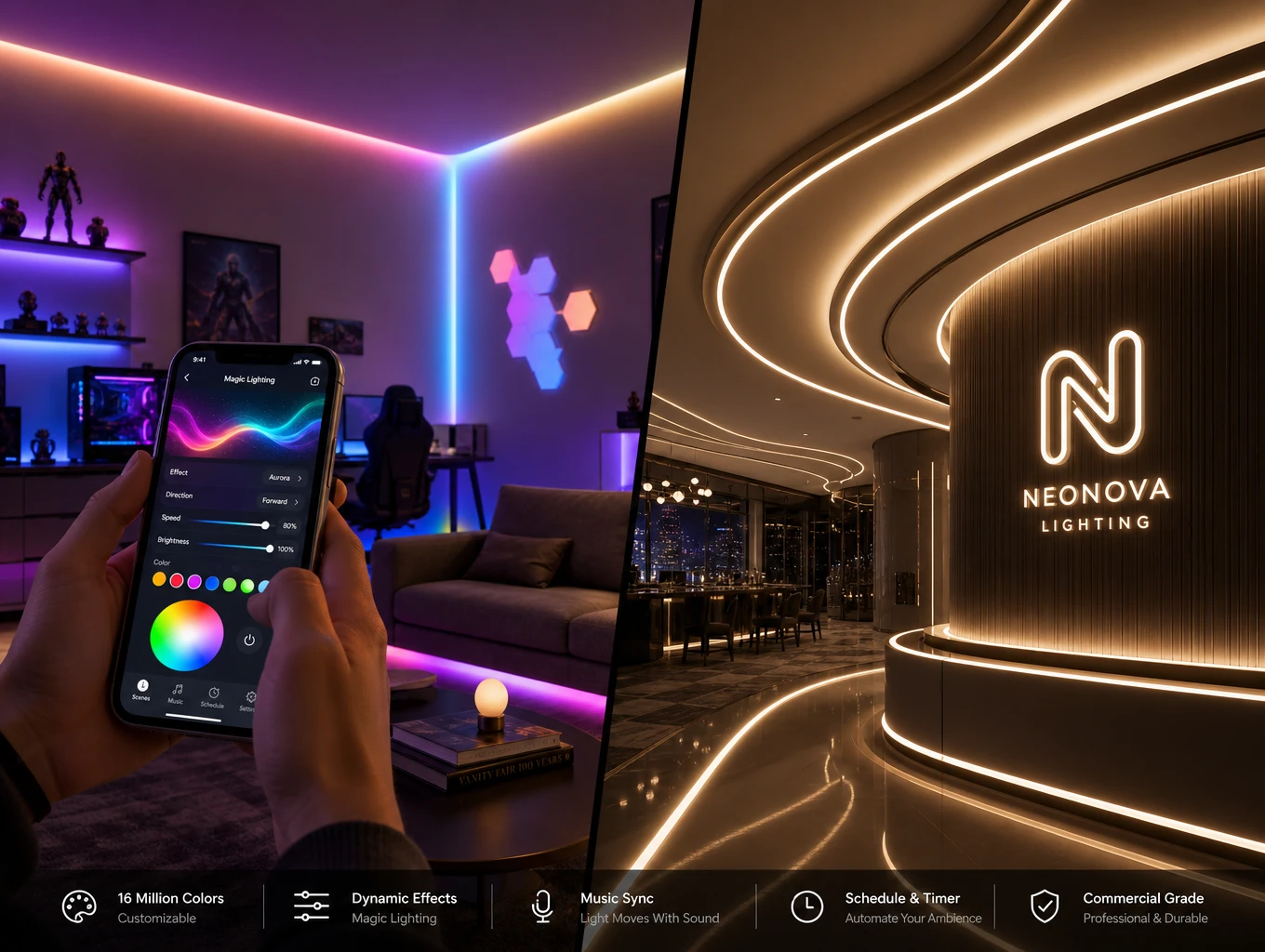
To make a smart procurement decision, technical buyers must understand the design ideas behind these two product groups.
Systems that rely on app-based management prioritize software features over physical versatility. These products integrate standard light-emitting diodes into pre-set, fixed lengths. The primary selling point is wireless convenience. Users can control color-changing modes and music sync via Wi-Fi or Bluetooth. While this setup is great for home users, it severely limits physical adaptation during a commercial field installation.
In contrast, engineering-grade flexible systems prioritize physical layout, material endurance, and system integration. These lighting solutions are built for structural adaptation. Installation crews can cut, splice, and bend the hardware to match complex architectural shapes perfectly. Instead of using closed mobile apps, professional systems utilize open industrial protocols to interface with building management systems.
A primary challenge during a commercial installation is adapting linear fixtures to complex contours and sharp angles.
Consumer smart ropes come in fixed retail lengths, such as three-meter or five-meter spools. These lines feature integrated internal data networks. If an installation crew cuts a consumer smart line to fit a specific alcove, they break the digital circuit path. Cutting these lines instantly destroys communication to the rest of the chips, making the remaining section completely useless.
Furthermore, consumer casings use thin, low-density plastic jackets. These housings have a large minimum bend radius that often exceeds 40 millimeters. Forcing these lines into tight 90-degree corners kinks the internal copper traces. This kinking causes premature circuit failure and dead segments.
Professional-grade flexible neon lines are engineered specifically for field adaptation. They feature clear cut-marks at regular, tight intervals, such as every 10 or 25 millimeters. Technicians can trim the spools to exact physical dimensions on-site. This cutting does not disrupt current distribution or digital control logic.
Professional lines feature a tight 10-millimeter side-bend radius. They flex smoothly around complex architectural pillars and sharp geometric transitions without stressing the internal electronic paths.
When sourcing led technology for major commercial projects, procurement officers must look past marketing slogans. Engineering teams require verifiable data benchmarks to ensure the selected hardware complies with safety rules and meets energy efficiency goals.
The comparative matrix below outlines the core technical data separating mass-market app-controlled systems from professional customized linear systems:
| Technical Specification | Consumer App-Controlled Lighting | Professional Custom Engineering Grade | Direct Business Impact for B2B Buyers |
| Control Interface | Closed Mobile App (Wi-Fi / Bluetooth) | Open Industrial Protocols (DMX512, Dali, Art-Net) | Professional setups integrate smoothly into automated building grids and stage networks. |
| Field Customization | Fixed retail lengths; cutting ruins the circuit | Field-cuttable at regular, precise micro-intervals | Erases material waste; allows exact fitting into architectural alcoves. |
| Refresh & Frequency Rate | Below 1,500Hz (Visible camera flicker) | Over 4,000Hz (Flicker-Free Premium Drivers) | Guarantees clean, lines-free imaging under broadcast and security cameras. |
| Light Efficiency | 50 – 70 lm/W (High internal heat loss) | Over 110 lm/W | Maximizes luminous output while maintaining high energy efficiency. |
| Circuit Board Base | 1-ounce Single Copper Foil | 3-ounce Rolled Dual-Layer Copper | Prevents trace breaks and voltage drops across long continuous runs. |
| Ingress Protection (IP) | IP20 (Indoor) to IP65 (Splash-proof only) | IP67 / IP68 Dual-Extrusion Sealed | Complete safety against torrential rain, dust storms, and underwater submersion. |
| Color Index (CRI) | Below 80 Ra (Dulls environmental colors) | Over 92 Ra (High-Fidelity Chips) | Shows the true, rich colors of premium interior designs, finishes, and products. |
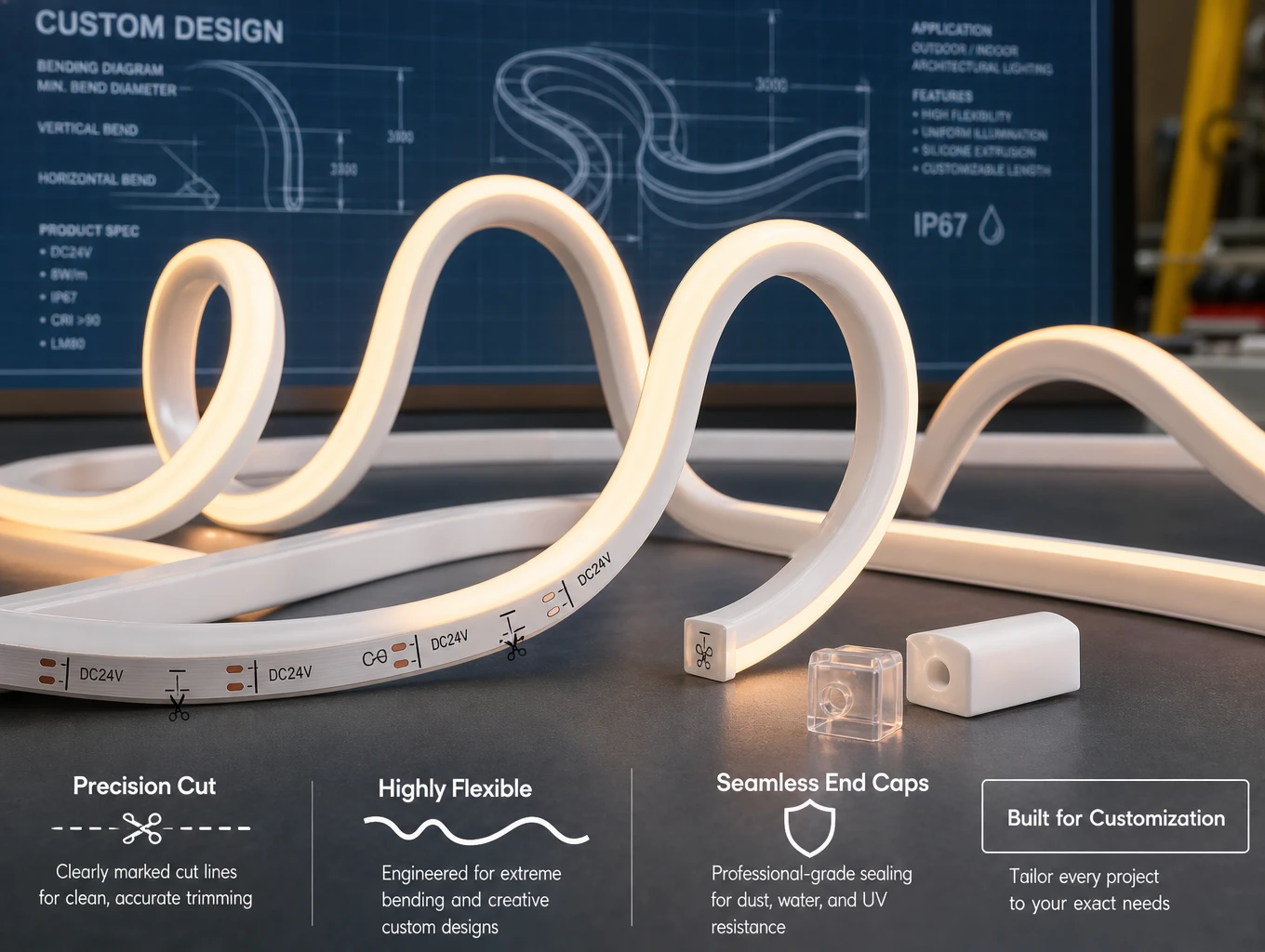
Linear fixtures mounted on building exteriors or high-traffic retail spaces face continuous wear. The chemical mix of the protective outer jacket dictates how long the light path retains its structural integrity and color accuracy.
Many consumer-grade lighting products use Polyvinyl Chloride (PVC) or basic plastic blends for their flexible diffusers. While these materials keep production costs low, they fail rapidly when placed outdoors.
Ultraviolet (UV) radiation breaks down the PVC polymer chains. This breakdown causes the jacket to turn yellow, cloudy, and hard within a few months. This yellowing distorts the output colors and reduces light transmission. Furthermore, PVC becomes brittle in freezing weather. This brittleness leads to surface cracks that let water leak directly into the electronics, causing immediate short circuits.
Professional custom solutions avoid these structural risks by using premium, gas-phase silicone dual-extrusions. Silicone molecules are inherently stable under intense UV exposure. This stability ensures the protective casing remains clear and flexible for over a decade.
Silicone handles extreme temperature variations seamlessly. It operates safely from -40°C up to +85°C without warping, stretching, or melting. It is also highly resistant to salt spray in coastal zones, chlorinated water in pool areas, and acidic rain in heavy industrial corridors.
The division between consumer app control and professional customization becomes very clear when evaluating system automation and controls integration.
App-driven consumer lights require an active wireless internet connection or local Bluetooth pairing to change lighting modes. If a commercial property manager installs dozens of these fixtures across a facility, a separate app instance must manage each unit. This closed setup does not scale.
Consumer apps cannot interface with master emergency lighting overrides, fire alarm shutdown grids, or third-party energy management software. If the local Wi-Fi network drops, the commercial lighting array can lose its programming or experience connection lag.
Professional customized linear lights use open, hard-wired communication standards like DMX512, KNX, Dali, and Art-Net. These open systems route through dedicated digital decoders. They connect directly to centralized automated control desks or master building management computer systems.
This hardware configuration allows for absolute customization. Light programming syncs perfectly with complex theatrical show control platforms, architectural dimming timelines, and occupancy sensors. This integration maximizes energy efficiency by turning off or dimming unused zones automatically.
The Operational Challenge: In mid-2025, a commercial engineering firm was hired to install dynamic, color-changing linear lighting along the perimeter of a large retail center. The initial design draft proposed using mass-market consumer smart rope lights to leverage their pre-built mobile app effects.
However, during early field testing, the installation crew ran into multiple structural obstacles. The fixed retail lengths left awkward dark spots at the corners of the building facade because they could not be cut to size. Additionally, the building's high-definition security cameras picked up a heavy, flashing screen flicker caused by the consumer power adapters' low refresh rates.
The Custom Engineered Solution: Project managers rejected the consumer lights. They specified professional, high-density customized silicone neon tubes running on a low-voltage 24V DC network. The manufacturing facility supplied long, wholesale spools cut precisely to the building's architectural blueprints. The system integrated heavy-duty, flicker-free constant-current drivers operating over 4,000Hz, connected directly to a centralized DMX512 master control system.
The Final Result: The installation crew completed the setup 40% faster because the customized neon lines fit directly into factory-matched aluminum mounting tracks without excess wiring slack. The high-density diode array provided a completely seamless line of light with zero reflection spots on the building's glass windows.
The upgrade eliminated all camera flicker, ensuring clean security footage. Most importantly, integrating the lights with the facility's automated night timers optimized power distribution, delivering a 45% reduction in monthly utility costs and achieving high energy efficiency.
To ensure maximum lifetime performance and safety from customized linear systems, installation teams must follow three professional rules:
Calculate and Control Voltage Drop: Low-voltage DC networks experience electrical resistance over long distances. This resistance can cause the light to dim at the tail end of a long run. Installation crews must use the proper wire thickness (AWG) based on the distance from the driver. They must also set up multiple power injection feeds to ensure perfectly even brightness from start to finish.
Isolate High-Voltage Transformers: The custom neon tubes operate on touch-safe, low-voltage power. However, the external power supplies connect directly to high-voltage building mains (110V/220V AC). Technicians must house these power boxes inside locked, ventilated weather-proof enclosures away from public areas and moisture.
Seal All Cut Edges Hermetically: When cutting a flexible neon tube on-site, technicians must cut strictly on the marked lines. The cut end must be sealed immediately using factory endcaps and industrial silicone adhesive. This step maintains the system's IP67/IP68 rating, blocking air and humidity from corroding the internal copper circuit board.
Consumer smart lights are engineered for fixed, plug-and-play home spaces. They cannot be cut to fit specific dimensions without destroying the internal digital circuit paths. Commercial builds demand precise field-cuttable linear systems that leave zero dark gaps or messy wiring slack along walls and building surfaces.
Mass-market app-controlled lights use budget power adapters with low refresh frequencies, creating moving dark lines on camera screens. Professional customized neon lines use premium constant-current drivers operating over 4,000Hz. This ensures a clean, flicker-free display under high-definition security setups and broadcast camera lenses.
Yes. While cheap consumer lights use PVC housings that turn yellow, crack, and hard under weathering, professional systems use premium, UV-stable optical silicone. These industrial housings maintain soft flexibility and color accuracy in extreme climates ranging from -40°C up to +85°C.
THINK TEAM KING specializes in manufacturing high-end commercial-grade neon ceiling systems and rugged, flexible lighting solutions tailored for global B2B projects. We avoid closed consumer software, building our lines to integrate seamlessly with open industrial protocols like DMX512, Dali, and Art-Net via professional digital decoders.
Every batch of our led neon lights undergoes strict automated quality testing, ensuring reliable performance, code compliance, and excellent energy efficiency for large installations. Whether your project requires high-volume wholesale neon lighting or a custom-engineered commercial lighting configuration, THINK TEAM KING delivers certified systems built to match your exact technical specifications.

It provides all-round service for customers
and users 24 hours a day.
Enter your email for exclusive offers
and information on new upcoming products.


