


Time:2026-07-23
The global commercial entertainment, architectural hospitality, and experiential retail sectors are undergoing a profound transformation toward real-time interactive environments. Static lighting facades and simple pre-programmed color cycles are no longer sufficient to capture audience engagement or establish brand distinction in flagship venues, mega-clubs, transit hubs, and immersive entertainment centers. Today's venue operators, lighting designers, and master engineering contractors demand dynamic, multi-sensory lightscapes that react instantaneously to ambient soundscapes and live audio feeds.
Implementing high-performance smart neon sync with music architectures across large-scale commercial facilities introduces complex engineering challenges. Consumer-grade lighting strips rely on cheap ambient electret microphones, susceptible to acoustic distortion, high latency, dropouts, and premature electrical failure under high-volume conditions.
For international procurement managers, MEP (Mechanical, Electrical, and Plumbing) contractors, and B2B sourcing agents, achieving reliable audio-reactive lighting requires transitioning to industrial-grade hardware. Partnering with a specialized manufacturing plant like TTK LED Neon provides access to zero-latency Digital Signal Processing (DSP) controllers, addressable silicone extrusions, and bulletproof DMX512/Art-Net control frameworks engineered for continuous commercial operation.
To appreciate the engineering rigor behind commercial-grade audio-reactive lighting, sourcing managers must understand the fundamental differences in signal acquisition, frequency decomposition, and response latency between consumer-grade lighting accessories and industrial architectural systems.
Consumer light strips rely on built-in electret condenser microphones that capture air pressure waves. In commercial environments—such as crowded bars, high-decibel nightclubs, or industrial exhibitions—ambient noise pollution, reverberation, and speaker distortion clip the microphone's pre-amplifier. This results in chaotic, non-rhythmic flashing that ruins the visual atmosphere.
Professional smart neon sync with music installations utilize direct, isolated line-level audio inputs (typically balanced XLR, 1/4-inch TRS, or optical S/PDIF connections) fed directly from the venue’s main Digital Audio Workstation (DAW) or front-of-house mixing console. By bypassing airborne acoustic interference, the lighting controller receives a pristine, high-fidelity audio signal with an ultra-wide dynamic range (greater than 100 dB SNR), ensuring that lighting transitions match the intended musical composition.
Processing continuous analog audio into discrete visual commands requires real-time mathematical decomposition. Industrial lighting controllers integrate dedicated 32-bit floating-point Digital Signal Processors (DSP) running hardware-accelerated Fast Fourier Transform (FFT) algorithms.
The discrete audio input stream x(n) is mathematically mapped from the time domain into discrete frequency bins X(k) in the spectral domain via the Discrete Fourier Transform equation:
X(k) = Sum [from n = 0 to N - 1] of { x(n) * e^[ -i * 2 * pi * k * n / N ] }Where:
N represents the sample window size (typically 512 or 1024 samples for low-latency audio processing).
x(n) is the discrete time-domain audio amplitude value at sample n.
X(k) is the complex spectral component for frequency bin k.
By executing this calculation up to 1,000 times per second, the DSP engine isolates distinct acoustic registers and routes them to specific addressable zones along the silicone neon tube:
Sub-Bass & Low-End (20 Hz to 250 Hz): Triggers high-current pulse modulation, driving structural accents and perimeter baselines in synchronization with kick drums and bass drops.
Mid-Range Frequencies (250 Hz to 4,000 Hz): Controls color spectrum shifts, fluid gradient washes, and spatial sound-tracking across large wall surfaces in response to vocals and brass instrumentation.
High Frequencies & Treble (4,000 Hz to 20,000 Hz): Drives ultra-fast, high-density pixel chasing, strobe bursts, and sparkle effects triggered by hi-hats, cymbals, and acoustic transients.
Human perception registers a distinct disconnect if the delay between an acoustic event (such as a snare hit) and its corresponding visual flash exceeds 20 milliseconds. Consumer Bluetooth and Wi-Fi light strips frequently suffer from network propagation delays ranging between 80 ms and 250 ms, creating an uncoordinated visual experience. Industrial smart neon sync with music systems engineered by TTK LED Neon maintain total end-to-end system latency below 8 milliseconds, delivering instantaneous visual feedback that feels completely unified with the soundscape.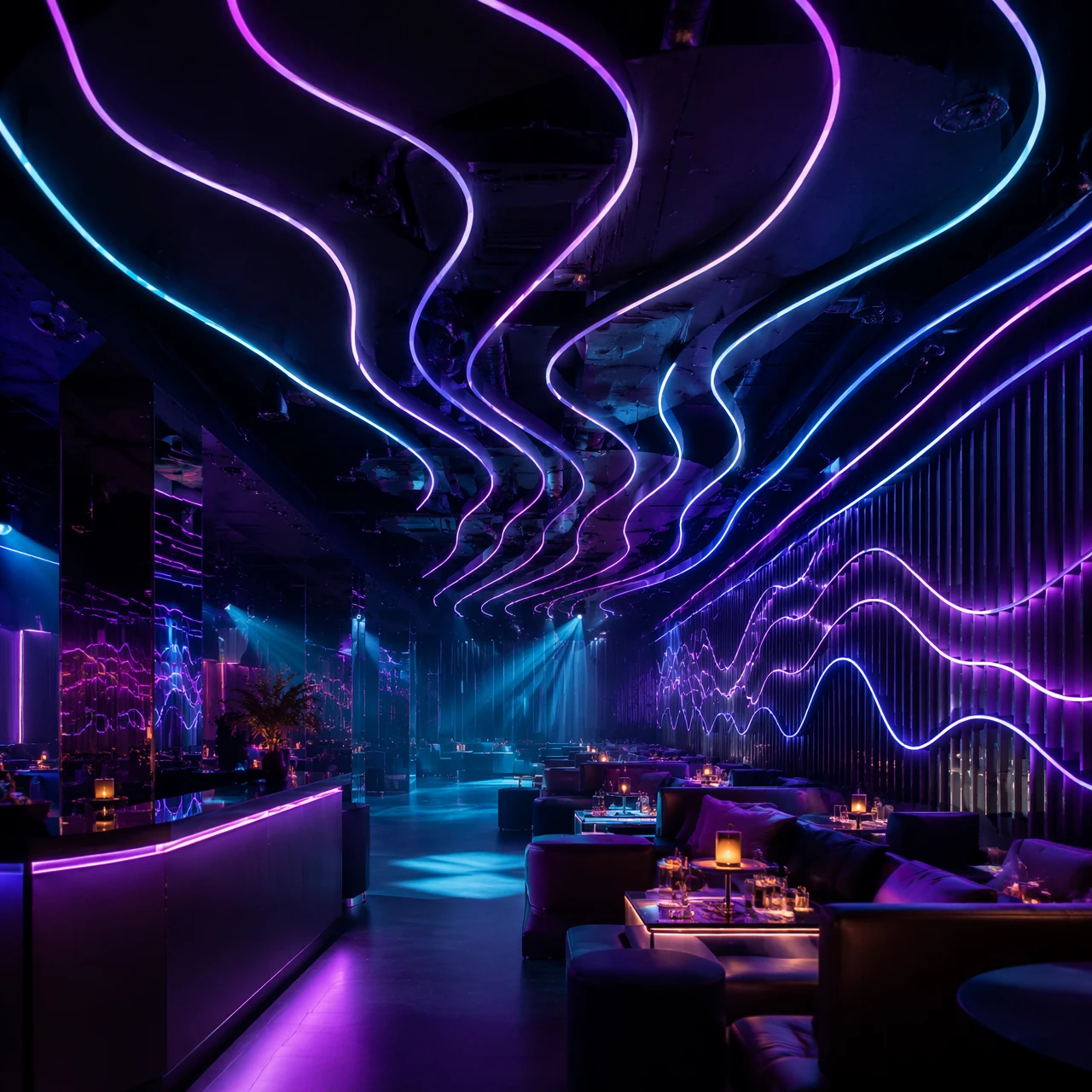
Deploying audio-reactive flexible neon across multi-story facades or expansive entertainment venues requires robust, noise-immune control network topologies.
Wi-Fi (802.11 b/g/n) and Bluetooth Mesh consumer protocols operate on the overcrowded 2.4 GHz ISM radio band. In commercial venues filled with thousands of mobile devices, wireless cash terminals, and metal building structures, radio frequency (RF) interference leads to severe packet loss, lag, and sudden signal drops.
Enterprise-grade interactive installations rely exclusively on hardwired, differential-voltage communication protocols:
DMX512-A (EIA-485): Utilizes balanced differential signaling across twisted-pair shielded cables. Capable of transmitting control data up to 300 meters without signal boosters, making it immune to electromagnetic interference (EMI) from nearby HVAC equipment and high-voltage power lines.
Art-Net & sACN (Ethernet-Based Protocols): Encapsulate multiple DMX universes into standard UDP/IP network packets over Cat6 fiber-optic infrastructure. This allows a central audio-visual media server to synchronize tens of thousands of addressable RGB/RGBW neon pixels across immense multi-acre venue layouts.
High-Speed SPI (Serial Peripheral Interface): Drives individual pixel ICs (e.g., WS2811, UCS512, TM1914) directly inside the silicone sleeve at clock rates exceeding 800 kHz, enabling high-frame-rate (greater than 60 fps) dynamic audio animations.
| Architectural Metric | Consumer Bluetooth / App-Based | Standalone Hardware DSP Controller | Enterprise Art-Net / DMX512 Matrix |
| Max End-to-End Latency | 80 ms to 250 ms (Severe Lag) | 5 ms to 12 ms (Imperceptible) | Under 3 ms (Real-Time Broadcast Quality) |
| Audio Input Source | Internal Electret Mic (Noisy) | Balanced 3.5mm / Line-In Jack | Direct Digital DAW / S/PDIF Feed |
| Maximum Run Distance | 10 meters (RF Dropouts) | 100 meters (RS-485 Differential) | Multi-Kilometer (Fiber Network) |
| Pixel Addressing Density | Single Zone / Non-Addressable | 512 Channels per Universe | Unlimited Multi-Universe Mapping |
| EMI & Noise Immunity | Extremely Low | High (Shielded Enclosure) | Industrial Grade (Galvanic Isolation) |
| Target Application | Residential / DIY Accent | Bars, Clubs, Retail Stores | Stadiums, Theme Parks, Facades |
Audio-reactive lighting subjects solid-state electronics to far greater electrical and thermal stress than steady-state static lighting. Synchronizing neon lights with music involves perpetual, high-frequency pulse-width modulation (PWM) switching, rapid current surges, and sudden thermal spikes during high-volume bass hits.
Rapid Duty Cycle Transient Stress:
[Static Light State] ──> Steady Current Draw & Thermal Equilibrium
[Music Sync State]  ──> 0% to 100% Rapid Current Spikes ──> Severe Thermal Expansion Cycle
During an intense audio-driven strobe sequence, the internal surface-mount diodes (SMDs) transition from 0% off-state to 100% full-white brightness within microseconds. This rapid switching creates micro-thermal expansion cycles within the internal flexible printed circuit (FPC). In cheap flexible lighting constructed with 1-ounce or 2-ounce thin copper foils, these thermal stresses lead to micro-fractures in solder joints, causing intermittent section failures and dead pixels.
TTK LED Neon engineers solve this reliability issue by manufacturing all addressable audio-reactive neon products using heavy-duty, 3-ounce double-sided rolled annealed copper FPCs. The ultra-thick copper layer acts as an internal heat sink and structural backplane, distributing thermal energy evenly across the profile and withstanding millions of expansion-contraction cycles without trace fatigue.
The intense flickering and rapid color transitions inherent in audio-reactive displays expose the housing material to high levels of high-energy visible light and potential heat buildup.
Commercial PVC Housings: Under rapid thermal stress and direct UV radiation, polyvinyl chloride releases plasticizers, leading to micro-cracking, severe yellowing, and optical clouding within 6 to 12 months.
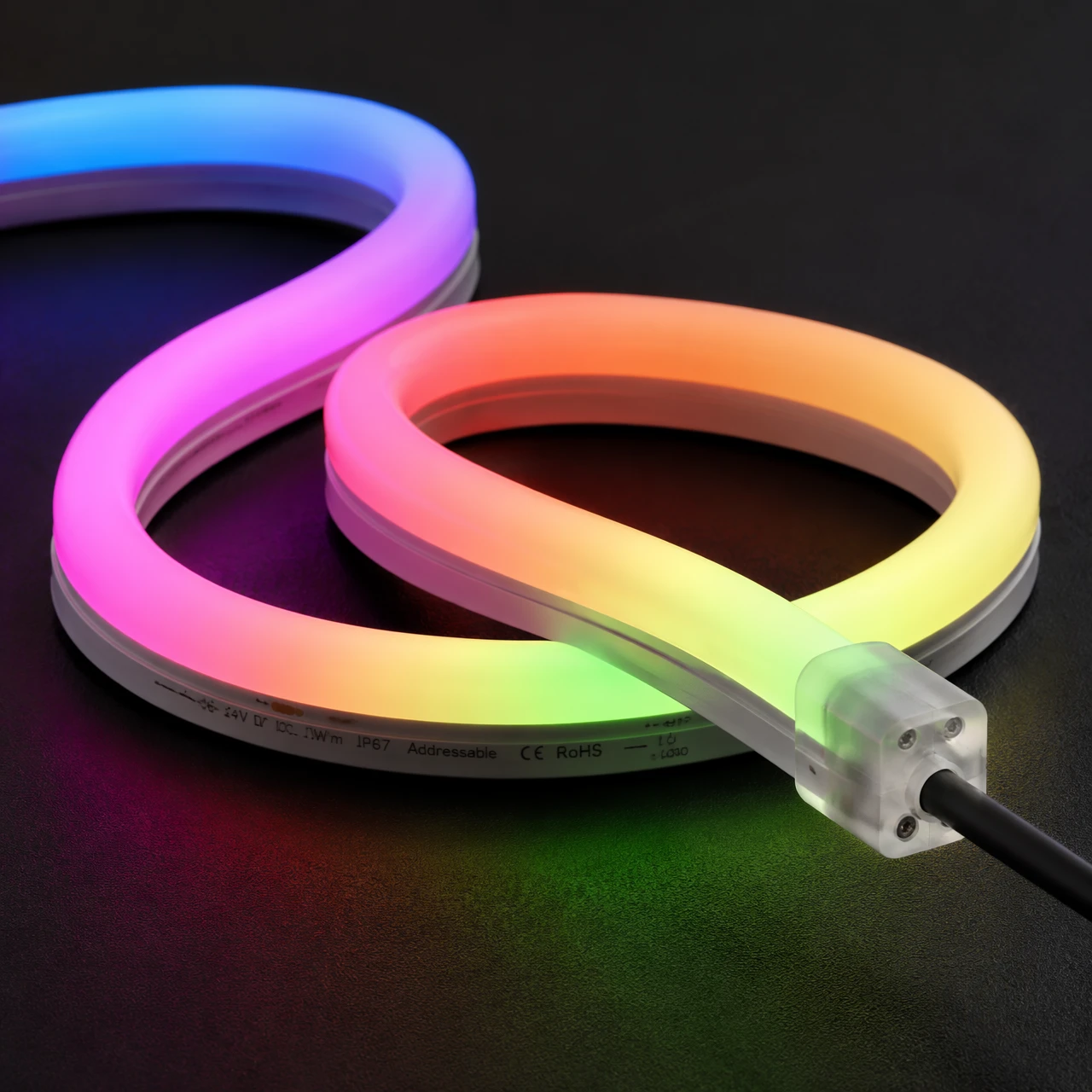
Gas-Phase Co-Extruded Silicone: TTK LED Neon utilizes 100% gas-phase optical silicone. Silicone exhibits a rigid, inorganic silicon-oxygen (-Si-O-Si-) molecular backbone with bond dissociation energy of 445 kJ/mol, making it immune to thermal degradation from -50°C up to +200°C. The housing maintains a high light transmission efficiency rating (over 93%), ensuring that rapid sound-reactive light pulses retain maximum visual impact without optical absorption loss.
A critical oversight in large-scale smart neon sync with music installations is failing to account for transient inrush current during synchronized strobe or bass-beat events.
When an audio track hits a loud sub-bass pulse, several hundred meters of addressable neon light up simultaneously to 100% full-white output (RGB all driven to maximum). This creates an instantaneous, massive current draw across the DC distribution bus.
Transient Current Spike Formula:
I_peak = N_diodes * I_diode_max * Dynamic_Sync_Multiplier
If the power distribution grid is improperly sized, this sudden current spike causes a severe voltage drop (Delta V), leading to controller brownouts, reset loops, visible flickering, and color shifting toward the red end of the spectrum.
Unbuffered Power Grid:
[Bass Drop Hit] ──> Current Spike ──> Bus Voltage Drops below 18V ──> Controller Reboots / Light Crash

TTK Buffered Bus Architecture:
[Bass Drop Hit] ──> Current Spike ──> Dual Feed + Active PFC Drivers ──> Stable 24V Output Throughout
The total voltage drop along a uniform direct-current copper bus bar is calculated using Ohm's Law adapted for linear resistance:
Delta V = (2 * L * I * rho) / A
Where:
Delta V is the total voltage drop along the run (in Volts, V).
L is the linear circuit distance (in meters, m).
I is the total peak transient current during full audio synchronization (in Amperes, A).
rho is the electrical resistivity of copper (1.72 x 10^-8 Ohm-meter at 20°C).
A is the cross-sectional conductor area of the FPC traces (in square meters, m²).
To prevent electrical instability during audio-reactive pulse sequences across multi-meter commercial installations, TTK LED Neon implements a three-part power topology:
High-Voltage 24V/48V DC Native Architecture: By operating at 24V or 48V DC rather than legacy 5V or 12V layouts, operating currents are reduced by 50% to 75%, cutting resistive voltage drop along the linear run by up to 16 times (Formula: P_loss = I^2 * R).
Parallel Power Injection Loops: For continuous runs exceeding 10 meters, dual-ended power injection harnesses feed DC power directly to both ends and intermediate points of the strip, ensuring balanced voltage across every LED driver.
Active Power Factor Correction (PFC) Switching Power Supplies: Utilizing industrial-grade power supplies featuring active PFC (greater than 0.96) and high peak-load headroom (greater than 150% surge capacity for 10 seconds). This prevents supply shutdown during abrupt, rhythmic audio spikes.
For global enterprise buyers, purchasing agents, and lighting specifiers, selecting a reliable B2B manufacturing partner involves evaluating production capacity, testing rigor, and custom OEM/ODM support.
Factory Quality Verification Pipeline at TTK LED Neon:
[Automated SMT High-Speed Assembly]
               │
               ▼
[Automated Optical Inspection (AOI)]
               │
               ▼
[Multi-Axis Spectroradiometer Color-Binning]
               │
               ▼
[72-Hour Continuous Audio Modulation Burn-In Test]
               │
               ▼
[IP68 Liquid Silicone Co-Extrusion & Sealing]
Every batch of addressable sound-reactive neon produced in our modern facility undergoes stringent environmental and electrical verification protocols:
Continuous Audio Modulation Burn-In Testing: Fixtures are connected to high-power DSP drivers and subjected to continuous 72-hour burn-in cycles running randomized 10 Hz to 20 kHz audio pulse modulation. This stress-tests solder joints, IC timing controllers, and silicone thermal channels under real-world dynamic conditions.
3-Step MacAdam Ellipse Color Binning: Automated spectroradiometer inspection verifies that all RGB/RGBW diodes match strict chromaticity coordinates, ensuring uniform color mixing across separate production shipments.
IP68 Liquid Silicone Injection Sealing: Terminal connections and end-caps are sealed using automated high-pressure liquid silicone injection molding, creating a continuous water and dust barrier compliant with marine-grade outdoor requirements.
THINK TEAM KING provides end-to-end customization for large-scale commercial and architectural rollouts:
Custom DMX/SPI Address Mapping: Pre-program internal IC pixel lengths, universe offsets, and channel counts directly at the factory to match your venue's lighting control blueprints.
Factory-Molded IP68 Wire Harnesses: Custom-length jumper cables, quick-connect waterproof couplings, and audio-line breakout boxes pre-assembled for rapid on-site installation by electrical contractors.
Architectural Mounting Track Integration: Heavy-duty, precision-extruded aluminum mounting profiles (flexible, rigid, and recessed) provided with pre-drilled fixing points to streamline installation on complex building facades.
Standard dynamic light strips run pre-programmed animation loops stored on a memory chip that repeat indefinitely regardless of the environment. In contrast, smart neon sync with music systems integrate real-time digital audio processing (DSP) hardware. They dynamically analyze incoming line-level audio frequency spectrums using Fast Fourier Transform (FFT) algorithms, instantly translating real-time bass, mid-range, and treble beats into synchronous color, pulse, and pixel-chasing movements with zero perceptible lag.
Yes, absolutely. Our commercial-grade interactive neon platforms support native DMX512-A differential protocols and Ethernet-based Art-Net/sACN signals. They connect seamlessly with industry-standard lighting consoles (such as MA Lighting grandMA, Avolites, ChamSys, and Obsidian Onyx) and dedicated media servers, allowing lighting designers to map pixel arrays alongside moving heads, video walls, and laser systems.
All TTK LED Neon commercial silicone flexible tube extrusions carry true IP67 (temporary submersion) or IP68 (continuous underwater/exterior) ingress protection ratings. Featuring UV-immune gas-phase silicone jackets, IK08 mechanical impact resistance, and UL94 V-0 flame retardancy, our fixtures are built to withstand severe outdoor weather, high-decibel acoustic vibrations, chemical exposure, and intense thermal cycling in public spaces.
Integrating professional-grade smart neon sync with music architectures into your commercial venues, retail environments, or architectural projects unlocks immersive visual experiences that elevate brand engagement. Sourcing directly from an asset-heavy manufacturer like TTK LED Neon guarantees high component quality, zero-latency performance, strict building code compliance, and factory-direct pricing. Avoid low-grade consumer accessories that fail under heavy commercial use.
Are you preparing to specify interactive audio-reactive lighting, request custom product samples, or secure factory-direct wholesale pricing for an upcoming commercial development? Our experienced engineering team is ready to assist you with layout design, electrical load calculations, DMX network mapping, and customized OEM/ODM fabrication.

It provides all-round service for customers
and users 24 hours a day.
Enter your email for exclusive offers
and information on new upcoming products.


