


Time:2026-07-14
The global commercial signage and architectural display market is undergoing a structural revolution. Today, international sign assembly plants, custom advertising factories, and commercial LED display manufacturers face a severe production bottleneck. When building complex illuminated script fonts, intricate corporate logos, or tight-angled geometric light channels, engineering teams struggle with traditional co-extruded flexible lights. Conventional integrated neon tracks are notoriously difficult to bend around sharp radiuses without crimping the internal circuitry. These rigid layouts lead to high material scrap rates, slow manual assembly lines, and a complete lack of field repairability when a single component fails.
To protect your factory production margins and accelerate assembly turnaround times, your operation requires an industrial-grade separated rgb neon strip architecture. Sourcing structural systems where the outer silicone diffusion jacket and the internal flexible LED tape are decoupled eliminates installation stress entirely. Working directly with a certified, asset-heavy production facility ensures that your automated sign assembly lines receive perfectly calibrated, high-clearance hardware every single time.
For factory sourcing managers and engineering project directors, understanding the physics behind a separated rgb neon strip system is essential to unlocking higher throughput on the shop floor. Standard neon flexible products fuse the internal circuit board and the outer polymer sleeve together during a single extrusion process. While this creates a solid boundary, it introduces severe physical limitations when fabricating custom-shaped commercial signage.
When an assembly technician attempts to bend a traditional fused neon strip at a sharp $90^\circ$ angle for a custom sign letter, two opposing mechanical forces occur simultaneously:
Outer Tensile Stress: The outer edge of the thick silicone jacket stretches intensely, causing the polymer to thin out and lose its uniform diffusion properties. This creates visible light leaks and hot spots.
Inner Compressive Solder Failure: The internal flexible printed circuit (FPC) board is crushed against the inner wall. This compression causes microscopic fractures in surface-mount solder joints, leading to intermittent flickering or complete circuit failure.
The Structural Separation Breakthrough: A premium separated system completely avoids this mechanical stress. The manufacturer supplies an empty, structural silicone diffusion channel engineered with a precise internal retention groove. The flexible high-density RGB LED tape is sourced as a standalone component. Because the internal lighting track can slide independently within its housing, it completely avoids tension and compression during sharp bending maneuvers.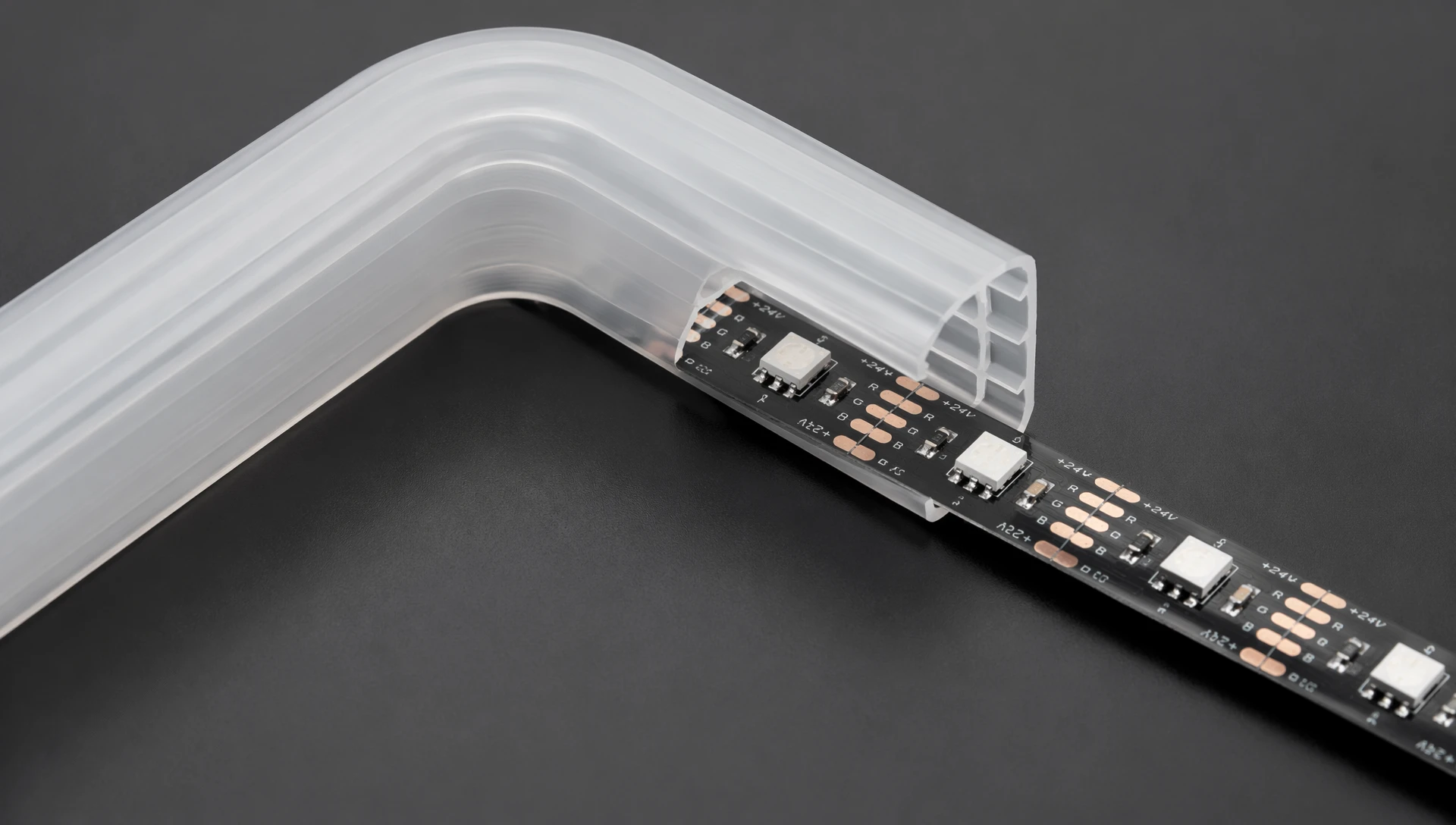
For corporate procurement agents and factory operations directors, shifting to a modular assembly model drives immediate financial returns. Analyzing the true cost of sign fabrication reveals that manual bench labor and material scrap represent the largest drains on factory profitability.
In traditional sign building, a worker must carefully measure, cut, solder, and hand-seal every single corner turn of an integrated neon strip. This intricate process requires highly skilled technicians and takes considerable time per layout.
With a separated rgb neon strip workflow, the assembly process is split into two rapid, high-speed steps. First, the empty, highly flexible silicone jacket is routed into the sign base-plate groove in one continuous motion. Second, the technician pulls or slides the independent RGB LED tape into the channel using an integrated pulling cord. This mechanical optimization reduces total bench assembly time by up to $45\%$, allowing your factory floor to double its daily sign output without hiring extra staff.
If a single LED chip fails due to static discharge or an electrical surge in an integrated system, the entire custom sign module must be scrapped, pulled apart, and rebuilt from scratch.
A separated setup introduces true modular repairability to your product line. If an electrical issue occurs during final quality assurance testing, the internal RGB strip can be pulled right out of the silicone housing and replaced in seconds. The outer silicone track remains perfectly intact on the sign faceplate. This smart maintenance strategy reduces component scrap costs to zero and ensures your delivery deadlines stay completely on track.
Sourcing managers, quality engineers, and industrial procurement auditors need clear, empirical data to guide their component selections. Review the structural comparison table below to see why high-volume sign factories are moving away from legacy fused neon assemblies:
| Technical Parameters | Legacy Fused Neon Flex Strips | Premium Separated Systems | Factory Floor & Supply Chain Benefits |
| Minimum Bending Radius | 50mm to 80mm (Risk of Kinking) | 10mm to 15mm (Ultra-Tight Angles) | Enables crisp, flawless script fonts and intricate corporate logo details. |
| Circuit Repair Protocol | Full Fixture Demolition Required | Instant Manual Strip Extraction | Reduces assembly-line component scrap and post-warranty repair costs to zero. |
| Inventory SKU Efficiency | Must Stock Every Color/Size Match | Modular Jacket & Strip Stocking | Cuts warehousing costs by separating raw silicone profiles from LED reels. |
| Internal FPC Copper Track | 1-oz Standard Copper Base | 3-oz Rolled Annealed Dual-Copper | Eradicates voltage drops over extended sign perimeters; matches brightness. |
| Jacket Compound Type | Cheap Halogenated PVC Blends | 100% Gas-Phase Optically Pure Silicone | Prevents outdoor cracking, yellowing, and hardening from heavy environmental UV. |
Achieving flawless illumination across custom sign displays requires following strict engineering tolerances on your assembly floor. Sourcing teams should train their production staff on these three foundational installation methods to get the most out of a decoupled component layout:
Before laying down the flexible components, ensure that your automated CNC machinery cuts the acrylic or aluminum sign backplates to match the outer width of the silicone extrusion. The retention groove should feature a slight mechanical undercut. This engineering detail allows the empty silicone track to snap tightly into place without relying heavily on messy industrial adhesives. This clean mechanical fit dramatically improves production speed and keeps the workplace clean.
Because high-purity gas-phase silicone naturally exhibits a high friction coefficient, sliding a long flexible light circuit through an empty channel can create resistance over runs exceeding five meters.
To ensure smooth automated assembly, premium component factories treat the inner guide rails of the silicone jacket with a permanent, microscopic dry-powder coating. This technical finish drops internal sliding friction by up to $70\%$. It allows assembly workers to effortlessly slide high-density RGB circuits around multiple $90^\circ$ bends without stretching the copper traces or straining the circuit architecture.
For international procurement managers supervising global distribution networks or high-volume sign assembly centers, logistical agility is a major competitive advantage. Relying on fixed, pre-assembled multi-color light strings complicates factory inventory forecasting and ties up significant operating capital in slow-moving SKUs.
When your factory works with traditional co-extruded neon, you are forced to forecast and stock every possible configuration of color, jacket shape, and voltage rating. This complex matching process leads to overstocked warehouses with slow-moving inventory.
Transitioning your supply chain to a separated rgb neon strip architecture simplifies your warehousing plan into an efficient modular matrix. Your facility only needs to stock bulk reels of raw, high-clearance silicone diffusion profiles alongside standard master spools of premium RGB internal circuits. When a bulk commercial purchase order arrives, your assembly floor can mix and match these modular components on demand, dramatically improving inventory turnover and reducing carrying costs.
When auditing potential manufacturing plants in major global production hubs, corporate sourcing agents must look past basic product flyers. Commercial buyers should audit three critical factory metrics to guarantee a stable supply chain:
Precision Extrusion Tolerance Calibration: Ensure the supplier utilizes real-time laser micrometer monitoring on their silicone extrusion lines. For a decoupled system to work perfectly, the internal track dimension of the empty silicone jacket must maintain a tight tolerance of $\pm0.05\text{mm}$. Any variation will cause the internal light strip to loose focus or jam during assembly.
Advanced Multi-Axis SMT Laser Welding: Verify that the factory runs high-speed automated Surface Mount Technology (SMT) assembly equipment. The independent RGB flexible circuit must use reinforced solder formulations that withstand the physical pulling forces encountered during long sign installations.
Rigorous Thermal Performance Evaluation: Top-tier manufacturers conduct strict automated thermal testing on their decoupled component systems. Because the internal lighting strip is surrounded by a separate air gap inside the silicone sleeve, the factory must use thick, 3-ounce copper circuit layers to effectively pull heat away from the LED chips, maintaining long-term light output.
When you source your flexible architectures from a certified commercial manufacturer like THINK TEAM KING, the separated design delivers unmatched layout flexibility and massive labor savings. By decoupling the outer silicone diffusion jacket from the internal RGB circuit, your assembly staff can form sharp corners and tight letter loops without putting stress on the electronics. This method completely prevents internal solder failures, minimizes material scrap, and speeds up factory throughput.
Our engineered silicone diffusion jackets feature specialized internal friction ribs and mechanical locking grooves running along the base of the channel. Once the internal RGB circuit is pulled into its final position, these integrated structures grip the edges of the circuit board securely. For vertical outdoor signs or high-vibration applications, adding a small drop of our clear industrial silicone adhesive at the terminal end-caps locks the entire assembly firmly into a permanent, weather-resistant position.
Yes, we provide extensive custom engineering and fabrication support. THINK TEAM KING specializes in manufacturing premium OEM/ODM linear flexible systems for global assembly hubs, custom sign makers, and corporate distribution networks. Running our own automated, high-precision extrusion lines, we provide fast wholesale turnaround times, custom interior channel geometries, and pre-packaged assembly kits tailored exactly to your corporate production blueprints.
An exhaustive evaluation of modern commercial signage trends confirms a vital operational fact: advanced material engineering dictates product reliability and factory profitability. Choosing modular, high-density separated rgb neon strip solutions from a verified reference manufacturer removes assembly failures, satisfies international building safety codes, and cuts costly maintenance claims to zero. Rigid, legacy alternatives create high financial risks due to high scrap rates and labor-intensive manual assembly.
Are you looking to secure a reliable, high-volume supply chain for an upcoming commercial branding rollout? Do you need to upgrade your current sign assembly lines with premium, high-efficiency flexible components? Our engineering desk is ready to help. We can analyze your layout schematics, calculate voltage distributions, and provide tailored, factory-direct wholesale pricing.

It provides all-round service for customers
and users 24 hours a day.
Enter your email for exclusive offers
and information on new upcoming products.


