


Time:2026-04-13
In the professional architectural lighting sector, signal latency is more than an inconvenience—it is a critical system failure. Whether you are engineering a high-visibility commercial facade or a high-end smart home, your smart led lights must respond with microsecond precision. Even a 50ms delay can compromise the visual integrity that global brands demand for their flagship locations.
As lighting networks transition from basic static colors to complex digital ecosystems, the controller serves as the central processing unit. Selecting high-spec hardware is the only way to ensure your light solution remains stable, responsive, and perfectly synchronized.
To eliminate lag, you must optimize the data throughput between the controller and the LED. While a standard controller modulates voltage via basic Pulse Width Modulation (PWM), professional smart rgb neon strip controllers transmit digital data packets to Integrated Circuit (IC) chips (such as WS2811 or UCS1903) embedded within the neon flex.
Selecting the appropriate protocol is a critical step in project procurement:
SPI (Serial Peripheral Interface): Ideal for medium-scale retail displays. It offers high-speed data for fluid "chasing" effects. However, because the signal is "unbalanced," it is susceptible to attenuation and requires data repeaters every 15–20 meters to prevent timing drifts.
DMX512 (Digital Multiplex): The industrial gold standard. DMX utilizes a balanced differential signal that cancels out electromagnetic interference. It supports up to 512 channels per universe, ensuring zero-latency synchronization across massive architectural structures.
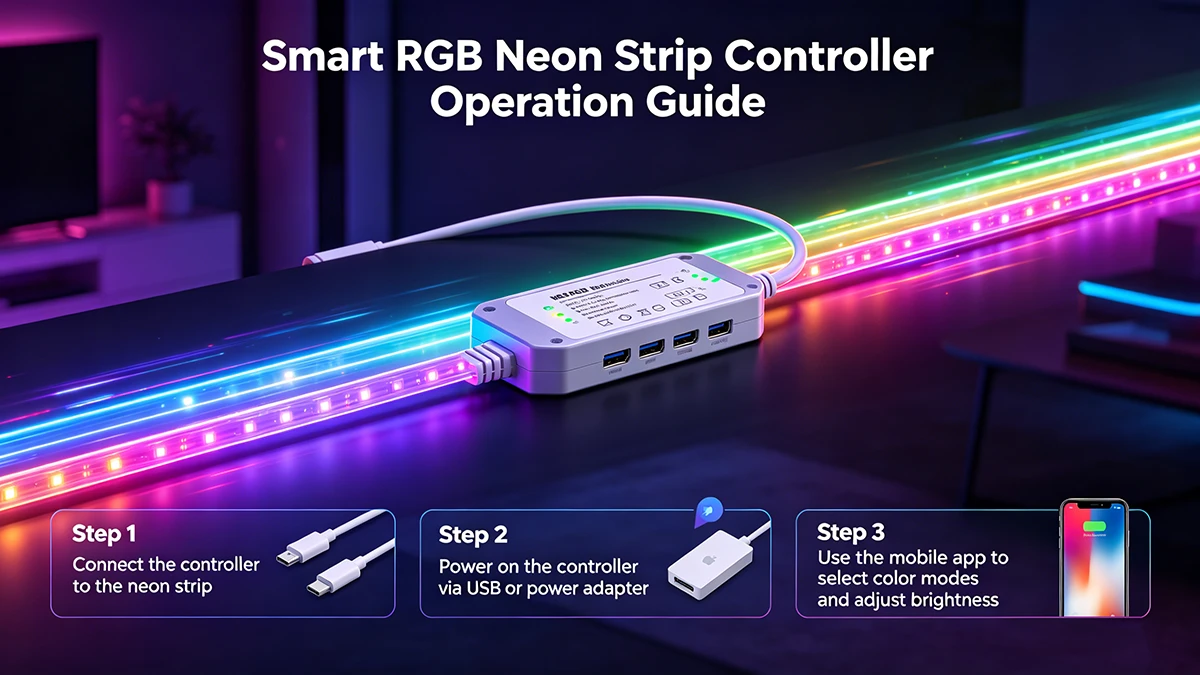
For entertainment and hospitality venues, smart neon sync with music is a high-impact feature. However, low-grade consumer hardware often causes "visual stutter," where the light pulse fails to align with the audio transient.
Professional-grade systems achieve real-time synchronization through dedicated hardware processing:
3.5mm Direct Line-In: Avoid integrated microphones that suffer from ambient noise interference. A direct AUX feed ensures the controller receives a clean, high-fidelity audio signal.
Digital Signal Processing (DSP): High-performance controllers use DSP to bifurcate audio into specific frequency bands. You can calibrate the low-end (20Hz–200Hz) to trigger deep pulses and the high-frequencies (2kHz–20kHz) to trigger rapid color shifts. This technical approach ensures your smart neon sync with music remains mathematically aligned with the audio waveform.
While hardwired systems offer maximum stability, wifi-enabled neon light controllers provide essential flexibility for retrofitting or difficult-to-wire environments.
Most industrial smart lights operate on the 2.4GHz frequency. Although 5GHz offers higher bandwidth, 2.4GHz provides the superior penetration power required to bypass concrete walls and metal studs common in commercial construction.
For high-density environments with heavy Wi-Fi congestion, Bluetooth Mesh is the superior light solution.
Node-to-Node Communication: Every controller functions as a repeater, passing data to the next unit in the chain.
Network Redundancy: If one controller fails, the data signal automatically reroutes through an alternate node, ensuring the overall sync remains uninterrupted by packet loss.
The engineering required to sync a smart rgb neon strip is remarkably similar to the low-latency tech found in high-end gaming consoles. Users prioritize responsiveness, as seen in high search volumes for how to sync ps5 controller or how to sync ps4 controller.
Just as gamers require instant feedback to win, architects require instant response to maintain visual immersion. Whether it is a user asking how to sync a wii remote control or a technician calibrating lighting smart lights, the technical goal is identical: Zero Input Lag. By utilizing 32-bit ARM processors, our controllers match the response times of world-class gaming hardware.
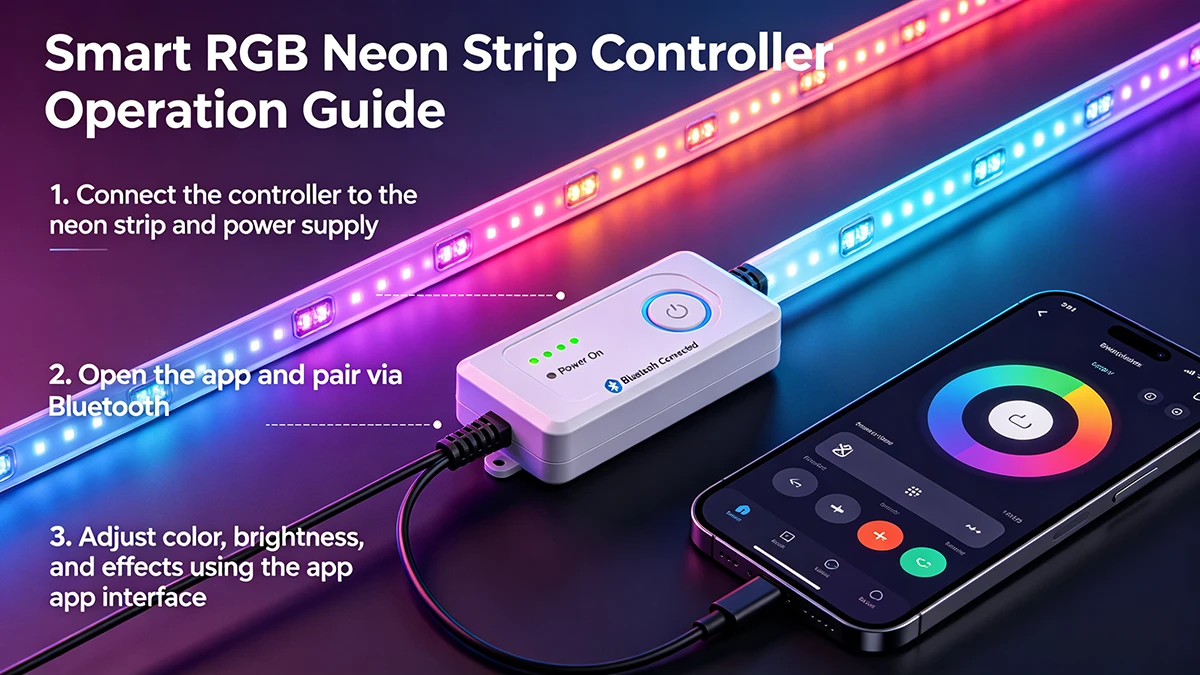
To maintain a 100% stable smart lighting system, adhere to these industrial installation standards:
Shielded Twisted Pair (STP) Cabling: Use STP cables (like CAT6) for DMX data lines to protect data packets from Electromagnetic Interference (EMI).
Common Ground Logic: All power supplies and controllers must share a common ground (V-) to prevent ground loops, which cause flickering or delayed signal responses.
Thermal Management: Digital controllers are essentially micro-computers. If the processor exceeds 60°C, it may "throttle" its clock speed, causing visible lag. Ensure all control enclosures have adequate ventilation to maintain peak processing performance.
This is typically caused by processing latency in microphone-based units. To resolve this, upgrade to a controller with a Line-In audio port and use a shielded audio cable to maintain signal purity.
Perform a "Hard Reset" by holding the pairing button for 10 seconds. For wifi-enabled neon light controllers, ensure your mobile device is on the 2.4GHz band to ensure a successful digital handshake.
A standard DMX signal can travel up to 300 meters without a booster. However, for large smart lighting projects, we recommend an optical isolator/splitter every 100 meters to ensure signal integrity.

It provides all-round service for customers
and users 24 hours a day.
Enter your email for exclusive offers
and information on new upcoming products.


