


Time:2026-07-20
The global commercial landscape is experiencing a massive shift toward high-fidelity visual branding and adaptive architectural illumination. Simple, static single-color signage is no longer sufficient to capture consumer attention in premium retail environments, transport hubs, or modern hospitality complexes. To stand out, international design agencies, project engineers, and global procurement departments are specifying complex, programmable media facades and fluid, chasing digital displays.
However, moving from classic static illumination to smooth, animated matrix displays introduces severe engineering challenges for B2B supply lines. Traditional flexible lighting fixtures often suffer from visible pixelation ("hotspots"), noticeable signal delays across long linear distances, and high failure rates in harsh environments.
To overcome these technical obstacles, commercial project managers are upgrading to premium high-density rgb neon strips for dynamic effects. Partnering with a specialized, asset-heavy production facility allows enterprise sourcing teams to ensure perfect color blending, bulletproof electrical design, and long-term durability that keeps corporate facilities looking flawless for years.
For lighting engineers and procurement specialists managing high-end commercial projects, the most critical visual metric is complete optical homogeneity—creating a smooth, unbroken line of light without visible dark spots or jagged pixel gaps. Achieving this perfect look depends directly on the physical spacing between individual light-emitting diodes (LEDs) inside the protective polymer housing.
In standard flexible lighting products, manufacturers often space out diodes to cut production costs, using 30 or 60 LEDs per linear meter. While this works well enough for deeply recessed, indirect background lighting, it fails completely when used for direct-view architectural accents or sharp corporate logos. Wide gaps between chips create uneven light pools and harsh shadows, ruins smooth animated effects, and makes branding look cheap.
Premium high-density rgb neon strips for dynamic effects solve this issue by using dense chip layouts, typically mounting 120, 144, or up to 240 surface-mount diodes (SMDs) per single meter.
Minimizing this pitch spacing down to sub-millimeter tolerances creates a continuous, unbroken ribbon of light source.
To calculate the exact pitch required for an installation, engineers use human visual acuity equations to determine the minimum blending distance. The required viewing distance $D$ to eliminate visible pixelation is a direct function of the physical pitch space $P$ between the center points of adjacent LED chips:
Where $\theta$ represents the human eye's limiting resolution angle, typically valued at 1 arcminute ($0.0167°) under normal lighting conditions.
| LED Density (Chips/Meter) | Physical Pitch Space (P) | Minimum Visual Blending Distance (D) | Optical Performance Rating |
| 30 LEDs/m | 33.3 mm | ~11.45 meters | Unacceptable for direct-view branding; heavy hotspots. |
| 60 LEDs/m | 16.6 mm | ~5.71 meters | Requires deep diffusion channels; visible pixelation up close. |
| 120 LEDs/m | 8.3 mm | ~2.85 meters | Smooth dispersion at medium distances; standard commercial grade. |
| 240 LEDs/m | 4.1 mm | ~1.41 meters | Premium dot-free performance; flawless even at point-blank range. |
By upgrading to a high-density configuration of 240 chips per meter, the physical distance required for the light to blend into a seamless line drops to just 1.41 meters. This allows designers to place high-impact digital signs right at eye level in luxury retail store windows, corporate lobbies, and interactive museum exhibits while maintaining a perfectly clean, high-tech appearance.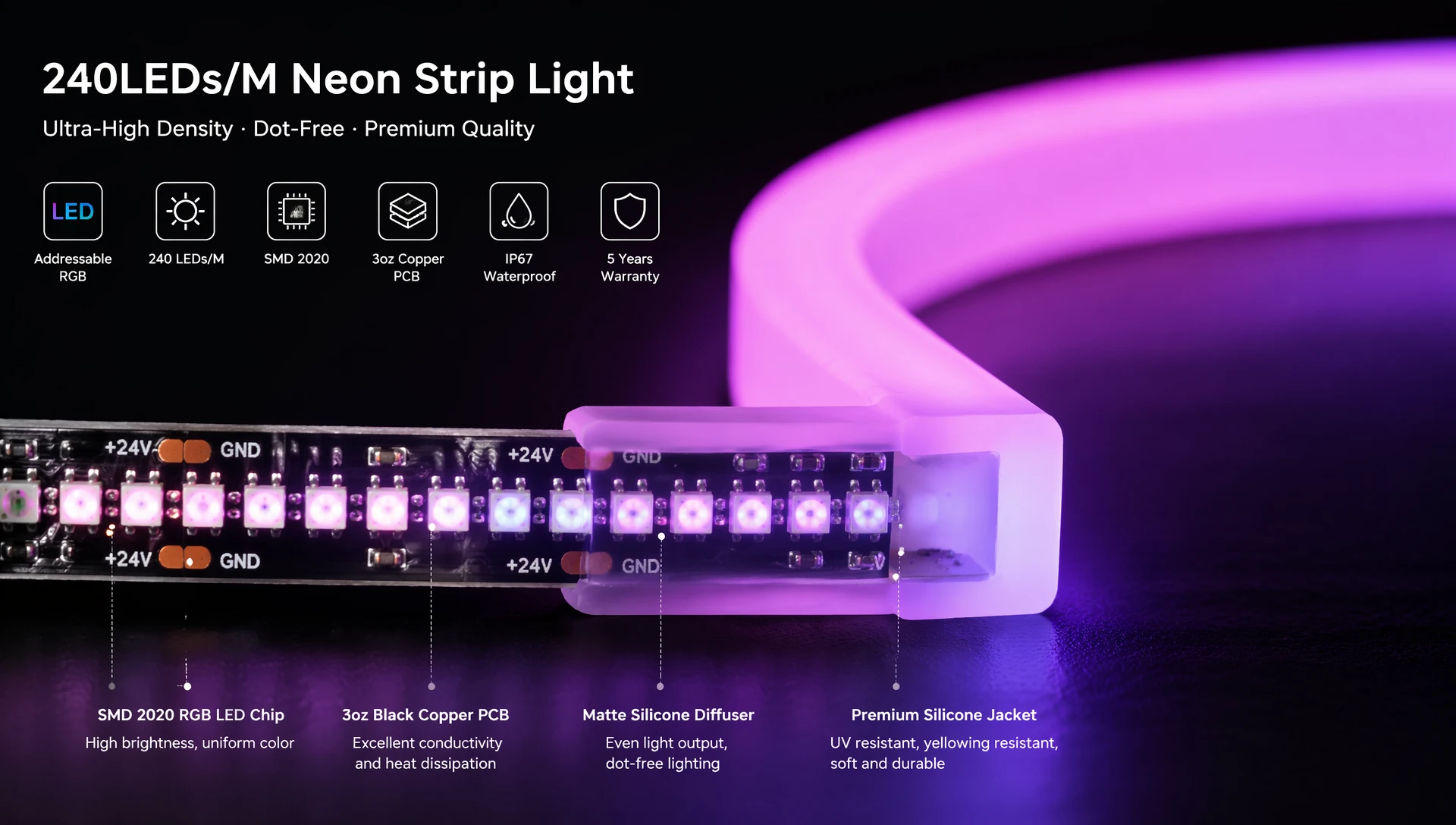
Achieving fluid, lifelike animations—like running water effects, gentle color fades, or video-mapped graphics—requires sophisticated digital control architectures. Industrial buyers must look past simple power ratings and evaluate the underlying integrated circuit (IC) hardware that controls the light.
SPI (Serial Peripheral Interface) Addressable Frameworks: SPI configurations use a simple three-wire or four-wire setup (Data, Clock, Ground, and Power). Because they process data efficiently, SPI protocols are the industry standard for complex, high-resolution indoor installations and detailed corporate logos that require individual pixel control.
Native EIA-485 DMX512 industrial Architecture: For large-scale building exteriors and major commercial projects, native DMX512 protocols are preferred. DMX512 operates over a highly robust differential signaling system that resists electromagnetic interference (EMI), allowing control signals to travel hundreds of meters across a factory floor or building facade without dropping packets.
The quality of a dynamic lighting system relies heavily on its embedded control chips. Low-quality ICs use low-frequency pulse-width modulation (PWM), which causes visible flickering on camera screens and ruins professional video broadcasts or smartphone photos taken by customers.
To guarantee flawless performance, industrial-grade systems integrate high-end, constant-current smart control chips (such as the UCS512C4, WS2811, or TM1814 series) directly onto the internal circuitry.
These premium control configurations offer major technical advantages:
High-Frequency PWM Dimming (>4 kHz): By refreshing the diodes thousands of times per second, these chips eliminate all visible and camera-detected flicker, making them perfect for television studios, automotive showrooms, and high-end retail spaces.
Built-in Data Redundant Lines (Dual-Signal Frameworks): High-reliability fixtures feature two data lines: a main data line and a backup data line. If a single LED chip or internal connection breaks during operation, the backup line instantly reroutes the control signal around the damaged section. The rest of the installation keeps running perfectly, preventing embarrassing dark spots on corporate signs and avoiding emergency maintenance calls.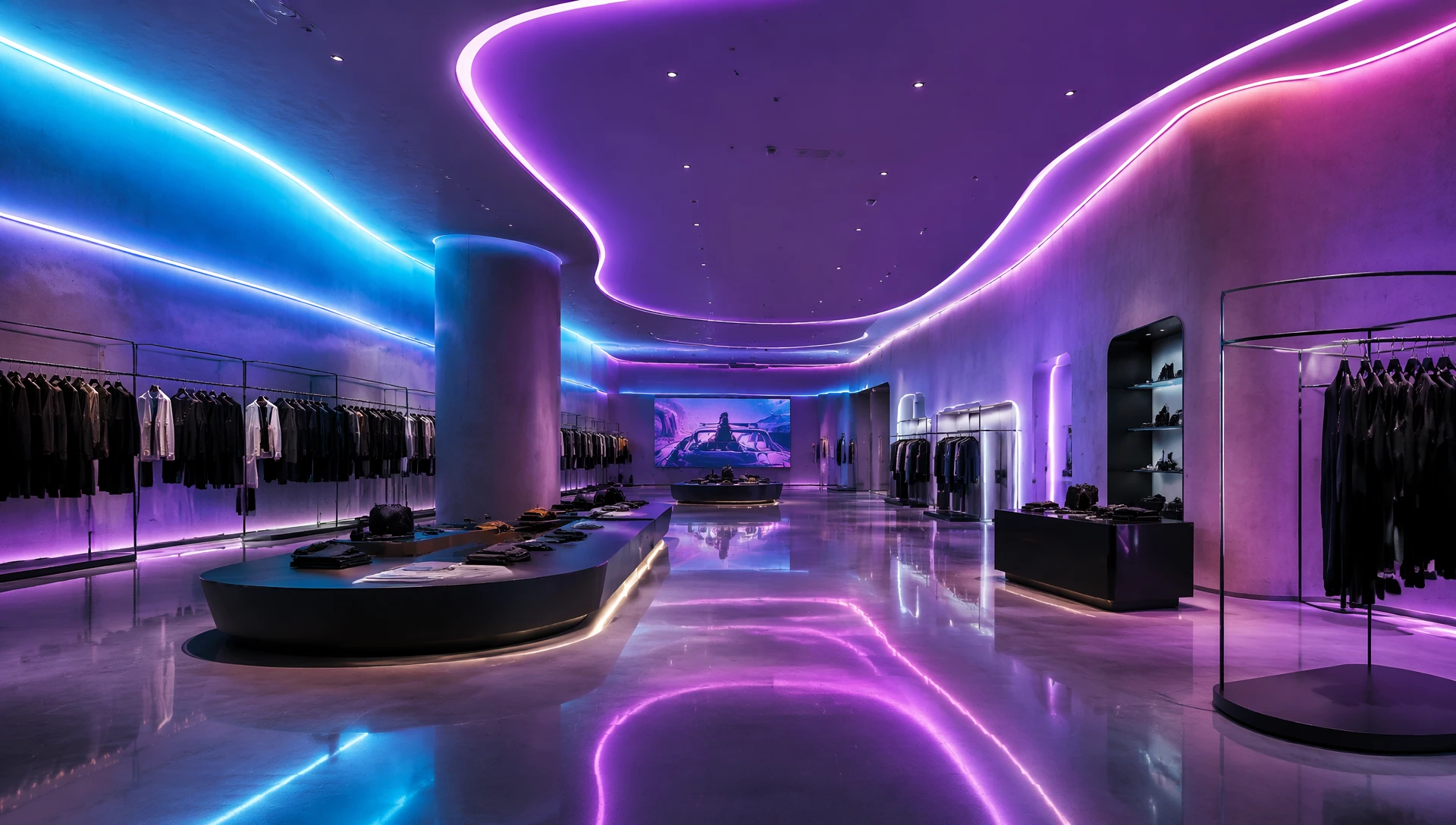
Packing 240 LED chips into a single linear meter generates significant thermal energy. Without proper heat management, this trapped heat accelerates chip aging, causes noticeable color shifts, and drastically shortens the operational lifespan of the entire installation.
The lifespan of a high-power diode is tied directly to its operating junction temperature. If internal temperatures climb past 85°C, the chips lose efficiency, dim prematurely, and fail early.
[LED Junction Heat Source]
       │
       ▼
[3-oz Double-Sided Rolled Annealed Copper FPC Substrate] ──> High Thermal Conductivity
       │
       ▼
[Thermally Conductive Gas-Phase Silicone Diffuser Jacket]
       │
       ▼
[Heavy-Duty Structural Aluminum Mounting Profile] ──> Dissipation into Ambient Air
To manage this heat, leading B2B manufacturers like TTK LED Neon construct internal circuits using extra-thick, 3-ounce double-sided rolled annealed copper flexible printed circuits (FPCs). This heavy-duty copper backing serves as a high-performance thermal highway, pulling heat away from the dense diode clusters and safely venting it into the heavy-duty aluminum mounting tracks. This thermal management system keeps operating temperatures well below 60°C, ensuring stable brightness and helping the system reach an operational lifespan exceeding 60,000 hours.
The material used for the outer diffusion jacket plays a huge role in both light output and product life. Cheap PVC plastics quickly break down when exposed to weathering and sunlight, but premium manufacturing plants utilize advanced gas-phase co-extruded silicone polymers.
Material Properties Matrix:
┌──────────────────────────────┬──────────────────────────────┐
│  Property                    │ Pure Gas-Phase Silicone      │ Commercial PVC Plastic       │
├──────────────────────────────┼──────────────────────────────┤
│  UV Radiation Stability      │ Immune (No yellowing)        │ Poor (Turns brittle/yellow)  │
│  Extreme Temp Performance    │ -50°C to +200°C              │ -10°C to +60°C only          │
│  Chemical & Ozone Resistance │ Outstanding                  │ Highly vulnerable            │
│  Light Transmission Rating   │ Exceeds 93%                  │ Drops rapidly below 70%      │
└──────────────────────────────┴──────────────────────────────┘
Using high-purity silicone ensures the outer casing stays perfectly clear and flexible, allowing vibrant colors and sharp dynamic movements to shine through clearly for decades.
When deploying hundreds of meters of linear lighting around factory perimeters or large corporate facilities, proper electrical design is critical. Sourcing teams must ensure the system maintains consistent brightness across long distances without overloading power grids.
Running low-voltage direct current (DC) over long distances naturally encounters electrical resistance within the copper circuit traces. This resistance causes a progressive drop in voltage along the line, leading to dimming and inaccurate colors near the end of the run.
12V Distribution: [Power Input: 12V] ══════ 5 Meters ══════> [End Voltage: 9.2V - Visible Fading]
24V Distribution: [Power Input: 24V] ════════════ 15 Meters ════════════> [End Voltage: 22.8V - Uniform Light]
To counter this voltage drop over long architectural runs, specialized engineering teams use 24V DC or 48V DC power systems instead of standard 12V layouts. Higher operating voltages lower the overall current draw across the circuit, reducing line resistance and allowing for continuous runs of up to 15 to 20 meters from a single power connection point.
Large industrial complexes must follow strict power quality rules to avoid penalties from local utility companies. Cheap power supplies can inject electrical noise back into the grid, disrupting sensitive manufacturing machinery on the factory floor.
[Main AC Power Grid]
       │
       ▼
[Active Power Factor Correction (PFC) Filter Module] ──> Smooths out current distortions
       │
       ▼
[Clean 24V/48V DC Output (Power Factor > 0.96 / THD < 8%)]
       │
       ▼
[High-Density RGB Neon Strips for Dynamic Effects]
To prevent these issues, premium industrial installations use commercial power drivers equipped with Active Power Factor Correction (PFC). These advanced drivers smooth out electrical distortions, keeping the power factor above 0.96 and Total Harmonic Distortion (THD) below 8%. This clean electrical footprint prevents interference with nearby automated production lines and ensures hassle-free integration with building management systems.
For corporate procurement agents managing complex global supply chains, partnering with a dependable, high-volume production facility is essential to keeping project timelines on track. Sourcing directly from an asset-heavy manufacturer guarantees strict quality control and dependable delivery schedules.
Before choosing a long-term supply vendor for major commercial installations, procurement teams should confirm that the factory utilizes automated production and testing equipment:
High-Speed Automated SMT Assembly Lines: Computerized pick-and-place machines ensure uniform, durable solder joints across every production run, eliminating human errors and preventing dead pixels.
Multi-Axis Spectroradiometer Inspection: Every production batch must undergo precise color-matching tests to ensure all diodes fall within a strict 3-step MacAdam Ellipse tolerance. This guarantees perfect color consistency across separate factory shipments.
Automated Injection-Molded Weatherproofing: Industrial exterior projects require true IP67 or IP68 waterproof ratings. While lower-grade products rely on manual end-cap gluing, advanced factories use high-pressure liquid injection molding lines to fuse terminal connections directly to the main body, creating an absolute barrier against moisture.
Standard flexible lights often use wide spacing between chips, which creates uneven "hotspots" and jagged movements during animations. Our premium high-density rgb neon strips for dynamic effects feature up to 240 LEDs per meter. This tight spacing creates a smooth, unbroken line of light that blends perfectly even at close range, delivering fluid, lifelike digital animations.
Yes. Our high-density systems are engineered with clear, precise cut marks along the side or bottom of the flexible housing. We provide complete outdoor sealing kits and clear technical instructions, allowing your installation crews to easily adjust lengths on-site while maintaining a secure, weather-resistant IP68 seal.
At THINK TEAM KING, we enforce strict color-binning protocols using automated multi-axis spectroradiometers. Every production batch is held within a tight 3-step MacAdam Ellipse tolerance, ensuring identical color temperature and brightness across every shipment for global project rollouts.
Sourcing specialized high-density rgb neon strips for dynamic effects from an experienced, asset-heavy manufacturer like TTK LED Neon eliminates installation issues, ensures compliance with building safety regulations, and avoids expensive post-installation maintenance. Lower-grade consumer alternatives simply cannot deliver the long-term reliability required for large-scale commercial spaces.
Are you looking to optimize your component supply chain, request custom product samples, or get a competitive factory-direct quote for an upcoming development? Our engineering team is here to assist you with layout planning, electrical calculations, and custom options tailored to your project blueprints.

It provides all-round service for customers
and users 24 hours a day.
Enter your email for exclusive offers
and information on new upcoming products.


