


Time:2026-05-20
The global commercial, industrial, and residential lighting markets are changing fast. Today, project managers, electrical engineers, and property owners in the united states and worldwide care about safety and performance just as much as visual impact.
In the past, traditional linear systems relied on basic light bulbs or early led strip lights. However, those old systems created an uneven, pixelated look. This segmented light ruined clean interior surfaces and distracted the eye.
Modern linear styling requires an entirely seamless, continuous beam of light. This premium look is known as dotless lighting. At the center of this architectural movement are high-density rgb neon tubes. By packing a massive number of diodes onto a heavy-duty circuit board, these advanced systems erase all dark spaces between light points.
For international wholesale buyers and distribution networks, sourcing high-quality led neon lights is a vital business strategy. It ensures your projects pass municipal inspections and satisfy workplace rules. This comprehensive guide explains the technical layout, material advantages, and cost effectiveness of high-density neon systems.
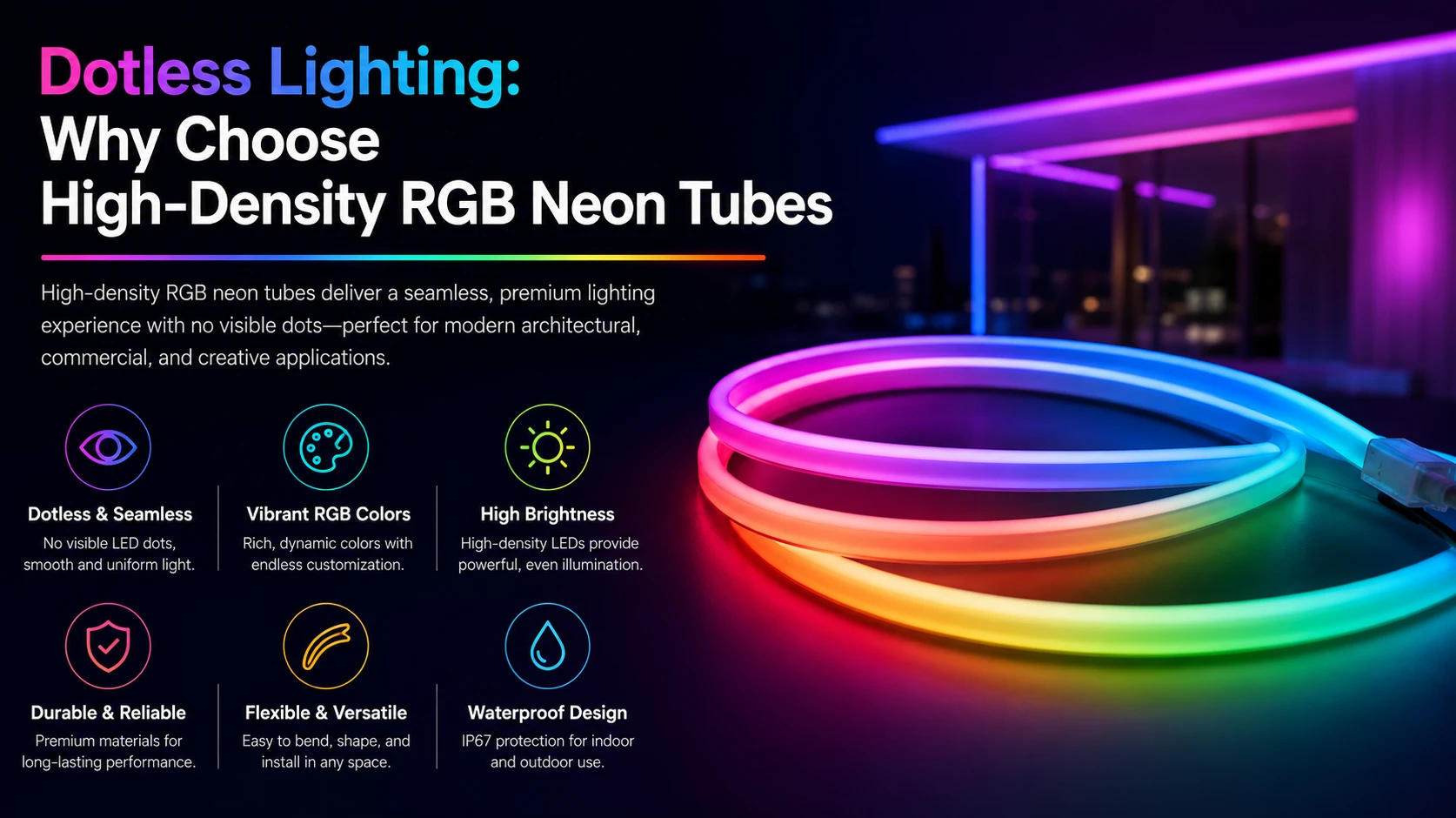
Modern commercial spaces take design ideas directly from elite hotels, minimalist corporate offices, and professional stage lighting trends. Designers no longer hide ambient fixtures completely behind deep drywall pockets. Instead, they integrate linear paths directly into exposed glass walls, open metal beams, and ceiling panels. This setup turns the led lighting product into an exposed design element.
Exposed installations demand a perfect led light visual quality. Standard flexible light strips show dark pixel gaps. When reflected off glossy polished marble floors or smooth glass partitions, these dots look messy. They lower the perceived luxury of the building.
Using a premium dotless lighting setup fixes this layout challenge. It transforms raw light points into a clean, uniform bar of brilliant color. This solid light line provides flawless accent lighting that flatters architectural contours from every viewing angle. It allows design teams to create custom linear visual patterns that are instantly eye catching to visitors and clients.
To eliminate pixelated hot-spots, engineering teams must evaluate internal diode spacing. Standard aftermarket LED strips carry a low density of diodes. This loose spacing relies heavily on a thick outer cover to scatter the white light or colored light. Unfortunately, a thick cover cuts down the total light output and lowers efficiency.
In contrast, engineering-grade high-density rgb neon tubes use tight internal component placement. These advanced systems pack 120, 240, or even more light-emitting diodes into a single meter. They combine red green and blue chips closely together.
Because the light sources sit incredibly close, their light outputs overlap perfectly inside the casing. This dense setup produces an immediate, unbroken beam of brilliant color without requiring thick, light-blocking covers.
| Technical Engineering Spec | Standard Low-Density Strips | High-Density RGB Neon Tubes | Direct Value to Commercial B2B Buyers |
| Diode Count per Meter | 30 to 60 LEDs | 120 to 240+ LEDs | Creates an instantly uniform, dotless line of light. |
| Refresh & Frequency Rate | Below 1,200Hz | Over 4,000Hz (Flicker-Free) | Guarantees crisp, clean images on high-definition cameras. |
| Light Efficiency | 50–70 lm/W | Over 105 lm/W | Delivers superior brightness while maintaining high energy efficiency. |
| Ingress Protection (IP) | IP20 or IP44 | IP67 / IP68 Fully Sealed | Provides total protection against rain, dust, and pressure washes. |
| Circuit Board Build | 1-ounce Single Copper | 3-ounce Dual rolled Copper | Prevents trace damage and breaks during tight corner bends. |
| Bending Radius | Over 40mm | 10mm Side-Bend Flex | Adapts smoothly to sharp architectural lines and signage. |
Electrical and visual longevity depends heavily on the chemical makeup of the flexible outer jacket. The chosen protective sleeve changes how well the light path handles sun exposure, high temperatures, and structural stress over a long lifespan.
Historically, low-cost factories used Polyvinyl Chloride (PVC) plastic sleeves because the raw components were cheap. However, PVC degrades quickly under commercial use. When exposed to constant solar rays or high interior heat, PVC jackets turn cloudy and amber.
This color shift dulls your colors, altering true color settings. Even worse, PVC turns brittle and cracks over time, letting moisture slip inside. This moisture ingress results in short circuits and sudden product failures.
Professional engineering systems avoid these risks by utilizing premium, gas-phase silicone formulations. This material science choice provides multiple safety and style advantages:
Zero UV Yellowing: Silicone does not degrade or fade under direct solar radiation, keeping your light clear for years.
Thermal Stability: Premium silicone handles major temperature shifts easily, working safely from -40°C up to +85°C
Chemical and Fire Safety: Silicone is naturally fire-resistant, self-extinguishing, and completely non-toxic. It releases no harmful gas smells in high-heat spaces.
Modern commercial spaces demand rich, dynamic color adjustments instead of old single color choices. High-density tubes allow designers to create complex color movements, running chases, and active interactions. Every section of the light path can display unique data, allowing full coordination with professional stage layouts and smart building controllers.
Managing this advanced color control requires smart power networks. These smart drivers check the internal circuit board status constantly. They deliver power precisely based on active demand, maximizing energy savings and helping businesses reduce energy waste.
By controlling current delivery, the smart grid keeps all inner parts cool. This shields the system from voltage surges and keeps the neon lighting functioning safely across a 50,000-hour life.
The Operational Challenge: In early 2025, a premier transit hub renovation project in the united states required 4,000 meters of color-changing accent lights. The fixtures had to mount directly into low, polished metal ceilings, making reflection dots highly visible. The project demanded a completely dotless look, full match with automated building safety controls, and extreme power efficiency to pass green building rules and earn an energy star equivalent rating.
The Engineered Solution: Project managers specified high-density, silicone-jacketed RGB neon tubes. The supplier provided factory-custom lengths designed for easy installation with quick-connect waterproof joints. These custom runs used heavy-duty 3-ounce copper circuit boards to ensure even current delivery over long wiring paths.
The Final Result: The terminal completed installation 30% faster due to the easy-fit design and light hardware. The high diode count completely erased dot reflections on the polished metal ceiling, delivering a clean, luxury feel. The upgrade cut total power use by 48% compared to earlier models, delivering massive energy savings, matching strict environmental goals, and passing all municipal safety checks instantly.
To secure a clean, long-lasting installation and maximum cost effectiveness, field crews should follow three industrial protocols:
Calculate Voltage Drop: Low-voltage lines face resistance over long distances, causing light to dim at the tail end. Teams must use the correct wire gauge and plan power inject points to maintain solid brightness across the whole setup.
Isolate High-Voltage Connections: While the flexible tube operates on safe low-voltage power, the main power supply connects to building mains. Place all power boxes inside locked, ventilated cabinets away from public access and wet spots.
Apply Perfect Field Seals: When trimming a flexible tube to size on-site, technicians must cut strictly on the marked lines. Seal all cut ends immediately with factory endcaps and industrial glue to lock out moisture and dust from the internal copper circuit board.
High-density systems pack a massive number of diodes (often 120 to 240+ LEDs per meter) directly onto the circuit board. This tight spacing allows individual light outputs to blend seamlessly inside the casing, removing the dark spots and pixel gaps common in low-density retail options.
Yes. When manufactured with premium silicone extrusions and sealed with factory-grade endcaps, high-density tubes achieve full IP67 or IP68 waterproof ratings. This guarantees safe, reliable operation through heavy rain, high humidity, and dust storms.
Our setups utilize premium, high-efficacy LED chips coupled with smart constant-current power controllers. This engineering design maximizes luminous output while drawing minimal electricity. It allows commercial buyers to achieve extreme brightness while reducing total building utility expenses and maximizing long-term energy savings.
Absolutely. High-density neon products are fully compatible with professional control protocols, including DMX512, Dali, and Art-Net via advanced digital decoders. This makes it simple to integrate systems into automated building grids or dynamic led neon signs. LumiEasy specializes in engineering these exact lighting solutions.
We manufacture premium high-density rgb neon tubes with integrated smart chips that deliver seamless connection, strict regulatory compliance, and verified flicker-free performance for elite commercial projects globally.
Whether you require a high-volume run for wholesale neon lighting or a tailored architectural deployment, LumiEasy ensures complete technical support and compliance with western design standards.

It provides all-round service for customers
and users 24 hours a day.
Enter your email for exclusive offers
and information on new upcoming products.


