


Time:2026-07-24
In the modern landscape of experiential corporate branding, flagship retail design, broadcast studios, and international trade exhibitions, static signage no longer captures the attention of global audiences. Modern corporations, interior design firms, and commercial event contractors are rapidly shifting toward illuminated, multi-dimensional brand activations. At the forefront of this architectural transformation are branded neon backdrops with company logo integration—engineered lighting structures that fuse corporate visual identity with high-efficiency solid-state LED illumination.
Unlike legacy glass neon or basic flat printed backdrops, commercial-grade silicone LED neon backdrops deliver high optical luminance, total color consistency, extreme structural durability, and low operational voltage. However, transitioning a corporate brand’s precise typography, fine-line logo geometry, and exact Pantone colors into an illuminated 3D neon backdrop presents complex design, electrical, and manufacturing challenges.
For global procurement managers, OEM/ODM sourcing agents, and commercial contractors, selecting a specialized manufacturing partner like TTK LED Neon ensures that corporate brand assets are translated with uncompromising technical precision. From custom vector engineering and CIE 1931 chromaticity matching to structural acrylic fabrication and global safety compliance, factory-direct manufacturing delivers the reliability required for enterprise-level deployment.
The primary challenge in manufacturing branded neon backdrops with company logo integration lies in converting two-dimensional vector brand guidelines (such as CMYK, Pantone, or RGB specifications) into a physically illuminated 3D silicone neon flex profile without compromising brand integrity.
Corporate logos frequently contain intricate typography, thin serifs, sharp negative spaces, or tight geometric radiuses. Standard commercial neon flex profiles (typically 10mm to 15mm in width) cannot bend at acute angles below their physical minimum bend radius (often 30mm to 50mm) without creasing the internal Flexible Printed Circuit (FPC) or causing optical light attenuation.
To solve this, TTK LED Neon utilizes specialized micro-extrusion silicone flex profiles ranging from 3.5mm to 6mm in width, paired with custom 2-axis CNC channel carving:
Micro-Serifs & Fine Lines (3mm to 6mm): Driven by ultra-narrow top-bend and side-bend silicone extrusions housing high-density SMD 2016 or SMD 2216 LED arrays (up to 280 LEDs/meter) to prevent visible light spotting and maintain smooth, seamless illumination across micro-scale brand typography.
Primary Lettering & Framing (8mm to 12mm): Utilizes high-lumen, uniform-diffusing dome or flat-surface silicone profiles to form bold corporate wordmarks and outer perimeter iconography.
Acute Angle Junctions: Rather than forcing continuous bends that stress FPC traces, precision-cut internal wire-bridge junctions are hand-soldered and encapsulated in liquid silicone at corners under 45 degrees, preserving structural stability and clean geometric sharpness.
When matching logo stroke widths to neon profile dimensions, strokes under 5mm are assigned to 3.5mm or 4mm micro-silicone flex. Strokes between 6mm and 12mm utilize standard 8mm or 10mm profiles, while sharp corner radiuses below 15mm are crafted using encapsulated soldered junctions to prevent FPC trace fatigue.
A major point of friction for corporate brand directors is color misalignment. A logo rendered in Pantone 286 C Blue or Pantone 186 C Red must illuminate in the exact same color wavelength when powered on, matching physical print collaterals and digital brand displays.
Monochromatic LEDs emit specific peak dominant wavelengths (measured in nanometers), whereas brand colors are defined within the CIE 1931 Chromaticity Diagram by specific coordinates.
The color variance between an illuminated logo and official brand standards is measured using the CIELAB Delta E 1976 equation:
Delta E* = Sqrt [ (L2 - L1)^2 + (a2 - a1)^2 + (b2 - b1)^2 ]
Where:
L* represents Perceptual Lightness.
a* represents the Red/Green Chromaticity Axis.
b* represents the Yellow/Blue Chromaticity Axis.
To achieve strict brand compliance, TTK LED Neon enforces a Delta E threshold under 2.0 (Delta E < 2.0), rendering color variations imperceptible to the human eye. This accuracy is achieved through three specialized production steps:
Custom Phosphor Binning: Formulating specialized phosphor mixes over blue LED die chips to generate precise Kelvin temperatures and custom chromaticity coordinates matching physical brand swatches.
MacAdam 3-Step Ellipse Sorting: Filtering all SMD LEDs through automated spectroradiometer binning to guarantee zero color batch variance across high-volume production orders.
Pigmented Silicone Extrusion Jackets: Matching the outer silicone diffuser jacket color to the LED's off-state hue, ensuring the logo retains its corporate brand color even when the backdrop lighting is turned off.
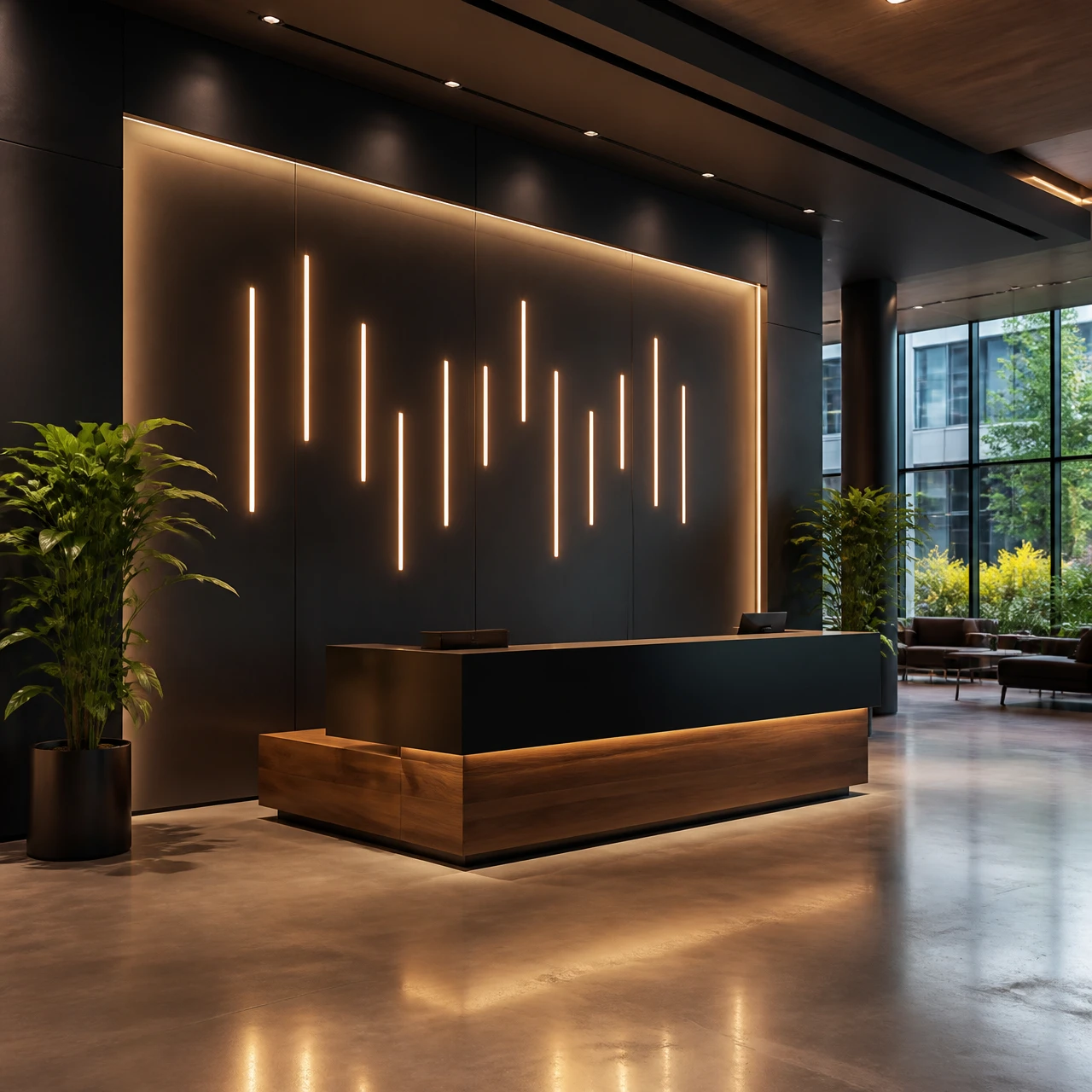
A branded neon backdrop with company logo integration requires a rigid, optically clear, or aesthetically aligned substrate to support the neon flex elements, route power wiring invisibly, and withstand shipping and installation stresses.
The complete mounting structure consists of a solid backing panel (such as cast acrylic or acoustic felt), engineered with precision CNC-routed rear wiring channels, low-profile standoff hardware, and a UV-resistant structural silicone bond securing the silicone neon array.
The backplate serves as the structural foundation for the logo. Selecting the appropriate sheet grade directly impacts optical transparency, structural rigidity, and long-term yellowing resistance.
PMMA Cast Acrylic Sheets: Manufactured by pouring liquid monomer into glass molds. Cast acrylic features superior optical clarity (greater than 92% light transmission), high tensile strength, zero internal stress, and clean laser-cut edges. It resists crazing when exposed to chemical cleaning solvents and exhibits zero yellowing over 10 years of indoor/outdoor UV exposure.
Extruded Acrylic Sheets: Produced via continuous mechanical rolling. Extruded acrylic contains internal stress, making it prone to cracking or melting during CNC routing and laser cutting. It exhibits higher thickness tolerances (+/- 15% vs +/- 5% for cast), which leads to uneven flush-mounting of custom neon channels.
For high-end commercial logo backdrops, TTK LED Neon specifies 100% virgin Mitsubishi or Evonik Degussa cast acrylic in thicknesses ranging from 5mm to 12mm.
| Substrate Material | Structural & Acoustic Property | Ideal Commercial Application | Key Architectural Advantage |
| High-Density Cast Acrylic (Clear/Black/Colored) | Tensile Strength: 75 MPa Light Transmission: Over 92% | Corporate Lobby Wall, Retail Flagships, TV Studios | Ultra-slick aesthetic, high rigidity, invisible wiring options |
| PET Acoustic Felt Panels | Noise Reduction Coefficient (NRC): 0.85 Class A Fire Rated | Open-Plan Tech Offices, Conference Rooms | Absorbs room reverberation while highlighting illuminated brand logo |
| Aluminum Honeycomb Panels | Bending Stiffness: Extremely High Weight: Low (3.5 kg/m²) | Trade Show Booths, Touring Stage Backdrops | High strength-to-weight ratio, warp-proof during transport |
| Steel Mesh / Grid Framing | Open Area: 65% to 85% Industrial Aesthetic | Retail Apparel Display, Urban Venue Backdrops | Industrial aesthetic, lightweight, modular hanging options |
For freestanding exhibition backdrops or semi-outdoor venue entrances, the mounting structure must withstand structural loads, handling forces, and wind pressures.
The wind force acting on an outdoor or open-air event backdrop is calculated using the dynamic pressure equation:
F_wind = 0.5 * rho * (v^2) * A * C_d
Where:
F_wind is the total wind force acting on the backdrop structure (in Newtons, N).
rho is the air density (typically 1.225 kg/m³ at sea level and 15°C).
v is the maximum rated wind speed (in meters per second, m/s).
A is the total surface area of the backdrop panel (in square meters, m²).
C_d is the drag coefficient of the backdrop geometry (typically 1.2 for flat solid panels, reduced to 0.4 to 0.6 for perforated or mesh panels).
By factoring these structural calculations during the engineering phase, TTK LED Neon reinforces backdrop backing plates with internal steel tubular frames and heavy-duty floor baseplates, preventing structural flexing or tipping during high-foot-traffic corporate events.
Ensuring uniform brightness across an intricate logo backdrop requires detailed electrical circuit design. Irregular power distribution leads to uneven illumination, thermal hot spots, and driver failure.
The electrical architecture feeds AC mains power (100V to 240V) into an active Power Factor Correction (PFC) 24V DC power supply, distributing low-voltage DC power across a Class 2 bus harness managed by localized Pulse-Width Modulation (PWM) or DMX decoders.
While 12V DC lighting systems are common in basic signs, enterprise-grade branded neon backdrops with company logo integration utilize 24V DC native power layouts.
Current Halving: Operating at 24V DC cuts operating current in half for the exact same wattage (Formula: P = V * I), reducing resistive power loss along internal FPC traces by 75% (Formula: P_loss = I^2 * R).
Extended Continuous Runs: 24V DC systems allow continuous neon flex runs of up to 10 meters from a single power injection point without visible end-to-end brightness degradation, compared to a 5-meter limit for 12V systems.
Power Supply Efficiency: Industrial 24V DC power units (such as Mean Well HLG or XLG series) achieve up to 94% electrical efficiency with active Power Factor Correction (PFC greater than 0.95), lowering operating heat within enclosed backdrop housings.
Corporate facilities require adaptable lighting controls—full brightness for daytime brand visibility, reduced output for video broadcasting, and dynamic color shifts for special corporate events.
TTK LED Neon integrates multiple industrial dimming and control interfaces into logo backdrop assemblies, covering architectural standards like 0-10V and DALI-2 for smooth 0.1% dimming, broadcast standards like DMX512-A and Art-Net for pixel-level synchronization, and smart building protocols including Tuya, Zigbee, Matter, and RS485 Modbus.
Flicker-Free Pulse-Width Modulation (PWM): Utilizing high-frequency PWM dimming drivers operating above 3,000 Hz. This eliminates refresh-rate rolling lines during digital camera video recording, live streams, or media interviews held in front of the backdrop.
RGBW Multi-Zone Addressing: Incorporating dedicated 4000K or 6000K white LED chips alongside RGB diodes inside the logo tubing. This allows the backdrop to output accurate monochromatic corporate white while retaining full RGB dynamic animation capabilities for celebratory events.
Deploying illuminated backdrops in public commercial environments, high-rise corporate headquarters, or international convention centers requires full compliance with regional electrical safety and flame retardancy regulations. Non-compliant signage faces immediate rejection by building inspectors and event safety marshals.
Commercial installations require compliance across three major safety domains:
Flame Retardancy: UL94 V-0 self-extinguishing optical silicone jackets.
North American Electrical Safety: UL2108 and UL8750 Class 2 low-voltage power distribution.
European & Global Compliance: Complete CE, RoHS, REACH, and EN 60598 certification.
Commercial interior fit-outs require building materials that minimize flame propagation and toxic smoke generation during a building fire.
TTK LED Neon formulates all custom neon extrusions using UL94 V-0 rated optical silicone. In standardized flammability testing, a vertical V-0 rated silicone specimen stops burning within 10 seconds after application of a naked flame, with zero flaming drops produced. Cheap PVC lighting extrusions fail this standard, melting rapidly and releasing toxic hydrogen chloride gas.
To comply with North American National Electrical Code (NEC) standards, corporate logo backdrops must operate under Class 2 power limits (maximum output voltage under 30V DC and maximum power under 100VA per channel). This eliminates shock hazards, allowing backdrops to be safely installed within reach of the public without requiring heavy conduit grounding enclosures.
Manufacturing a premium branded neon backdrop with company logo integration requires advanced industrial machinery, structured assembly workflows, and rigorous QA verification at every stage of production.
Manufacturing Steps:
[1. CAD Vector DFM] ──> [2. CNC Backplate Routing] ──> [3. SMT Assembly]
                                                               │
[6. Export Packaging] <── [5. 72-Hour Aging Test] <── [4. Silicone Sealing]
Upon receiving client vector files (.AI, .EPS, .DXF), TTK LED Neon’s structural engineers generate a comprehensive 3D CAD shop drawing. This blueprint defines precise panel dimensions, neon stroke widths, wire exit points, power supply mounting locations, and wall-mounting bracket positioning for client sign-off.
Acrylic or metallic backplates are cut using multi-axis CNC routers operating at tolerances within +/-0.1mm. Wire feed-through holes are counter-bored on the rear side of the sheet, allowing power leads to exit cleanly behind the neon flex without leaving visible wiring on the front face.
SMD LEDs are mounted onto 3-ounce copper flexible printed circuits via automated surface-mount technology (SMT) lines. The FPC is co-extruded with gas-phase optical silicone, creating a seamless, IP67/IP68 waterproof lighting element with uniform light distribution.
Experienced lighting technicians hand-mount the tailored neon elements into the CNC routed backplate channels using UV-stable structural silicone adhesives. Terminal connections are soldered and fully encapsulated with liquid silicone to ensure long-term mechanical reliability.
Every completed backdrop undergoes a continuous 72-hour burn-in aging test at maximum light output to stress-test electrical solder joints and thermal stability. Automated spectroradiometers verify color temperature, luminous flux, Color Rendering Index (CRI greater than 90), and chromaticity coordinates against the original brand specification.
To prevent transit damage during international air or ocean freight, completed backdrops are encapsulated in custom-cut, high-density EVA protective foam and packed inside reinforced 15mm plywood export crates. Packaging designs are tested to meet ISTA 2A international drop-test standards.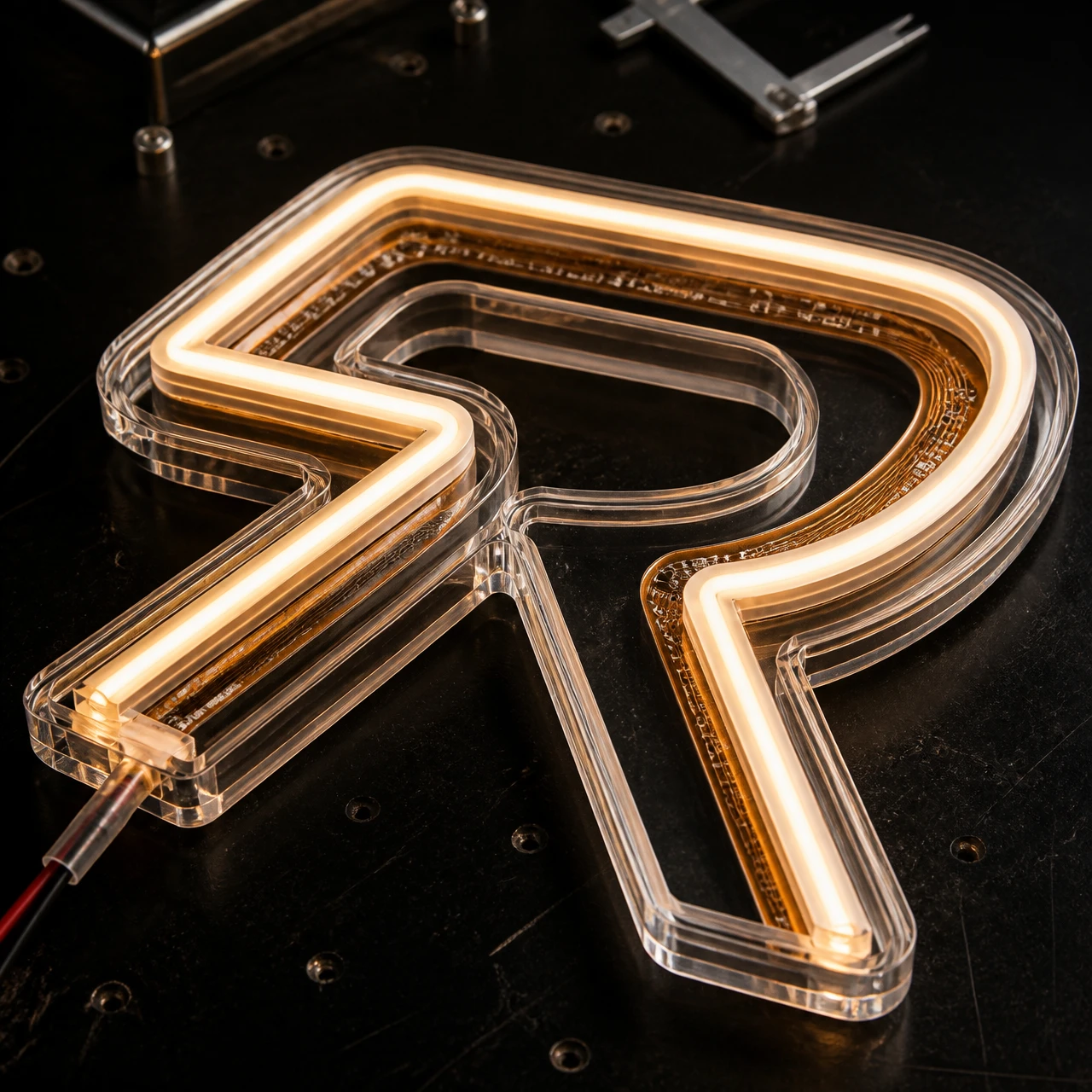
We utilize a dual-stage color-matching process. First, we match your brand's Pantone/RAL/CMYK codes to specific CIE 1931 chromaticity coordinates. Second, we combine custom phosphor-binned LED dies with color-pigmented silicone diffuser jackets. Every production lot is verified with a spectroradiometer to guarantee a Delta E threshold under 2.0 (Delta E < 2.0), ensuring complete visual consistency with your brand guidelines.
For permanent wall installations, we provide flush-mount keyhole cutouts, stainless steel standoff mounts, or hidden French cleat wall bracket systems. For portable trade show backdrops, we offer lightweight modular aluminum truss frames, acoustic PET collapsible panels, or quick-connect magnetic backing segments packed inside heavy-duty flight cases for rapid assembly without tools.
All TTK LED Neon logo backdrop assemblies are built using UL94 V-0 flame-retardant silicone profiles and Class 2 low-voltage (24V DC) electrical layouts. Our components carry complete CE, RoHS, REACH, UL2108, and UL8750 certifications, ensuring smooth compliance with commercial building codes and fire safety inspections across North America, Europe, Australia, and the Middle East.
Sourcing high-performance branded neon backdrops with company logo integration demands a manufacturing partner that combines optical physics, advanced material science, and precision custom fabrication. Sourcing directly from TTK LED Neon provides factory-direct pricing, total design flexibility, rigorous quality control, and dedicated engineering support for your global commercial projects.
Whether you are designing a flagship corporate headquarters, outfitting a national retail chain, or engineering an interactive trade show exhibition, our team is ready to bring your brand logo to light.

It provides all-round service for customers
and users 24 hours a day.
Enter your email for exclusive offers
and information on new upcoming products.


