


Time:2026-03-30
In the rapidly evolving landscape of commercial and industrial lighting, the shift toward 24V low voltage systems has moved from a trend to a global engineering standard. As we move into 2026, project requirements for large-scale hospitality, retail, and warehouse environments demand more than just illumination; they require systemic efficiency, long-term reliability, and strict regulatory compliance.
For electrical contractors and lighting designers, the primary challenge remains the "Physics of Power"—balancing the desire for long-run installations with the inherent limitations of voltage drop. This guide provides a deep dive into why 24V systems are the superior choice for modern infrastructure and how to optimize them for peak performance.
In the engineering phase of a commercial lighting project, the choice between a 12V and 24V platform is the single most influential factor affecting the installation's Efficiency and total cost of ownership. While 12V systems are often associated with small-scale DIY tasks, a professional 24V low voltage architecture offers a distinct "Physical Advantage" that is grounded in the fundamental laws of electricity.
The primary engineering advantage of a 24V system lies in its superior efficiency at handling electrical current. To deliver a specific amount of power to the lights, a 24V low voltage system requires only half the current (amperage) compared to a standard 12V setup. Think of it like a water pipe: by increasing the pressure (voltage), you can move the same amount of water using a much thinner stream, which creates far less friction.
This 50% reduction in current is a strategic game-changer for 24v low voltage neon strip lights. In the world of electronics, lower current translates directly to significantly reduced heat generation within the internal copper circuit board. Since excessive heat is the number one cause of LED "burnout," phosphor degradation, and unsightly color shifting, 24V systems inherently run much cooler. This superior thermal efficiency ensures that the original brightness and precise color temperature remain stable over years of use. For commercial clients, this means their brand's visual identity stays protected through significantly longer operational cycles without the need for frequent replacements.
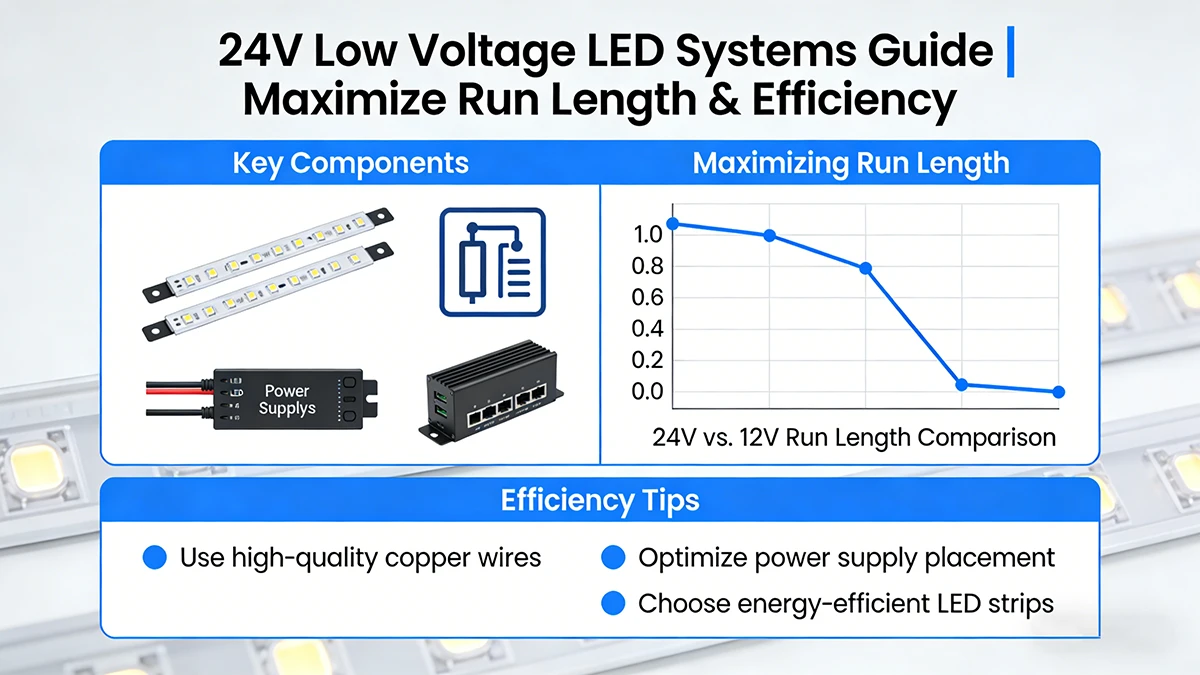
Voltage Drop is the physical decrease in electrical potential as energy travels through a conductor, caused by the inherent resistance of the wire. The superiority of 24V lies in its mathematical resilience to this loss. Because a 24V system starts at a much higher potential, a standard 1V drop represents a mere 4.1% loss in power. In a 12V system, that same 1V drop constitutes a massive 8.3% loss.
This mathematical reality allows 24V systems to achieve significantly Long-run continuous lengths—often up to 10 or 15 meters—without the unsightly "dimming at the tail" effect. For contractors, this means fewer power injection points, less wiring, and a more uniform, professional glow across the entire installation.
In high-occupancy commercial environments—such as hotel corridors, expansive retail showrooms, or industrial warehouses—minimizing the number of power injection points is essential for both aesthetic seamlessness and long-term maintenance. Every extra connection is a potential point of failure. Maximizing long-run performance requires a strategic combination of high-grade metallurgical components and intelligent wiring topologies.
The foundation of a stable long-distance run is the quality of the circuit board itself. Not all LED strips are created equal; most budget options utilize thin 1oz or 2oz copper, which struggles with resistance over distance. To support superior long-run stability, THINK TEAM KING utilizes 3oz (ounce) heavy-duty oxygen-free copper PCBs. Think of thicker copper as a wider "highway" for electrons; it drastically reduces electrical resistance and heat buildup. This allows for continuous, flicker-free runs of up to 10 or 15 meters from a single power feed, a massive upgrade compared to the standard 5-meter limitation of typical consumer-grade strips.
To further combat voltage drop in massive installations, engineers should implement advanced wiring strategies:
Double-Ended Feed: By powering a 24V low voltage strip from both ends, you effectively double the achievable run length while ensuring 100% brightness uniformity from the first LED to the last.
Parallel Home-Runs: Instead of "daisy-chaining" multiple strips in a series—which compounds resistance—each major 10-meter segment should have a dedicated "home-run" cable back to the UL Class 2 driver. This ensures each section receives full, clean power independently.
For B2B procurement in Europe and North America, technical specifications are often secondary to legal compliance. In professional construction, a lighting system that fails to meet regional fire safety or electrical standards is more than a technical error—it is a massive legal liability that can halt an entire project.
In the United States, the NFPA 701 standard is the benchmark governing the flame propagation of materials used in public occupancies. THINK TEAM KING’s energy-saving low voltage neon utilizes premium, high-density silicone encapsulation specifically engineered to meet these rigorous fire safety requirements. Unlike cheap PVC alternatives that can release toxic fumes or accelerate a fire, our silicone-based flex is self-extinguishing. This makes our products the "safe-spec" for high-stakes environments like hospitals, schools, and high-rise hotels where building codes are strictly enforced and non-compliance is not an option.
A UL Class 2 certification on a power supply is the ultimate "Gold Standard" for electrical safety in commercial lighting. This certification ensures that the output voltage and power are strictly maintained within safe limits—specifically under 60V DC and 100W per channel.
The primary engineering benefit of a Class 2 system is risk mitigation. By limiting the energy available in the circuit, it virtually eliminates the risk of lethal electric shock and significantly reduces the potential for electrical fires. From a logistical standpoint, utilizing 24V low voltage Class 2 systems is a massive cost-saver; in many jurisdictions, these "touch-safe" circuits do not require the expensive, labor-intensive metal conduits or specialized junction boxes mandated for high-voltage (120V/277V) systems. By specifying Class 2 compliant components, you are not just choosing a light—you are protecting the building's occupants, accelerating the inspection process, and safeguarding the contractor's insurance policy.
In the architectural landscape of 2026, modern lighting has transcended its role as a static "on/off" utility. It is now a dynamic component of smart building ecosystems. The integration of sophisticated digital controls and high-durability materials defines the next generation of 24v low voltage neon strip lights, transforming them from simple accent lights into intelligent, resilient infrastructure.
High-density 24V systems are engineered for perfect compatibility with professional architectural dimming protocols, such as DALI (Digital Addressable Lighting Interface) and 0-10V analog dimming. Because 24V systems operate at lower currents than 12V alternatives, they exhibit significantly higher stability during dimming cycles. This stability allows for smooth, flicker-free transitions—even at ultra-low brightness levels (1% or less). Such precision is essential for maintaining "Eye-Comfort" in high-end office environments and luxury hospitality suites, where harsh light flickering can lead to fatigue or migraines.
Beyond control logic, the physical longevity of the system is secured through advanced Silicone Co-Extrusion technology. By replacing legacy PVC materials with high-grade silicone, our neon strips offer a "defense-in-depth" against environmental degradation. Silicone is chemically inert and UV-stable, ensuring that the housing will not yellow, crack, or become brittle over time.
This material resilience is a critical factor for low-voltage landscape lighting in extreme climates. Our silicone-encapsulated 24V systems remain flexible and optically clear in temperatures ranging from a frigid -40℃ to a scorching 150℃. This thermal range ensures that whether installed in a sub-zero commercial freezer or a sun-drenched outdoor plaza, the light quality remains consistent. This fusion of smart "brain" (DALI) and rugged "body" (Silicone) makes 24v low voltage neon strip lights the definitive choice for future-proofed commercial designs.
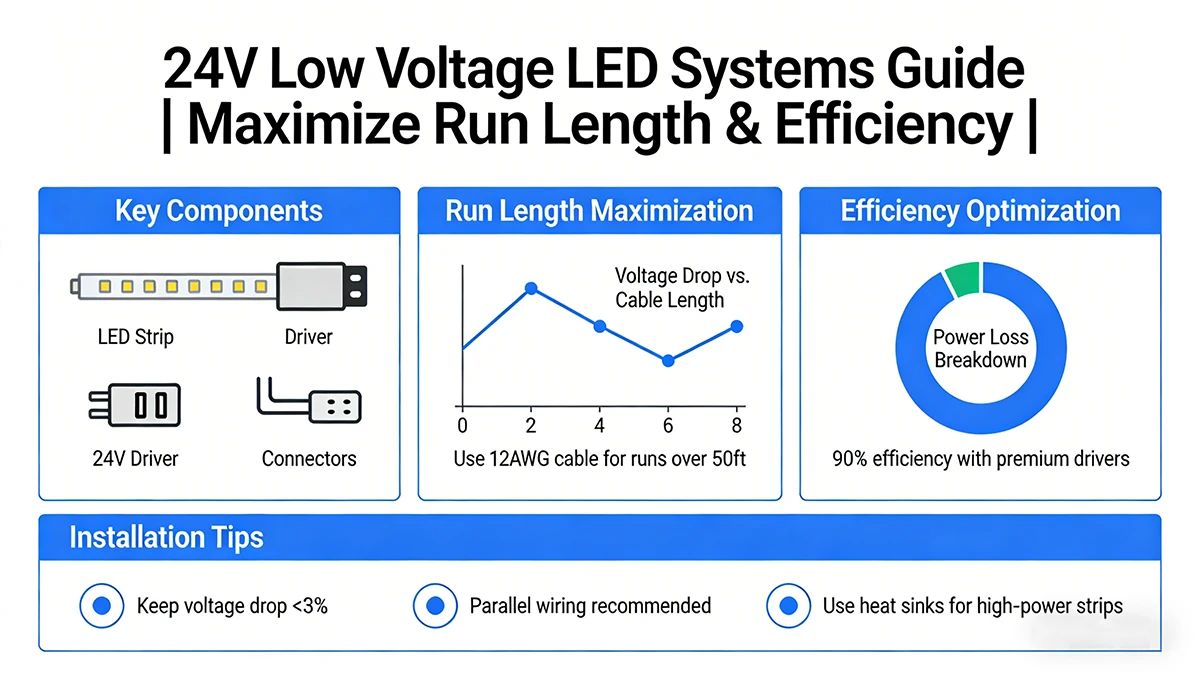
In the professional procurement of commercial lighting, the perceived "higher cost" of 24V components is a persistent myth that evaporates when viewed through the lens of system-wide Efficiency and total project expenditure. For a savvy developer or contractor, the initial unit price of a 24V low voltage strip is a minor variable compared to the massive savings realized in hardware and field installation.
Because a 24V circuit can effectively manage higher wattage over a significantly longer distance, a large-scale project requires far fewer drivers and transformers. Consider a 50-meter perimeter lighting project: a standard 12V setup might require ten individual power supplies to combat voltage drop. In contrast, the same project can often be powered by just five 24V drivers. This 50% reduction in the bill of materials (BOM) extends beyond the drivers themselves, as fewer units mean fewer primary AC electrical feeds and smaller housing enclosures.
On any modern job site, labor is the most volatile and expensive variable. By utilizing long-run 24V technology, contractors can reduce their on-site installation time by nearly 50%. The efficiencies are found in three key areas:
Simplified Wiring: Fewer power injection points mean fewer hours spent measuring, cutting, and soldering.
Streamlined Troubleshooting: With 24V, the risk of flickering or dimming is minimized, eliminating the need for costly post-installation diagnostic visits.
Reduced Hardware Footprint: Installing fewer junction boxes and less protective conduit speeds up the physical mounting process.
Ultimately, 24V systems offer a substantially lower Total Cost of Ownership (TCO), positioning them as the most energy-saving low voltage neon solution for the budget-conscious developer who refuses to compromise on quality.
While 24V is a "low voltage," safety in aquatic environments is determined by the IP (Ingress Protection) rating and the isolation of the driver. For pool-adjacent lighting, an IP68 rating is required. 24V is often preferred over 12V for pool perimeters because it allows the power supply to be located further away (in a dry equipment room) without losing significant brightness over the long cable run.
24V is objectively better for long runs. Due to the higher operating voltage and lower current, 24V strips experience significantly less voltage drop. This allows for continuous runs of 10-15 meters, whereas 12V strips typically show noticeable dimming after just 5 meters.
Flickering in a 24V low voltage system is typically a sign of "voltage instability" caused by an underpowered or poor-quality driver. If the total wattage of your 24v low voltage neon strip lights exceeds 80% of the transformer's capacity, the unit may enter a "hiccup mode," cycling on and off to prevent overheating. Additionally, using thin, high-resistance wiring over long distances can cause the voltage to dip below the LEDs' operational threshold. At THINK TEAM KING, we recommend using high-purity Oxygen-Free Copper (OFC) cabling and professional-grade UL Class 2 drivers to ensure a rock-solid, flicker-free performance for years to come.
No. Connecting a 12V LED strip to a 24V driver will cause an immediate over-voltage condition, resulting in the LEDs burning out or potentially causing a fire. Always match the voltage of your driver to the voltage of your strip.

It provides all-round service for customers
and users 24 hours a day.
Enter your email for exclusive offers
and information on new upcoming products.


